

21 Banks Just Committed To Putting Their Customers On A Blockchain
· Alexandar Artis
- BTC
- PAXG
What A Bank-Issued Dollar Actually Does To Crypto Adoption
On 1 September, twenty-one of the world's largest financial institutions committed to issuing one shared US dollar stablecoin. Bank of America, Citi, Goldman Sachs, Wells Fargo, UBS, Deutsche Bank, Santander, MUFG and Fidelity are on the list, targeting market in the first half of 2027.
The corporate detail is not what matters here. What matters is that these institutions are about to hand a blockchain-native asset to a customer base that has never touched crypto.
Why This One Is Real
Plenty of bank blockchain announcements have gone nowhere. This one has a date behind it.
The GENIUS Act was signed in July 2025 and takes effect on 18 January 2027. The consortium is targeting the first half of 2027. That is not a coincidence. These banks are not chasing a trend, they are arriving the moment the rulebook becomes load bearing.
The act also bans issuers from paying yield. That sounds like a constraint on the industry. For a bank it is close to a gift, because yield is the cheapest way to buy stablecoin market share, and removing it shifts the contest to distribution and trust. Which is to say, to the one thing these twenty-one institutions have that no crypto-native issuer can replicate.
What It Means For Adoption
The practical effect is that using a blockchain gets a lot easier for a lot more people.
Customers of these institutions will hold a token that settles on a public chain inside a wrapper they already trust. For most of them it will be the first digital asset they have ever owned, and they will not have to learn anything new to own it. Blockchain settlement stops being a thing you opt into and becomes a thing your bank already does.
That is how infrastructure normally goes mainstream. Not through people deciding to adopt it, but through it turning up underneath something they were already using.
The scale is worth sitting with. These twenty-one institutions serve customers across North America, Europe, East Asia, the Middle East and Africa, and today's stablecoin float is a fraction of the volume they could route on-chain. Which public chains carry it is the detail worth watching, because it would change the economics of whichever network wins that mandate.
Which public chains carry that volume is the detail worth watching. A meaningful share of institutional dollar settlement moving onto public rails is a different order of magnitude to today's stablecoin float, and it would change the economics of whichever network wins that mandate.
What It Means For Bitcoin
Very little, directly, and it is worth being straight about that rather than reaching.
A bank stablecoin competes for the dollar use case. It does not compete with Bitcoin and it does not create demand for it. Nobody buys Bitcoin because their bank issued a token.
If anything it narrows Bitcoin's story rather than widening it. Regulated dollar rails cover payments and settlement better than Bitcoin ever has. Anyone whose thesis rests on transactional utility should read this as mildly negative, because that use case is being taken by instruments purpose-built for it. What remains is scarcity and monetary premium, which is where the serious version of the argument has sat for years anyway.
The one observation worth recording is about posture. The same institutions that spent the last cycle explaining why none of this was viable have committed to building on it. That is a change in the direction of institutional travel. It is not a catalyst, it does not move price, and it should not be read as one.
There is a second idea worth flagging rather than asserting. Dollars held on public chains sit differently to dollars held in a bank account, and if bank issuance grows the on-chain float materially, that may change where the marginal buyer starts from. We are not treating that as a conclusion. Stablecoin float and Bitcoin move together, but float also grows when people rotate out of Bitcoin during volatility, so the relationship runs in both directions and a coincident correlation proves nothing on its own. Whether float growth actually leads returns is a testable question, and one we intend to put numbers to rather than repeat.
How We're Reading It
This is a commitment to build, not a product. The entity does not exist yet, formation is subject to conditions still being finalised, and issuers already live keep compounding their network effects in the meantime.
File it under market structure rather than under anything actionable. The rails are being laid by the people who spent a decade insisting they would not be. What gets carried on them, and by whom, is still an open question.
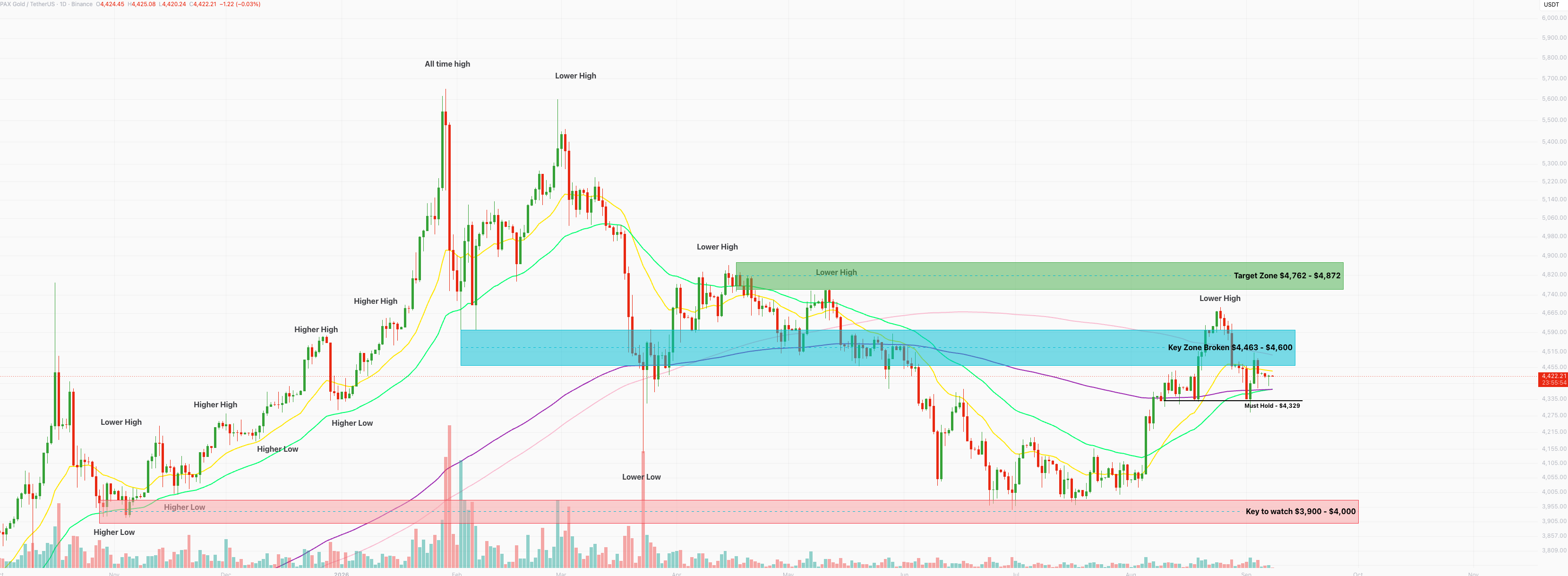
Stormrake Spotlight: Pax Gold (PAXG) ($4,422)
Source: https://www.tradingview.com/x/v1tAUx3a/
PAXG had a very flat day, growing just 0.05% from its open. It is stuck between key levels as well as key moving averages. As the bulls have the momentum we can favour a breakout to the upside, but it is something to watch as the week progresses.
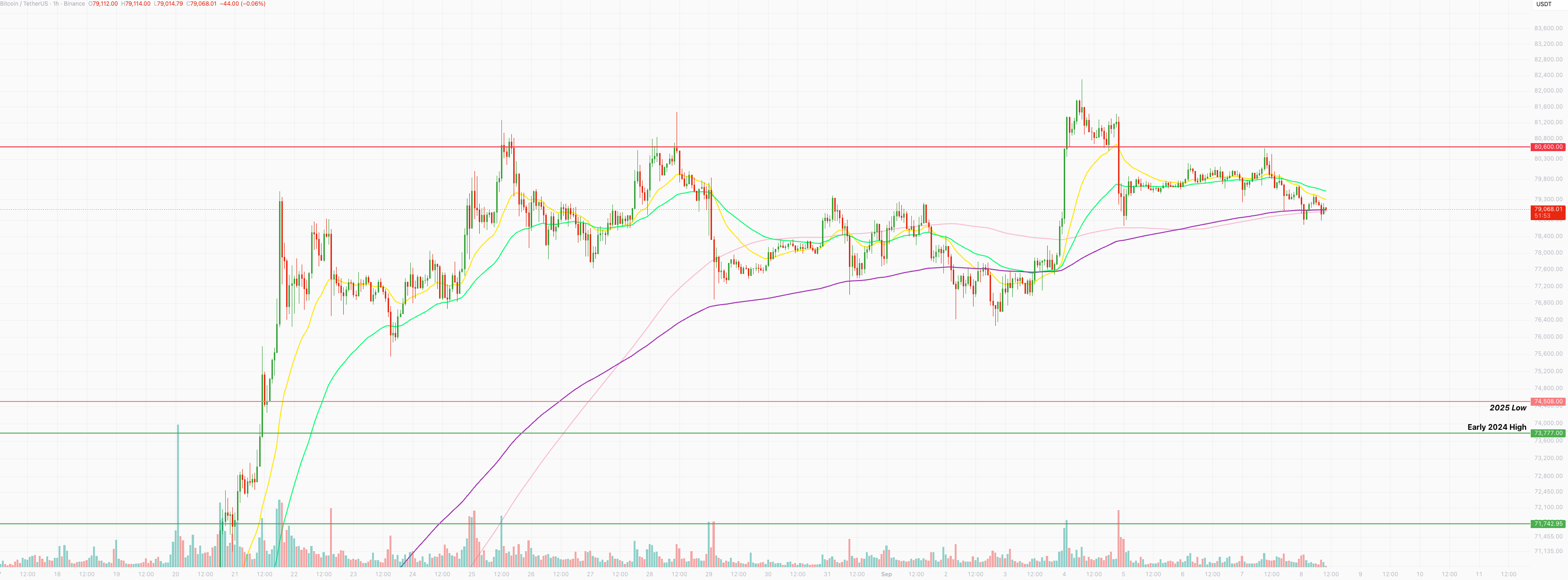
BTC/USD Key Levels and Price Action
Source: https://www.tradingview.com/x/BFAacA1P/
Losing 1.5% yesterday after failing once more to get above the key resistance level. Bitcoin has lost the short term momentum and now retests the bottom moving average which the bulls look to provide support from. If this breaks then we can expect BTC to retest the current low around $76.2k.
All prices are denominated in USD unless stated otherwise
Written by Alexandar Artis
Create a brokerage account today
No Advice Warning
The information in this newsletter is general only. It should not be taken as constituting professional advice from the author - Stormrake PTY LTD.
Stormrake is not a financial adviser and does not provide financial product advice. You should consider seeking independent legal, financial, taxation or other advice to check how the information relates to your unique circumstances. Stormrake is not liable for any loss caused, whether due to negligence or otherwise arising from the use of, or reliance on, the information provided directly or indirectly, by this newsletter.
Disclaimer
All statements made in this newsletter are made in good faith and we believe they are accurate and reliable. Stormrake does not give any warranty as to the accuracy, reliability or completeness of information that is contained here, except insofar as any liability under statute cannot be excluded. Stormrake, its directors, employees and their representatives do not accept any liability for any error or omission in this newsletter or for any resulting loss or damage suffered by the recipient or any other person. Unless otherwise specified, copyright of information provided in this newsletter is owned by Stormrake. You may not alter or modify this information in any way, including the removal of this copyright notice.
Copyright © 2026 Stormrake Pty Ltd, All rights reserved