

Eighteen Years, Six Billion Dollars and One Unbroken Ledger
· Bitcoin Deep Dive · Stormrake
- ZEC
- BTC

On Friday we covered the Binance breach as it unfolded. This note is not a rerun. It is about what the weekend told us, and why the timing could not have been more fitting.
On Saturday 31 October, with Binance still counting the cost, the Bitcoin whitepaper turned 18.
Where Things Stand Now
Three things have moved since Friday:
-
Attribution confirmed: The FBI has formally named North Korea’s TraderTraitor unit, confirming what analysts suspected on Friday.
-
Losses covered: Binance says it has now covered approximately 95% of the impacted amount, up from 90% on Saturday.
-
Withdrawals reopened: Phased withdrawals began on Sunday, Bitcoin first. DefiLlama tracked more than US$3.7bn in net outflows within 24 hours, though Binance says some of that is movement between its own wallets. So far, withdrawals are processing.
The Washout
On Friday we showed the price reaction rhymed with Bybit. The weekend filled in the more important detail: what kind of selling it was.
The final tally was US$1.57bn in liquidations over 24 hours, with roughly US$1.32bn of that from long positions. That is around 84% longs.
Forced selling is not the same as conviction selling. Those traders did not choose to exit Bitcoin. Their positions were closed for them. Once that leverage was cleared, the market went quiet. Bitcoin spent the weekend in a tight range between roughly US$77,200 and US$78,100, and ticked higher as Binance reopened withdrawals.
That does not mean the coast is clear. Bitcoin closed October around 8% lower, below its monthly open near US$83,500. As we flagged on Friday, Bybit’s larger fall came the week after the hack. This is that week. But a market that can absorb the largest theft in crypto history and then trade sideways is a sturdier market than the one we had a few years ago.
Four Years On From FTX
Four years ago this month, FTX collapsed. Within days, one of the largest exchanges in the world was gone and billions in customer funds were locked in bankruptcy. Bitcoin fell to around US$15,500 by 21 November 2022, and never traded that low again.
FTX was the capitulation event that set the cycle low. The shock that ends a bear market rarely feels like the end. It feels like the worst news yet.
Put the two events side by side:
FTX, November 2022: Fraud and insolvency. Customer funds locked in bankruptcy for years. The exchange collapsed. Bitcoin fell to a fresh cycle low.
Binance, October 2026: A hot wallet breach. About 95% of losses covered by Binance within 72 hours. The exchange is still operating and withdrawals have reopened. Bitcoin held about 30% above its July low.
In 2022 it took a genuine collapse, with real customer losses, to force the final low. In 2026 the largest hack in crypto history hit the largest exchange, and Bitcoin still could not break its September low of US$74,900.
That matters for the structure. Bitcoin’s bear market low came in July. September then set a higher low at US$74,900. Last week’s hack low of US$76,300 held above it. The market was handed the worst headline it could get, and the higher low survived. In our view, that strengthens the bullish case, and it fits the case we made in our Q4 Outlook, The Recovery Nobody Believes.
Some analysts are still calling for a fresh bear market low, with targets ranging down into the US$40,000s and below. In our view, that case is getting harder to make. It would need a bigger shock than the biggest hack on record, at the same point in the four-year cycle where previous bear markets ended. Past cycles are no guarantee, but that is not where the evidence points.
What Satoshi Wrote
On 31 October 2008, Satoshi Nakamoto posted Bitcoin: A Peer-to-Peer Electronic Cash System to a cryptography mailing list.
The problem it set out was simple. Online payments depended on financial institutions acting as trusted third parties, and that model carried weaknesses that could not be engineered away. Satoshi’s answer was a payment system built on cryptographic proof instead. In the paper’s own conclusion, a system for electronic transactions “without relying on trust”.
Now look at last week through that lens.
The Bitcoin network was not hacked. Every Bitcoin the attacker moved was moved with a valid signature from a wallet the exchange controlled. The protocol did exactly what it was designed to do. The weak point sat where trust was reintroduced.
Eighteen years in, the base layer has never been compromised. The failures have consistently happened at the edges, wherever a third party holds the keys on someone else’s behalf.
This is not an argument against exchanges or brokers. Custodians provide real value: access, liquidity, convenience and someone to call when something goes wrong. It is an argument for understanding where your risk actually sits. The design of Bitcoin gives every holder that choice, and knowing the trade-offs is part of owning it.
How Far The Industry Has Come
In 2014, Mt. Gox lost around 850,000 Bitcoin and collapsed. Users waited a decade for partial repayment.
In 2026, the largest exchange in the world suffered the largest hack on record. Within 72 hours the attacker had been named by the FBI, about 95% of the loss had been covered and withdrawals had reopened.
None of this makes hacks acceptable. Billions remain in the hands of a sanctioned state. But for adoption, an industry that can take a hit of this size and keep functioning matters as much as the price.
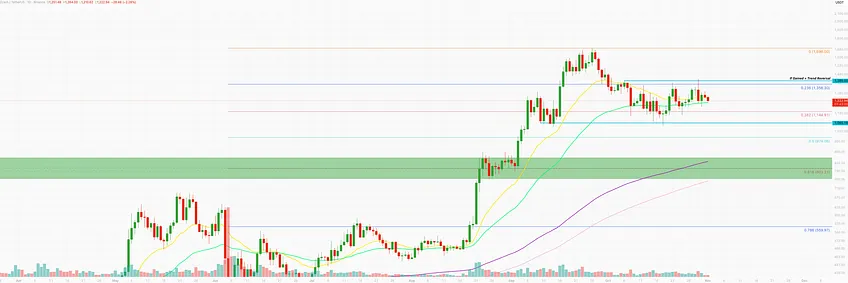
Stormrake Spotlight: Zcash (ZEC) ($1,222)
Source: https://www.tradingview.com/x/oqkq0gVC/
ZEC spent the weekend grinding a tad lower following its failure to gain that key level we have been watching for weeks now at $1,385. That failure to gain has strengthened the bears’ grip on ZEC. We can look for it to return to the lower side of the range at $1,066.
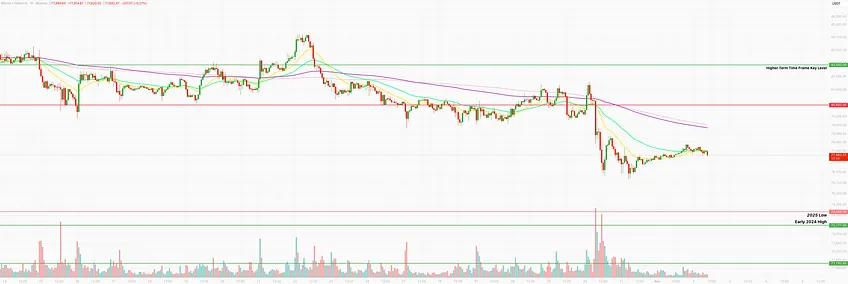
BTC/USD Key Levels and Price Action:
Source: https://www.tradingview.com/x/LOO99zr2/
Bitcoin spent the weekend grinding higher following the hack. Up nearly 2% from the low, the best situation for the bulls is if it can stay above $74.9k (September’s low). Currently the bears are fighting to stay in control as the moving averages are providing immediate resistance to BTC.
*All prices are denominated in USD unless stated otherwise*
Written by Alexandar Artis
Disclaimer
This information is general in nature and does not take into account your personal objectives, financial situation, or needs. Before acting, you should consider whether this information is appropriate for your circumstances and seek independent advice if necessary.
Digital assets are volatile and carry significant risk. Past performance is not indicative of future results. You may lose some or all of your investment.