

Japan's Live Demonstration: Printing to Save a Currency
· Macro Analysis · Stormrake
- BTC
- PAXG

Japan's currency crisis has been building for years, and this week it moved from a slow-motion story into something markets could actually watch unfold in real time. The yen weakened past 160 paired to the US dollar, prompting a coordinated intervention involving both Japanese and US authorities. Meanwhile, the Bank of Japan's own balance sheet sits at the centre of why the currency got this weak in the first place, and the mechanics of that story are worth understanding plainly.
How the BOJ Got Here
The Bank of Japan has spent years buying government bonds at a scale few other central banks have ever attempted, and it now holds roughly half of Japan's entire outstanding government bond market. That's not a modest policy lean, it's a central bank effectively becoming the dominant buyer of its own government's debt, created with newly issued currency. Formal yield curve control ended back in March 2024, but the BOJ kept buying large volumes of bonds regardless, and only this year has it begun signalling a genuine taper of those purchases.
The consequence of years of that scale of bond buying is exactly what currency markets have been pricing: a yen structurally weakened by a central bank that has spent years expanding the money supply to keep its own government's borrowing costs artificially low. When a government leans this heavily on its central bank to absorb its debt, the currency tends to bear the cost eventually, and Japan is now living through that bill coming due, with authorities forced into direct FX intervention just to defend the currency from the consequences of the printing that came before it.
Yields Are Rising on Both Sides of the Pacific
Japan's 10-year government bond yield touched 3% in early September, its highest level since 1996, before easing slightly to around 2.90%. The 30-year JGB yield sits near 3.97%. Those are levels this market hasn't operated at in three decades, and they reflect real strain, rising fiscal spending plans under the current administration, a central bank stepping back from its own bond market, and investors demanding genuine compensation for risk they were previously being shielded from.
That strain doesn't stay contained inside Japan. Japan remains the largest foreign holder of US government debt, and any meaningful repatriation of capital or forced selling tied to domestic bond market stress adds direct pressure to US Treasury yields as well. The US 10-year Treasury yield is currently trading around 4.79% to 4.80%, its highest level since late 2023, and the 30-year sits near 5.25%. Some of that move traces directly to this week's stronger-than-expected US jobs data lifting rate-hike odds, but a meaningful share of it is the same global bond market repricing playing out simultaneously across both economies, each one feeding the other.
Washington is responding to its own version of this pressure in real time. Treasury Secretary Scott Bessent doubled the size of the government's long-dated bond buyback operations in late August, and this morning markets are bracing for another escalation, reports point to an operation in the $5 billion to $6 billion range, aimed squarely at the 10-year to 30-year sector, and timed deliberately ahead of this week's 10- and 30-year Treasury auctions. Strip away the terminology and the intent mirrors exactly what's playing out in Tokyo - an authority stepping directly into its own government bond market to absorb supply and hold yields down, because the fundamentals underneath, a widening deficit, persistent inflation, and a wave of competing corporate issuance, aren't resolving on their own.
Japan is managing this through decades of central bank balance sheet expansion. The US is now managing an early version of the same pressure through an increasingly large, increasingly frequent buyback programme.
Why This Matters for Risk-On Assets, Bitcoin Included
Rising sovereign yields, in Japan, in the US, or both at once, function as a genuine headwind for risk-on assets broadly. Higher yields raise the discount rate applied to future cash flows and speculative assets alike, pull capital toward safer, higher-yielding government debt, and tighten financial conditions across the board.
Bitcoin, alongside growth equities and other longer-duration, rate-sensitive assets, tends to feel that pressure directly. This is the same basic mechanism explored in the recent note on the US jobs report, strong data pushing yields higher weighs on risk assets in the short term, regardless of the asset's own underlying merits.
The Longer-Term Case This Actually Strengthens
What's happening in Japan right now is a textbook, live example of exactly the problem Bitcoin was built to sit outside of - a central bank monetising its own government's debt at a scale that eventually forces a currency crisis, followed by authorities scrambling to intervene and manage the fallout of that printing after the fact. This isn't a hypothetical thought experiment about fiat currency risk. It's happening in the world's third-largest economy, in real time, this week.
A fixed-supply asset with no central bank able to expand its issuance to paper over fiscal strain doesn't carry this specific failure mode. Short-term, Bitcoin still trades as a risk asset and feels the same rising-yield pressure everything else does. Longer-term, every episode like Japan's is a live, concrete reminder of exactly why that fixed-supply design matters, and why the structural case for holding an asset outside this system doesn't weaken because rates are higher this month, it strengthens with every fresh example of what currency management by printing eventually costs.
What the Intervention Actually Proves
Rising yields on both sides of the Pacific are a genuine, near-term headwind for risk-on assets, and pretending otherwise would undersell what's actually happening in bond markets right now. What Japan is demonstrating live, and what Washington is now actively managing through an escalating buyback programme of its own, is the other half of the story, the actual cost of years of central bank money creation and rising sovereign debt loads eventually landing on yields and currencies, followed by direct intervention to manage the damage.
That's the exact dynamic Bitcoin's fixed supply was designed to sit outside of, and every instance of two of the world's largest economies stepping directly into their own bond markets in the same week adds another concrete data point to that case.
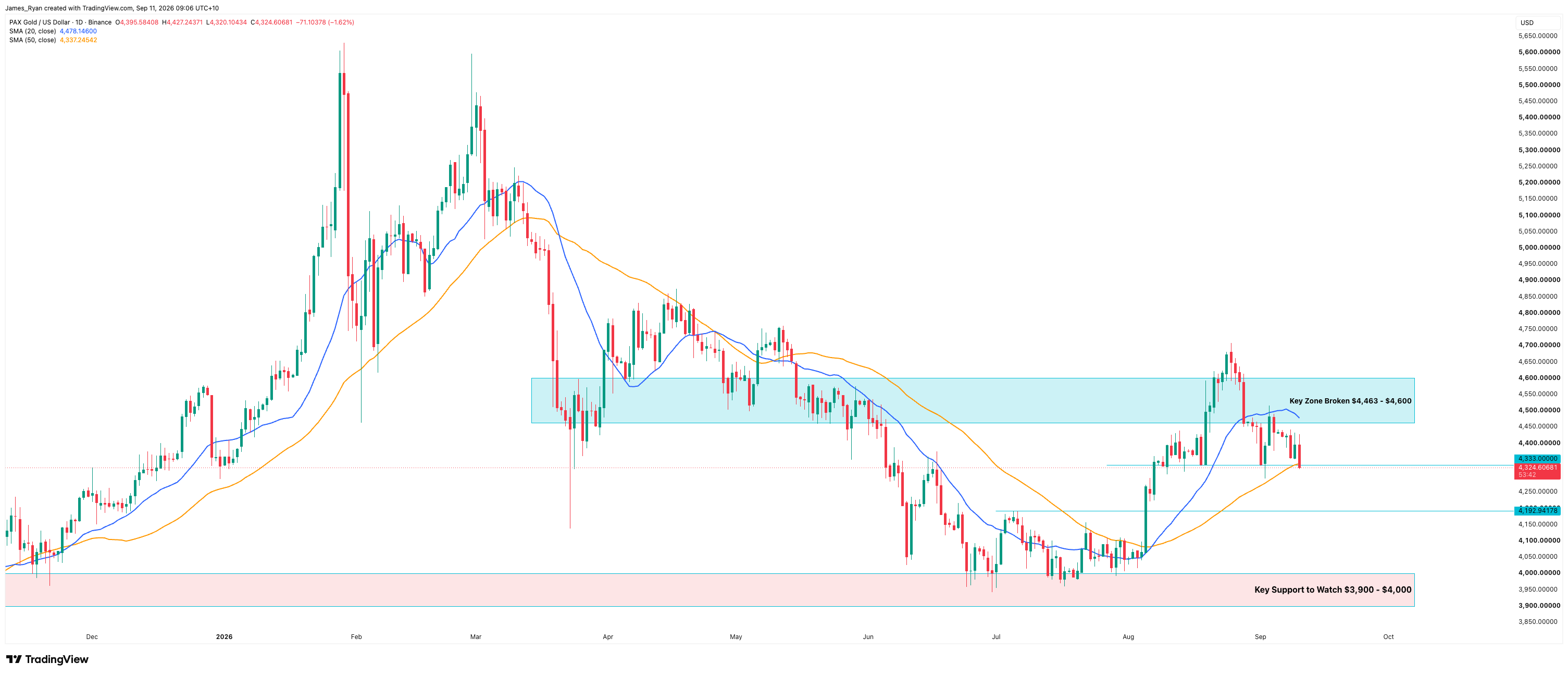
Stormrake Spotlight: Pax Gold (PAXG) ($4,324)
Source: https://www.tradingview.com/x/rU83y8CE/
PAXG has followed the rest of the markets in a correction earlier this morning, with bears attempting a swing below current local trend which was sitting at $4,333 and the daily moving average 50 support at the same level. Gold appears to hunting a retest of the breakout which resides at $4,192. This is something that does happen more often in an asset like Gold, as opposed to the higher volatility of a macro breakout in something like Bitcoin - where second chances to enter at generational lows are nearly non-existent, historically speaking.
BTC/USD Key Levels and Price Action:

Source: https://www.tradingview.com/x/maZkDvg7/
Speaking of Bitcoin, we've started to solidify the distribution between the three marginal higher high pushes over the last few weeks. We're now seeing follow-through for that aforementioned dip - this will likely lead into the third and final accumulation phase for Bitcoin this bear market, before it never looks back. As noted in previous articles, these dips will become more shallow as we progress and are highly unlikely to provide the same opportunity they did just a mere two months ago when we swung below $60K briefly. Institutional-smart money already added to their positions and loaded up the truck at those generational low prices for this cycle. The mid to low $70,000 range remains the short-medium term target where the larger accumulation support structures still remain.
All prices are denominated in USD unless stated otherwise
Written by James Ryan
Create a brokerage account today
No Advice Warning
The information in this newsletter is general only. It should not be taken as constituting professional advice from the author - Stormrake PTY LTD.
Stormrake is not a financial adviser and does not provide financial product advice. You should consider seeking independent legal, financial, taxation or other advice to check how the information relates to your unique circumstances. Stormrake is not liable for any loss caused, whether due to negligence or otherwise arising from the use of, or reliance on, the information provided directly or indirectly, by this newsletter.
Disclaimer
All statements made in this newsletter are made in good faith and we believe they are accurate and reliable. Stormrake does not give any warranty as to the accuracy, reliability or completeness of information that is contained here, except insofar as any liability under statute cannot be excluded. Stormrake, its directors, employees and their representatives do not accept any liability for any error or omission in this newsletter or for any resulting loss or damage suffered by the recipient or any other person. Unless otherwise specified, copyright of information provided in this newsletter is owned by Stormrake. You may not alter or modify this information in any way, including the removal of this copyright notice.
Copyright © 2026 Stormrake Pty Ltd, All rights reserved