

Bitcoin versus Real Estate
· Education · Stormrake
- BTC
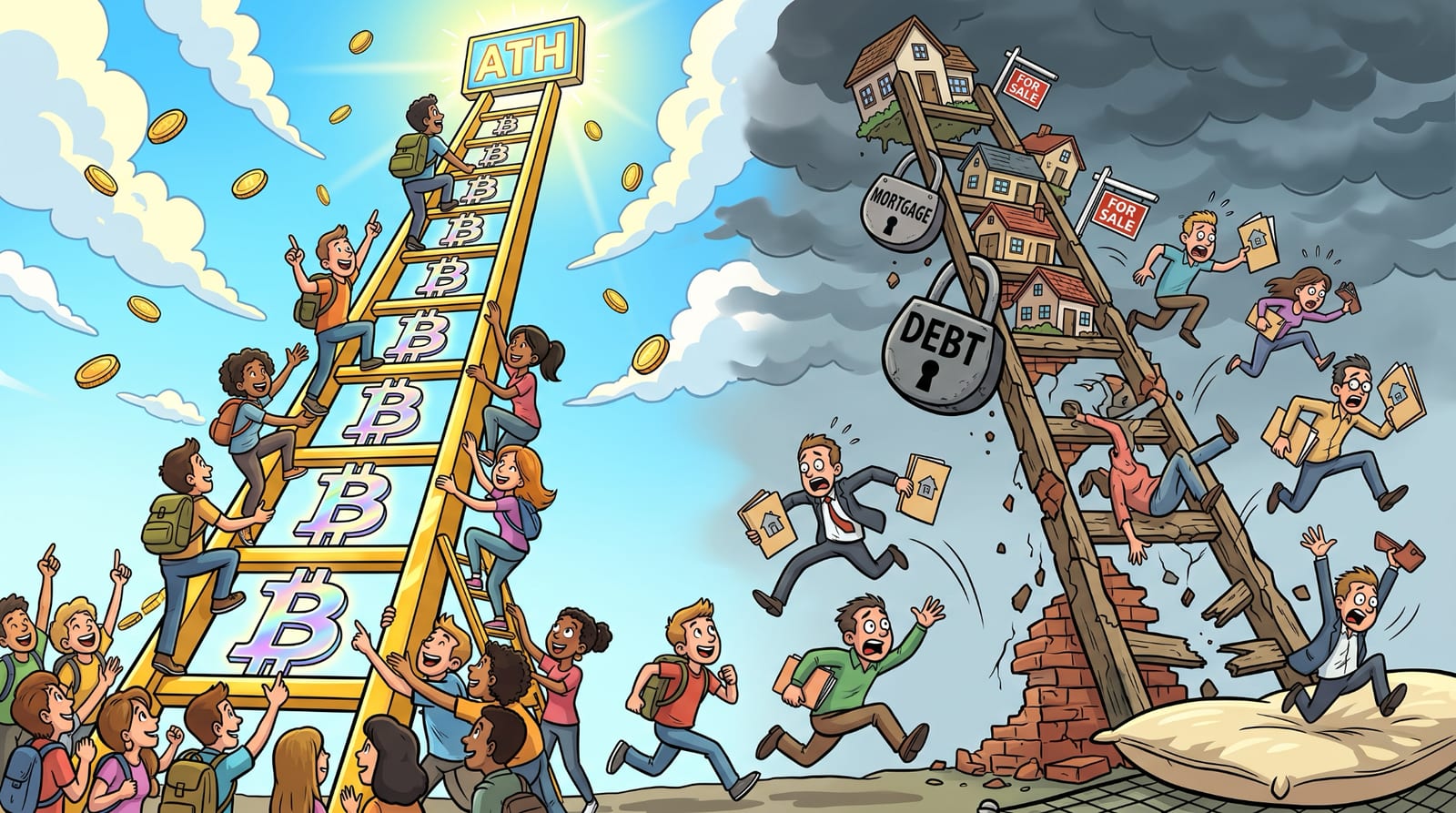
For a generation, Australians were told the safest way to build wealth was to buy a house. Now, one of the largest asset managers in the world has put a number on Bitcoin that sounds remarkably like the one housing delivered across the last decade. At the same time, the pillars that carried Australian property, cheap leverage, generous tax treatment and falling rates, have each moved the other way.
Our view is simple. Bitcoin is the new housing, with a higher ceiling and none of the friction. This article sets out why, what our own target implies, and what it would take for property to keep pace.
JPMorgan Puts a Number on Bitcoin
J.P. Morgan Asset Management's 2027 Long-Term Capital Market Assumptions, released in October, is the 31st edition of one of the most closely followed return forecasts in global finance. For the first time, Bitcoin is in it. The base case is a 10% compound annual return over the next 10 to 15 years, rising to ~17% in the most bullish, risk-on case.
That 10% is above the bank's assumptions for US large-cap equities (7.5%), US bonds (5.6% to 6.6%) and gold (5.5%), and just above private equity at 9.8%. A decade ago, a figure like this from a bank of that standing would have been unthinkable.
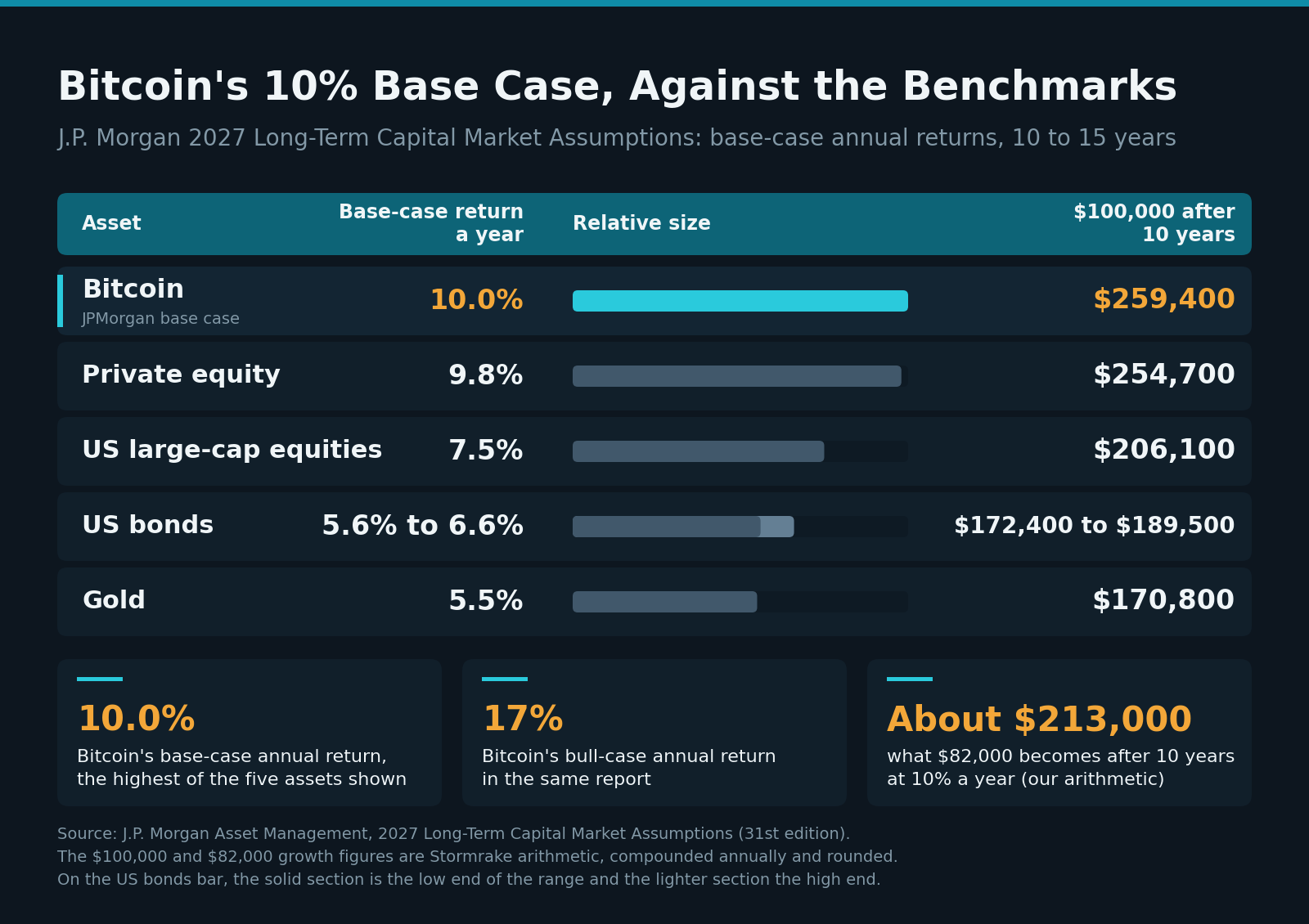
For context; 10% compounded for ten years takes a Bitcoin price of around $82,000 to roughly $213,000. This frames what a prestigious institution with a long record of caution on Bitcoin is now prepared to put in writing.
The Housing Engine That Delivered Close to 9%
Housing was the trade of a generation. Cotality data shows national dwelling values rose 66.5% over the ten years to August 2026, which is capital growth of about 5.2% a year. Add a gross rental yield of roughly 3.6% to 3.8% in recent months and the gross return lands close to 9% a year, within a percentage point of JPMorgan's base case for Bitcoin.
That is why Bitcoin is the new housing. It offers the same order of long-run return, without the deposit, the stamp duty, the maintenance bill or the tenant.
The engine that produced housing's decade has stalled. The Reserve Bank has lifted the cash rate four times in 2026 to 4.60%, the highest level in 15 years, and average owner-occupier variable rates now sit around 6.5%. National dwelling values have fallen for six consecutive months and are 5.2% below their March peak, with annual growth flat at 0.0%. Sydney is down 7.0% over the year and Melbourne 6.2%. In May we flagged auction clearance rates collapsing to around 50%, their weakest since 2020, and the data has only confirmed the direction since.
Tax has turned as well. From 1 July 2027, negative gearing on established homes bought after the 12 May budget is limited to offsetting income and gains from residential property, and no longer salary or other income. Moving forward, the 50% capital gains discount is replaced by an inflation-indexed cost base with a minimum 30% tax rate. Leverage, tax concessions and falling rates were the three pillars under housing. All three are moving against it at once.
Priced in Bitcoin, the House Keeps Getting Cheaper
Measure the same asset in a scarce unit and the picture changes. In 2017 the average Australian home cost about $550,000 AUD, roughly 300 Bitcoin. By 2021 it cost $750,000 AUD, or about 20 Bitcoin. By 2025 it cost over $1,000,000 AUD, around 5 Bitcoin. The fiat price climbed every cycle while the Bitcoin price of the house collapsed.
Housing reflects the steady dilution of the currency used to price it. Bitcoin sits on the other side of that trade.
Our Target, and What Housing Would Have to Do
Our projection is for Bitcoin to reach $180,000 to $200,000 USD by September 2029. From around $82,000 today, that is a gain of 120% to 144%, or 2.2 to 2.4 times, over roughly 2.9 years. The compound rate required is about 31% to 36% a year for those holding the raw, spot asset.
Apply the same gain to the national median dwelling value of $899,236 and the equivalent home would be worth about $1.97 million to $2.19 million by September 2029. That means adding roughly $1.07 million to $1.29 million of value in under three years, or about $1,000 to $1,200 every day for 2.9 years.
Compare that with what housing has actually delivered. The last decade averaged about 5.2% a year in capital growth. One of its strongest sustained stretches in modern history, the capital cities from 1998 to 2003, delivered around 10% a year. Run the national median at 10% a year for 2.9 years and it reaches about $1.19 million. Run it at the 30-year average of about 6.4% and it reaches roughly $1.08 million. Matching Bitcoin's target would take housing growth more than three times faster than one of the strongest stretches in its record, in the same period, with rates at 15-year highs.
What It Would Cost to Hold That House
Price growth is only half the story, because someone has to service the loan. Take a buyer with a 20% deposit and look at interest alone at today's headline range of 6.5% to 7.0%, with no principal repaid.
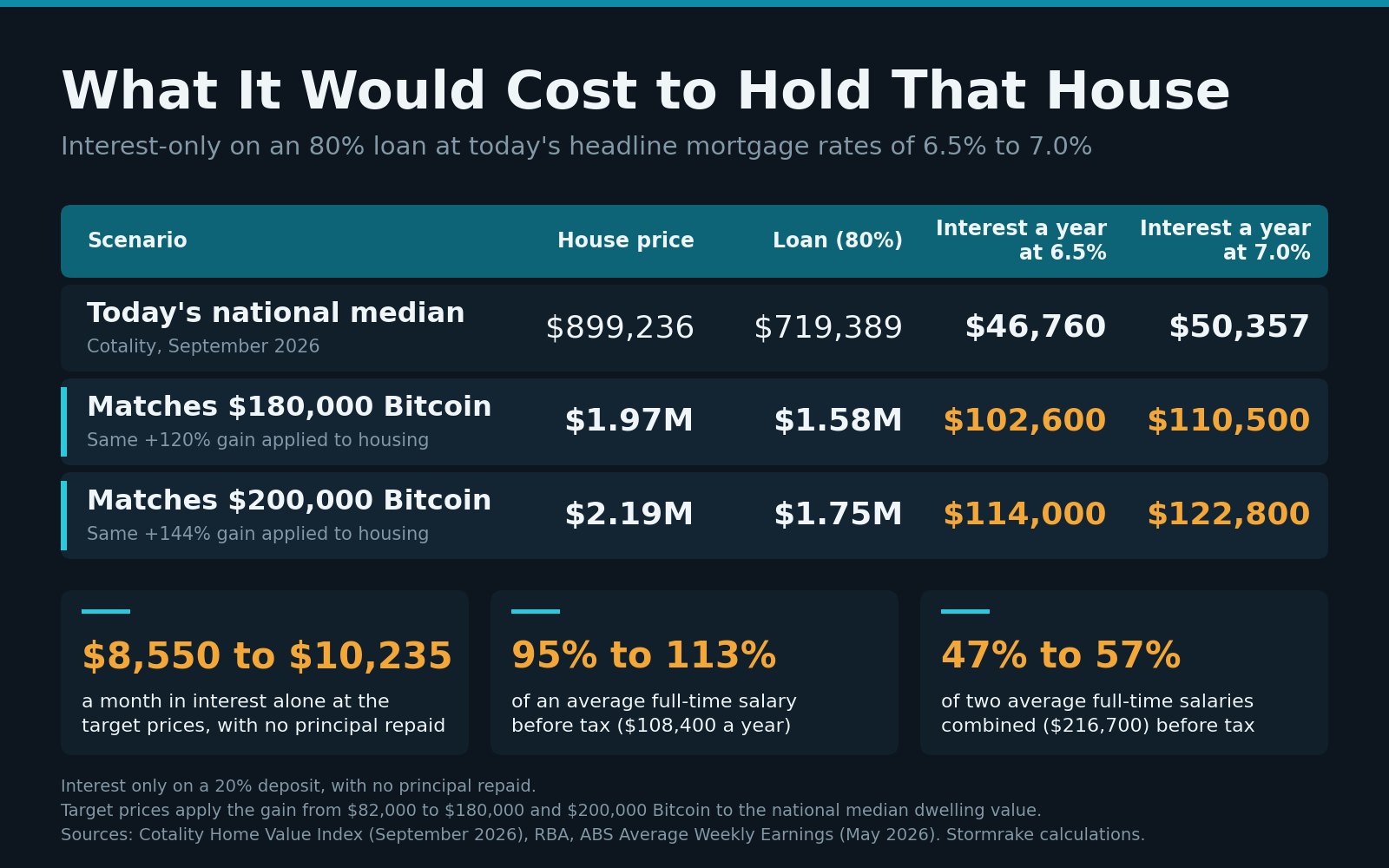
At the target prices, interest alone would cost $8,550 to $10,235 a month. The average full-time worker in Australia earns about $108,400 a year before tax, so the interest bill by itself would consume between 95% and 113% of that salary. Even two average full-time salaries combined, about $216,700, would hand 47% to 57% of gross pay to the bank in interest before a dollar of principal, tax, food or fuel. A household would need an income of roughly $340,000 to $410,000 to carry that debt without strain, three to four times average full-time pay.
Wages are growing at 3.7% a year, the slowest pace since 2022. For homes to reach those prices, incomes would need to roughly triple. An economy cannot reprice its housing that far while its workers earn $108,000, and the cost-of-living strain already visible would turn from a cycle into a permanent condition. The path to a house priced at Bitcoin-matching levels is closed by arithmetic.
The 20 to 1 Bet: First Home Buyers Are Starting to Go Underwater
The sharpest edge of this correction sits with first home buyers. The federal government's 5% deposit scheme, expanded on 1 October 2025, has put 102,594 first home buyers into a home in a year. A 5% deposit means borrowing 95% of the price, so every $1 of the buyer's own money controls $20 of property. That is a 20 to 1 leveraged position on an asset that was already historically expensive.
The arithmetic is unforgiving. A 5% fall in value erases the entire deposit. Take a $1,000,000 purchase with $50,000 down. With Sydney values now around 8.6% below their peak, the home is worth about $914,000 against a loan of $950,000, leaving the buyer roughly $36,000 underwater before a dollar of selling costs.
The data shows it happening. realestate.com.au's PropTrack analysis estimates about 89 scheme households were in negative equity in July, around 480 in August and about 1,143 in September, 2.4% of purchasers. That is more than a twelvefold rise in two months. Cotality analysis reported in The Australian found that about one in two homes bought in Sydney and Melbourne over the past year would now sell for less than the purchase price, and the RBA's October Financial Stability Review names 5% deposit buyers among those most likely to be in negative equity.
Forecasters expect more. Cotality's research director calls a 10% to 15% fall a fairly reasonable estimate, HSBC sees about 13% peak to trough, and Macquarie and CBA both see about 10%. With the cash rate at a 15-year high, repayments are rising on the same buyers whose equity is shrinking. Property was sold as the safe option, and the buyers with 5% down are the first to find out what that safety truly depended on.
Rentvesting: The Door That Needs No Deposit
The Bitcoin versus property debate matters for people still deciding whether to buy their first home. Shelter is a necessity, and nobody is weighing a roof against a coin. The question is how to pay for it. A 20% deposit on the national median is about $180,000, around 1.7 times an average full-time salary before tax, and the median home now costs about 8.3 times that salary. For many Australians, owning has moved from a few years of saving to well over a decade of saving.
That is where rentvesting comes in. A renter keeps the shelter and the flexibility, and invests the difference. On a median-priced home, a gross rental yield near 3.8% implies rent of roughly $34,000 a year, against $46,760 to $50,357 in interest alone on an 80% loan, before council rates, insurance or maintenance. That gap of roughly $12,500 to $16,000 a year can go into an asset with a 10% a year base case from JPMorgan and a $180,000 to $200,000 target from us. Bitcoin needs no 20% deposit, or even 5%. It can be bought in fractions and built up over time, with the upside captured from the first dollar.
The SMSF Door That Closed, and the One That Stayed Open
This is where the policy shift matters for self-managed super fund trustees. In our July piece on who controls your retirement money, we covered the government's push to treat super as a national asset. Weeks later, a rule change took effect that narrowed what trustees could do with their own funds.
Since 10 August 2026, SMSFs can no longer use limited recourse borrowing arrangements to buy residential property. Existing loans are grandfathered and commercial property borrowing is unaffected. Funds can still buy a home outright with cash, but the borrowing that let a modest balance control a much larger asset, the route many trustees used, has been legislated shut.
Bitcoin carries no equivalent restriction. An SMSF can hold it directly under the same investment strategy, sole purpose test and valuation requirements that govern any other asset. Super funds were also carved out of the May budget's CGT changes, which means a fund keeps the one-third CGT discount. That is an effective rate of 10% on gains held longer than 12 months in accumulation phase, and nil on assets supporting a retirement pension up to the transfer balance cap. Individuals holding assets outside super face the new regime from 1 July 2027.
Put the two side by side. Residential property inside super has lost its leverage. Bitcoin inside super has kept its full access, its tax treatment and an upside profile that housing cannot match. For a trustee weighing where the next dollar of retirement capital belongs, that is the asymmetry. Housing would need to do something it has never done to match our target. Bitcoin needs to repeat what its cycles have already shown.
Where This Leaves Allocators
Housing delivered the last decade. Bitcoin now has an institutional base case that matches it, and a cycle position that points to far more over the next three years. Rates are high, wages are slow, taxes have shifted, a growing number of recent buyers are already underwater and the borrowing lever for super funds has gone.
Our target of $180,000 to $200,000 by September 2029 is a call that the next leg belongs to scarce digital property. We would rather own that than a home that needs a household income above $340,000 to carry at the prices required to keep up.
Stormrake works directly with SMSF trustees to structure compliant Bitcoin exposure inside super, covering regulatory requirements, secure custody and reporting. If you hold an SMSF and want to discuss how this works for your fund, your dedicated Stormrake broker is ready to assist. Contact them today.
Written by James Ryan
Disclaimer
This information is general in nature and does not take into account your personal objectives, financial situation, or needs. Before acting, you should consider whether this information is appropriate for your circumstances and seek independent advice if necessary.
Digital assets are volatile and carry significant risk. Past performance is not indicative of future results. You may lose some or all of your investment.