

A Bank Run With No Exit
· Breaking News · Stormrake
- BTC
- ZEC

Two of the biggest custody failures of the year landed in the same week. One was a crypto exchange. One was a bank.
Different causes. Same lesson.
One Bank, Three Million Customers
On Tuesday, Paraguay’s central bank put ueno bank into resolution, its most serious step short of liquidation.
ueno is the country’s fifth largest private bank, with more than three million customers in a nation of roughly seven million. By most estimates, that is around 60% of Paraguay’s adults.
Its solvency ratio had fallen below half the legal minimum. Overnight, customers lost access to their balances, cash and transfers.
The Damage Is Spreading
-
13 mutual funds frozen. Five fund managers halted withdrawals because their money was parked at ueno.
-
All ueno bonds suspended. Trading has been halted on every bond the bank issued.
-
The state is caught too. Around US$380M from IPS, the state pension fund, is stuck, along with money from ANDE, the state power company, and the Itaipú dam.
-
Arrests and resignations. Eight executives have been detained and the central bank governor, a former ueno chief, is stepping down.
Deposits up to roughly US$38,000 are guaranteed. That helps small savers. It does little for a pension fund with hundreds of millions locked inside.
Healthy on Paper
In March, ueno reported a capital ratio of 15%, comfortably above the 12% minimum. Seven months later, it was shut overnight.
That is how bank failures work. The numbers look fine until they do not, and customers have no way to check for themselves.
CZ’s Warning
Following last week’s record hack, former Binance CEO Changpeng Zhao (CZ) told CoinDesk:
“If a crypto exchange can be hacked, banks are in a worse position, in my opinion.”
His argument: attackers need to find one weakness, defenders need to fix them all, and AI is handing attackers new tools faster than institutions can defend against them.
CZ offered no evidence that AI was involved in the Binance attack, and he is hardly a neutral voice. But the core point stands. Any institution holding other people’s money is a target.
Two Failures, One Lesson
Binance was hacked. ueno failed on its own lending. But their customers were in the same position: neither group actually held their assets.
A ueno customer holds a claim on the bank. A Binance customer holds a claim on the exchange. Crypto on an exchange is effectively an IOU, a paper promise to hand it over when asked.
Binance customers were made whole because Binance chose to absorb the loss. That was the exchange’s decision, not a protection built into Bitcoin. ueno’s customers are now waiting on a regulator.
What This Means for Bitcoin
Bitcoin was born out of a banking crisis for exactly this kind of moment. It is a bearer asset with a fixed, publicly verifiable supply that can be held with no bank or exchange in between.
But it only removes counterparty risk if it is held without a counterparty. Bitcoin left on an exchange carries the same kind of risk as money left in a bank.
That does not make Bitcoin risk free. Price volatility is real, and the Binance hack shows crypto platforms are prime targets. There is also some irony here: the Itaipú dam, whose cash is now trapped, powers much of Paraguay’s Bitcoin mining industry.
The Question Worth Asking
Most ueno customers went to bed on Monday with a working bank account. On Tuesday they could not pay a bill.
If your bank froze your accounts tomorrow, how long could you last?
And do you hold enough Bitcoin, held in a way you could actually rely on, to find out?
Why Markets Fell Overnight
Wednesday’s post-election rally was wiped out in a single session.
The S&P 500 fell 4.4%, its worst day since the April 2025 tariff shock. The Nasdaq dropped 5.5% and is now in correction territory, more than 10% below its record. Chip stocks had their worst day since March 2020.
The trigger was the AI trade. With Democrats now controlling both chambers of Congress, investors are worried about tighter regulation of AI and potential limits on new data centres. That threatens the spending boom that has driven much of this year’s market gains, so investors rushed to lock in profits.
Bitcoin got caught in the same risk-off wave, falling below $76,000 to a seven-week low. Bitcoin miners were hit especially hard, as many have pivoted to hosting AI data centres. More than US$1B in leveraged crypto positions were liquidated, mostly traders betting on higher prices.
This was a macro sell-off, not a crypto-specific one. Bitcoin is still trading as a risk asset alongside tech, and when the AI trade sneezes, crypto catches the cold.
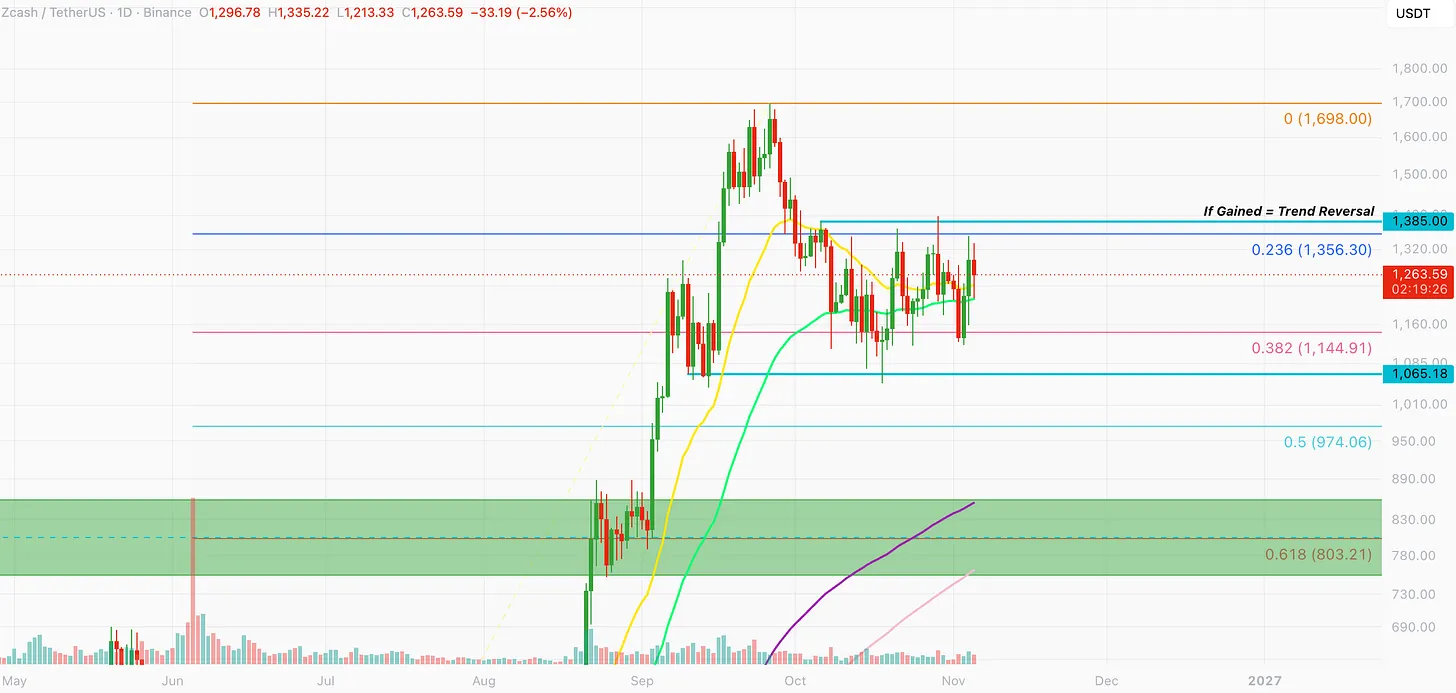
Stormrake Spotlight: Zcash (ZEC) ($1,260)
Source: https://www.tradingview.com/x/3i8J56EY/
Despite Bitcoin and the broader market losing momentum, ZEC is holding up considerably well. It is down just 2.6% over the last 24 hours and remains above its momentum averages, which keep it in a bullish posture. If markets can turn, ZEC could be among the leaders of the strongest coins.
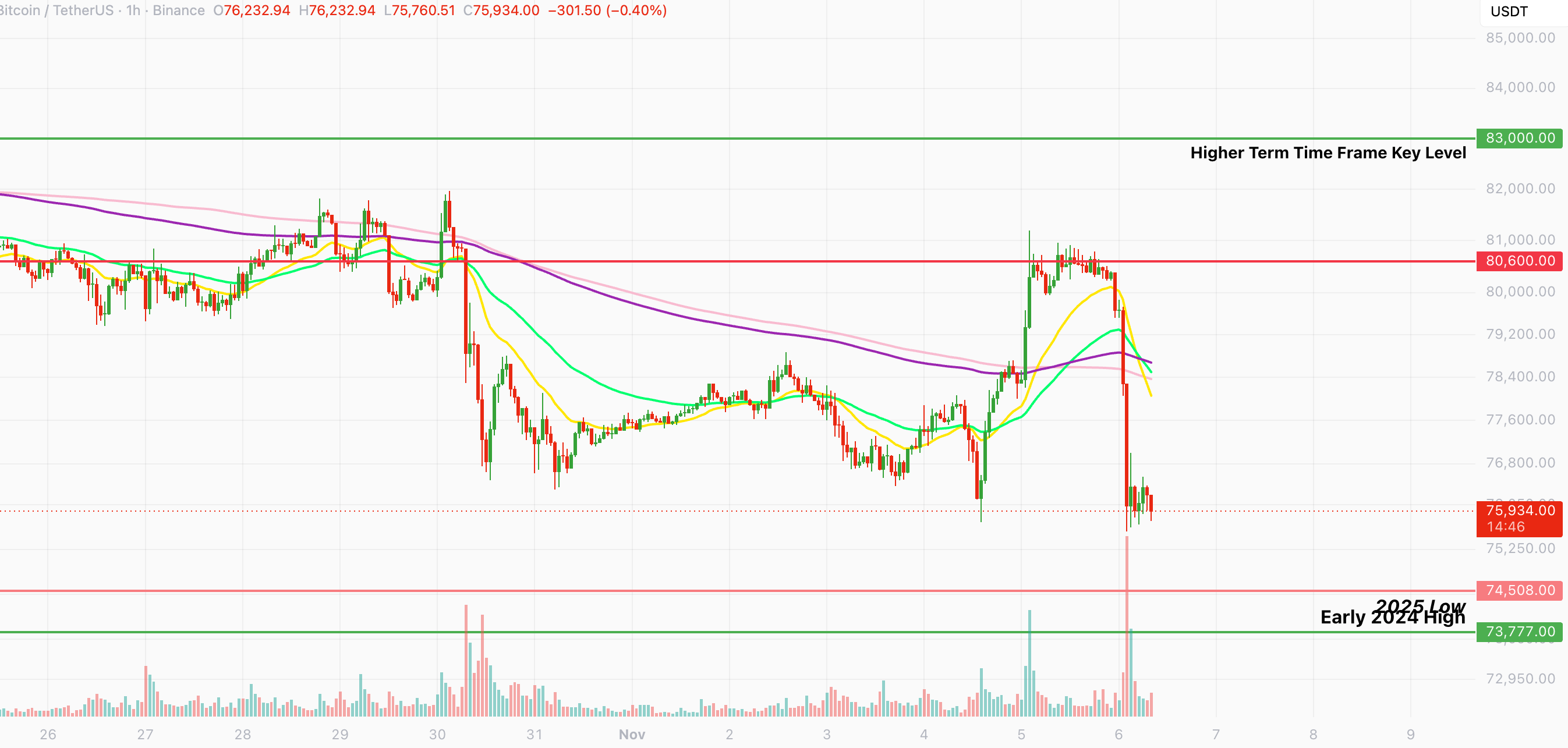
BTC/USD Key Levels and Price Action:
Source: https://www.tradingview.com/x/zEf7C4xl/
Bitcoin gave up its entire V-shaped reversal from the last 36 hours in just a couple of hours overnight. It failed to hold above the key level at $80.6k and fell 6% in three hours.
Bears have quickly reclaimed both momentum and structure. Bitcoin is now threatening to break below September’s low of $74.9k, which would be a blow to the overall structure.
*All prices are denominated in USD unless stated otherwise*
Written by Alexandar Artis
Disclaimer
This information is general in nature and does not take into account your personal objectives, financial situation, or needs. Before acting, you should consider whether this information is appropriate for your circumstances and seek independent advice if necessary.
Digital assets are volatile and carry significant risk. Past performance is not indicative of future results. You may lose some or all of your investment.