

The CLARITY Act Just Got Blocked. Here's What Actually Happened, and What Didn't.
· Regulation · Stormrake
- BTC
- PAXG

The Senate held its long-anticipated procedural vote on the CLARITY Act overnight, and it failed to clear the 60-vote threshold needed to advance. This was the vote the entire crypto policy world had been counting down to since Majority Leader John Thune filed cloture back on August 8, deliberately timed for the day the Senate returned from its August recess. Bitcoin, which had been trading near $82,000 in the lead-up at the start of this month, gave back roughly 8% as the outcome became clear, sliding toward the mid-$70K range today.
What This Vote Actually Was
This wasn’t a final up-or-down vote on the CLARITY Act itself, it was a cloture vote on the motion to proceed, essentially a test of whether the Senate had enough support to even begin formal debate on the bill. Sixty votes were needed. That threshold wasn’t met, which means the bill doesn’t move to debate under this attempt, and it’s effectively stalled for the remainder of the 2026 legislative calendar as things currently stand.
The House had already passed its version back in July 2025 by a wide 294-134 margin, including 78 Democrats. The Senate has been the genuine bottleneck ever since, largely over unresolved ethics language concerning federal officials with financial ties to digital asset businesses. Democrats sent Republicans a fresh counteroffer on those provisions on the very same day as the vote, suggesting negotiations haven’t fully collapsed, just stalled at the specific hurdle that’s blocked this bill for months.
Why the Timing Makes This Worse Than a Normal Delay
This failure lands at a particularly unforgiving point on the calendar. House Republican leadership had already cancelled the chamber’s planned voting weeks of September 21 and 28, meaning the House returns for just four days before leaving Washington until after the November midterms. With the Senate now also failing its own procedural test, the realistic window for CLARITY reaching the President’s desk in 2026 has effectively closed. Any revival would most likely need to wait for a post-election lame-duck session, and even that depends heavily on how the midterms reshape the numbers in both chambers.
Prediction markets had already been pricing this outcome as increasingly likely. Polymarket odds on 2026 passage had collapsed from a peak near 90% back in February down to around 18% heading into the vote, one of the steepest, most sustained confidence declines tracked anywhere in this note series.
The Reality of Today’s Decision
It’s tempting to read a blocked cloture vote as the end of the institutional crypto story in the US. That reading overstates what actually happened. Brian Vieten, senior research analyst at Siebert Financial, made the more measured point directly: markets may be too fixated on CLARITY’s fate specifically, since a failure simply leaves firms operating under the SEC and CFTC’s existing framework rather than a legal vacuum, and could push some product launches and tokenisation work into 2027 and 2028 rather than cancelling them outright. Separately, SEC Chair Paul Atkins has said the agency backs CLARITY but intends to keep advancing its own crypto rule-making regardless of whether Congress ultimately acts. The regulatory clarity this bill was meant to deliver isn’t fully cancelled by this vote, it’s simply not arriving through the legislative route this year, and other channels are still moving.
Where This Leaves Things
A blocked cloture vote is a genuine, meaningful setback, not a footnote, and it’s worth resisting the urge to spin it as anything other than that. What it isn’t is proof the underlying institutional push toward US crypto market structure has reversed. The SEC intends to keep moving with or without this specific bill, Democrats are still negotiating rather than walking away entirely, and the core disagreement remains narrow and nameable, ethics language, not a fundamental rejection of the framework itself. The legislative route just got considerably longer. The destination hasn’t obviously changed.
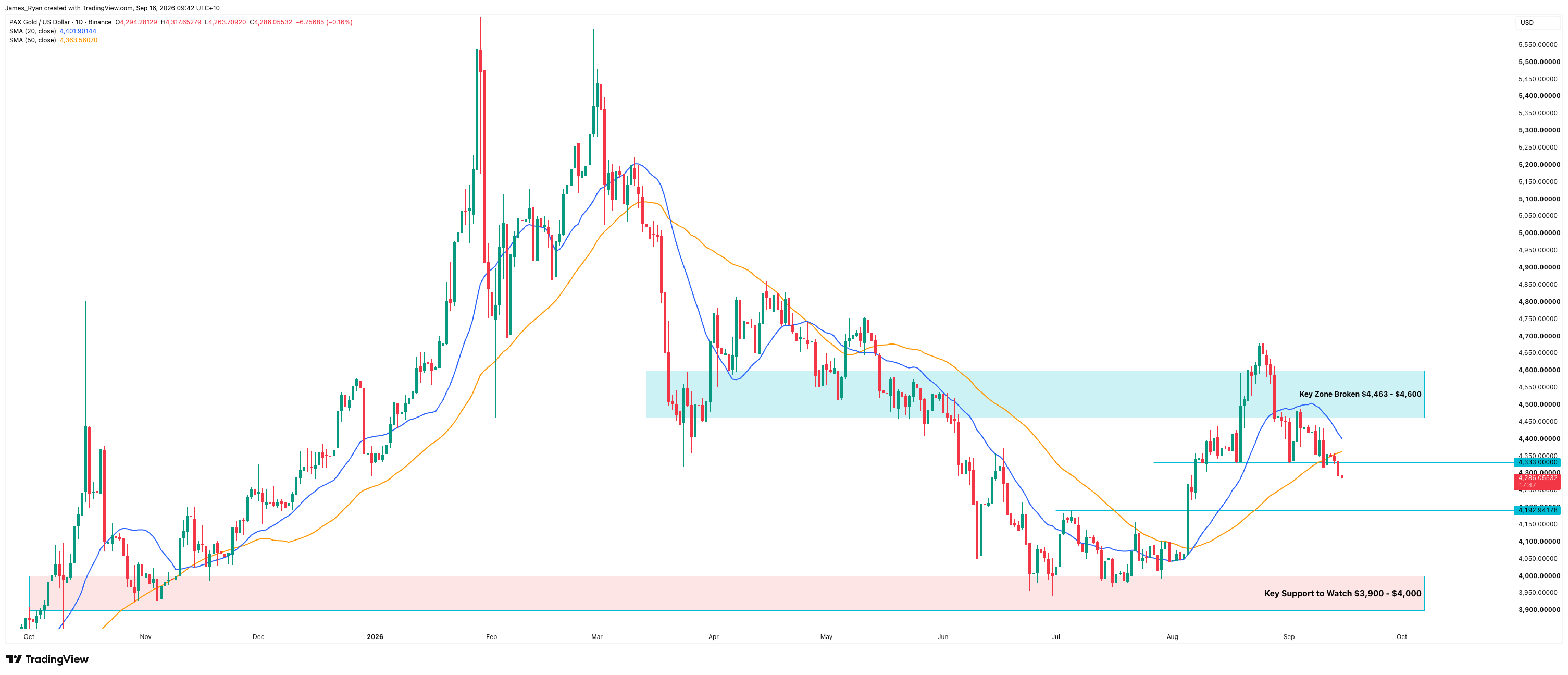
Stormrake Spotlight: Pax Gold (PAXG) ($4,286)
Source: https://www.tradingview.com/x/vpGQtIdF/
PAXG, tied 1:1 to the value of Gold is doing it’s job today to smooth out Bitcoin’s volatility for holders of both assets, not even down more than -0.21% for the day, a rather modest pullback when considering the volatility of Bitcoin’s wild swings when it comes to sentimental headlines. PAXG will likely keep grinding into the aforementioned $4,192 support over the coming days ahead, where it could begin forming a higher-low, providing excellent re-accumulation buying opportunities again.
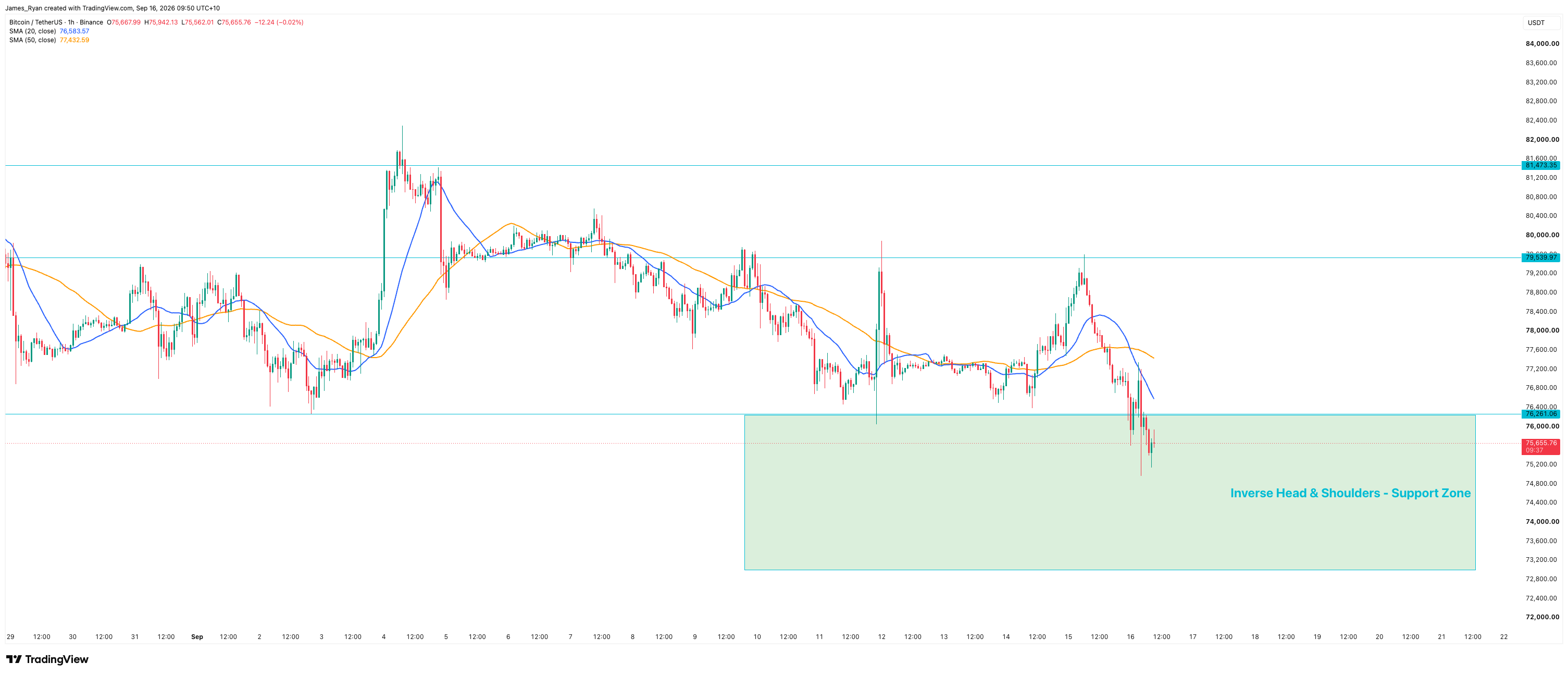
BTC/USD Key Levels and Price Action:
Source: https://www.tradingview.com/x/5Ih7OfBC/
Welcome to prime opportunity folks; after pulling back at the $80,000 resistance, we’re now setting up an extremely bullish market structure that will position Bitcoin exceptionally well in the coming months ahead as we lead into Q4 2026 and then into 2027 thereafter. BTC is now forming another Inverse Head & Shoulders, the exact pattern that saw us breakout of the $60K range. If we see this support zone hold between $76K - $73K, this will be the third and likely final accumulation before we go on to push up to the $100K sticker price for Bitcoin once again. Hindsight will look twenty-twenty for those still sidelines in cash waiting for a sweep of $50K again if this manifests. Patience is the key in these moments, and maybe more importantly - capitalising off these accumulation zones with additional allocations are necessary to maximise opportunity for when we get later into the cycle, leading into 2028-2029.
*All prices are denominated in USD unless stated otherwise*
Written by James Ryan
Disclaimer
This information is general in nature and does not take into account your personal objectives, financial situation, or needs. Before acting, you should consider whether this information is appropriate for your circumstances and seek independent advice if necessary.
Digital assets are volatile and carry significant risk. Past performance is not indicative of future results. You may lose some or all of your investment.