

The Second Oil Shock Playbook Is Back, and Hard Assets Wrote the Rules Last Time
· Macro Analysis · Stormrake
- BTC
- PAXG

Yemen’s Houthi rebels launched a wave of attacks on Saudi Arabia this week, wounding 73 people and igniting fires at oil facilities across the kingdom’s south, a sharp escalation layered on top of the ongoing US-Iran war that began in February. Houthi forces have also pushed toward the Bab al-Mandeb Strait, a critical Red Sea chokepoint, while the Strait of Hormuz, carrying roughly a fifth of the world’s oil, has seen tanker traffic collapse amid ongoing strikes. Brent crude has surged past $100 a barrel, up around 65% year to date, and the IEA has slashed its 2026 demand outlook by 2.5 million barrels a day, the sharpest cut since the pandemic. Goldman Sachs has warned Brent could clear $120 if Gulf output stays suppressed. This is not a brief flare-up. It is an ongoing, multi-front energy crisis with genuine supply chain consequences, and it deserves to be treated as one.
Why Bitcoin’s Reaction in February Matters Now
When the US-Iran war first broke out on 28 February, markets braced for Bitcoin to break down alongside the shock. It didn’t. Price had already begun stabilising off its early-February low near $59,930, and rather than printing a fresh low on the war’s outbreak, Bitcoin continued grinding higher into March. That’s a meaningful data point sitting quietly underneath all the noise. A genuine geopolitical shock to global energy supply, the kind that has historically sent risk assets reeling, didn’t force Bitcoin to a new low at the moment it hit. That resilience is worth remembering now that the same underlying conflict is escalating again.
The 1970s Playbook
History offers a genuinely useful lens here, and it centres on a detail many people miss: the 1970s didn’t have one oil shock, it had two. The 1973 Arab oil embargo quadrupled prices and triggered the first wave of runaway inflation. Policymakers spent years fighting it, made partial progress, and then the 1979 Iranian Revolution triggered a second oil shock, reigniting inflation just as the world thought the worst had passed. That second wave is the part of the story most relevant to today, a conflict-driven energy shock arriving on top of an economy that had only recently started making real progress against inflation.
The asset performance through that decade is instructive too. Broad equity markets struggled for years in real terms once inflation was stripped out, a genuine lost decade for paper assets. Gold, by contrast, ran from around $35 an ounce to over $800 by 1980, a generational repricing driven directly by the same stagflationary pressure. Hard, scarce assets didn’t just keep pace with inflation through that decade, they meaningfully outran it. And once the inflation was finally broken in the early 1980s, what followed was one of the largest, longest bull markets in financial history across nearly every asset class.
The Impact Today
Today’s setup rhymes with that second-shock dynamic closely enough to be taken seriously. Inflation had been cooling into 2025, and a fresh, conflict-driven energy shock arriving now, compounding an already fragile global bond market and rising sovereign yields covered in a recent note, carries real potential to reignite a second inflationary wave rather than a one-off spike. If that plays out anything like the 1970s did, the assets best positioned to benefit are the same category that outperformed last time: hard, scarce, supply-constrained stores of value that governments and central banks cannot simply create more of to paper over the pressure.
Gold is the obvious, well-worn beneficiary here, and it’s already behaving that way. But the stronger structural case sits with Bitcoin. Gold’s supply can still expand through mining, slowly, but it expands. Bitcoin’s issuance schedule is fixed and known in advance, hard-coded, and immune to any government or central bank response to an inflationary shock. Where gold took the better part of a decade to fully reprice through the 1970s, Bitcoin operates in a far more liquid, far faster-moving global market, with a fixed supply that makes it, if anything, a purer version of the same trade. A genuine second inflationary wave, arriving from the same category of shock, energy and conflict-driven, that defined the back half of the 1970s, is close to the ideal environment for the hardest, scarcest asset available to outperform every other category, gold included.
Two Central Banks, Two Shocks, One Answer
Rising yields, a weakening yen, and now a second energy shock layered on top of an already fragile inflation picture are not three unrelated stories. They describe the same underlying environment from different angles, one where paper claims on value are under genuine strain and scarce, hard assets have historically done the outperforming. Bitcoin held its ground when this exact conflict first erupted in February. If history’s second-shock pattern repeats even loosely, the asset best built to benefit isn’t the one that took a decade to reprice last time.
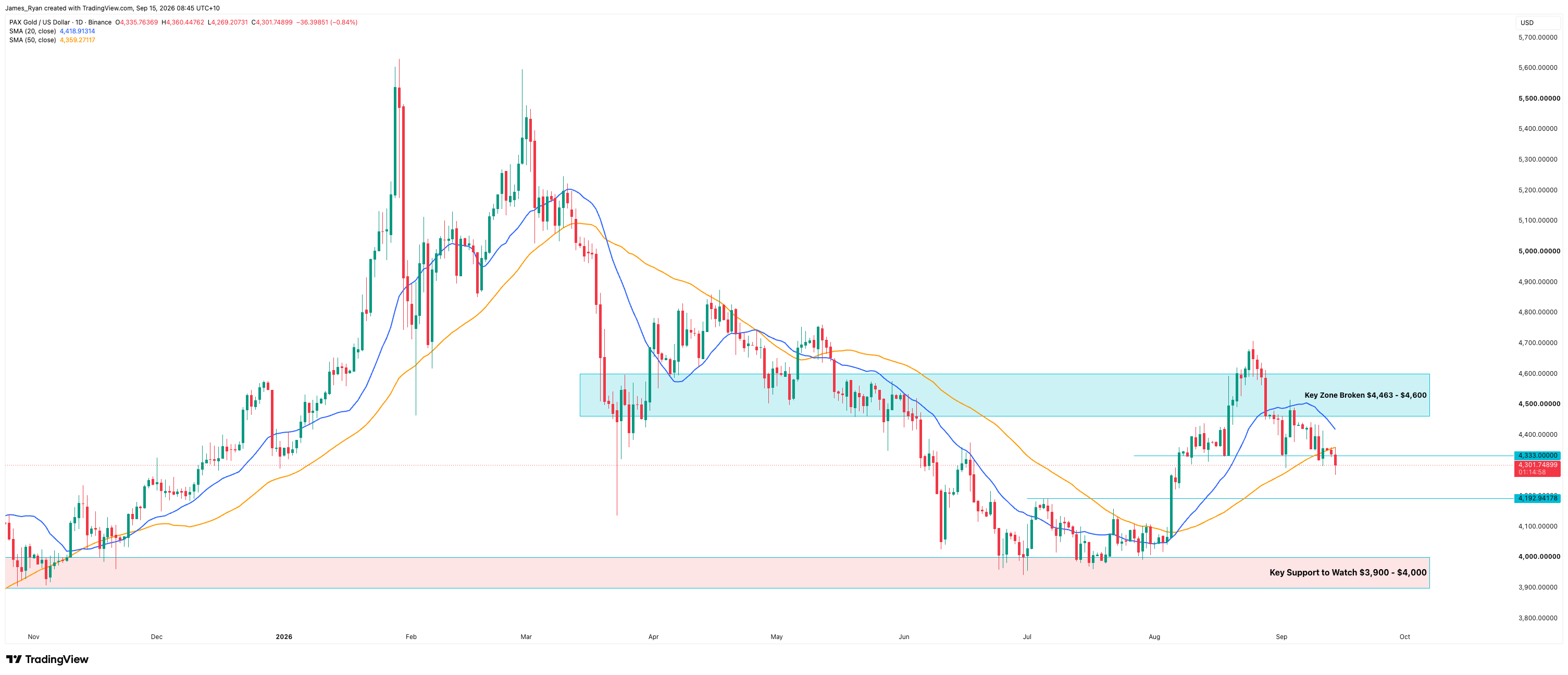
Stormrake Spotlight: Pax Gold (PAXG) ($4,301)
Source: https://www.tradingview.com/x/e7BToHp2/
PAXG continues to hover around the local support structure in the $4,300 pocket, however if momentum continues to slow here, a spill over into the $4,192 prior breakout would act as a clean retest for a higher low to begin forming. Any lower than this and smart money accumulators will be buying up the dip quickly, creating a larger but stronger accumulation structure.
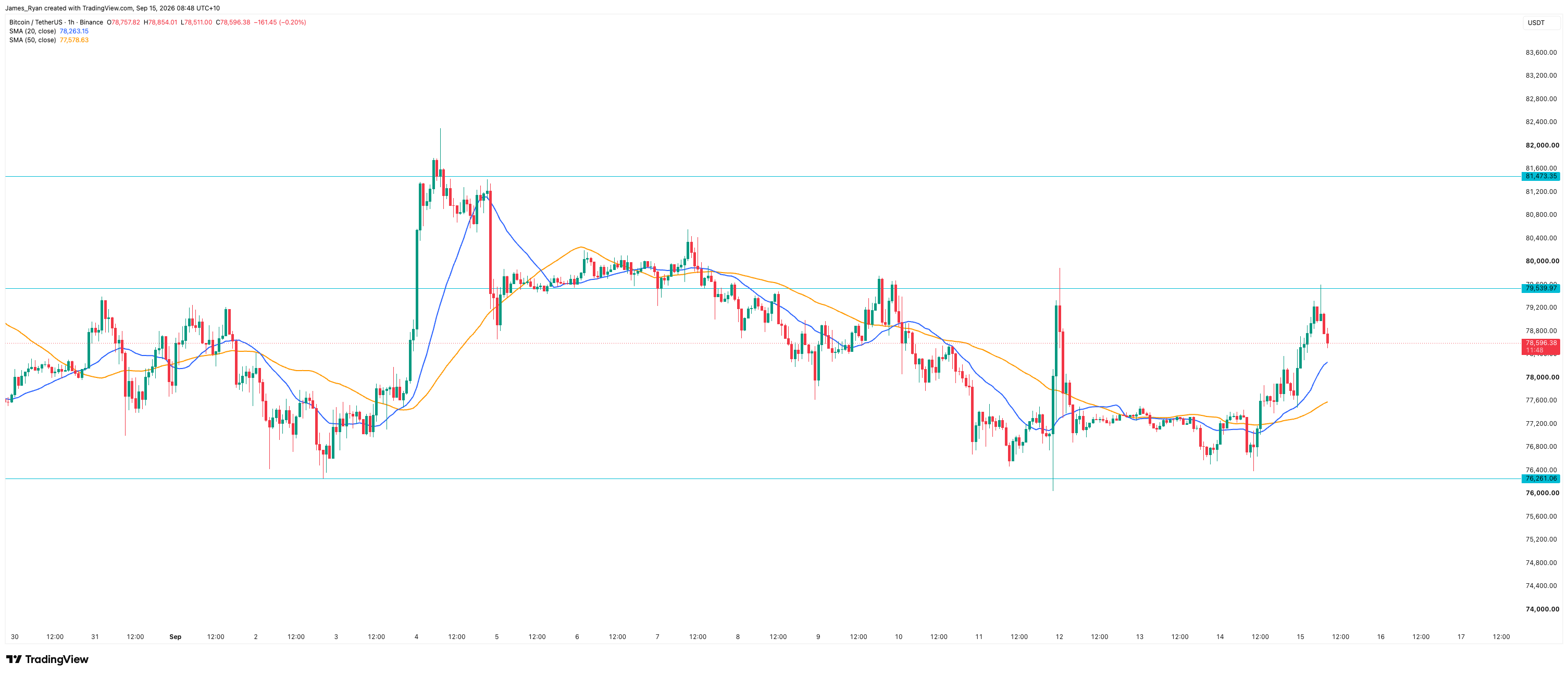
BTC/USD Key Levels and Price Action:
Source: https://www.tradingview.com/x/EugXNRvJ/
Bitcoin continues range bound between $79,500 and $76,000, with a quick push over the weekend from the low end of that range to the top, peaking at $79,600 early this morning. More chop is likely expected with significant macro-economic events taking place throughout the week, although a clean break of either the local support or resistance in this range would likely spell continuation in either direction once momentum picks up and confirms the next leg. Until then, the bulls and bears continue to fight it out a short-while longer.
*All prices are denominated in USD unless stated otherwise*
Written by James Ryan
Disclaimer
This information is general in nature and does not take into account your personal objectives, financial situation, or needs. Before acting, you should consider whether this information is appropriate for your circumstances and seek independent advice if necessary.
Digital assets are volatile and carry significant risk. Past performance is not indicative of future results. You may lose some or all of your investment.