

Rake Review October 2026: A Loud End to a Quiet Month
· Rake Review · Stormrake
- BTC
- ETH
- HYPE
- ZEC
- PAXG

Sometimes the most important thing a market does is nothing. For most of October, Bitcoin did exactly that. Hawkish dissents at the Fed, a trillion-dollar AI listing on the way and a US election days out barely moved it. Then, in the final days, Binance suffered the largest hack in crypto history. Bitcoin slid to a six-week low and closed the month down around 7%. A quiet month with a loud end, and a market sitting roughly 38% below its record high, a year on from the top.
A Year On From the Top
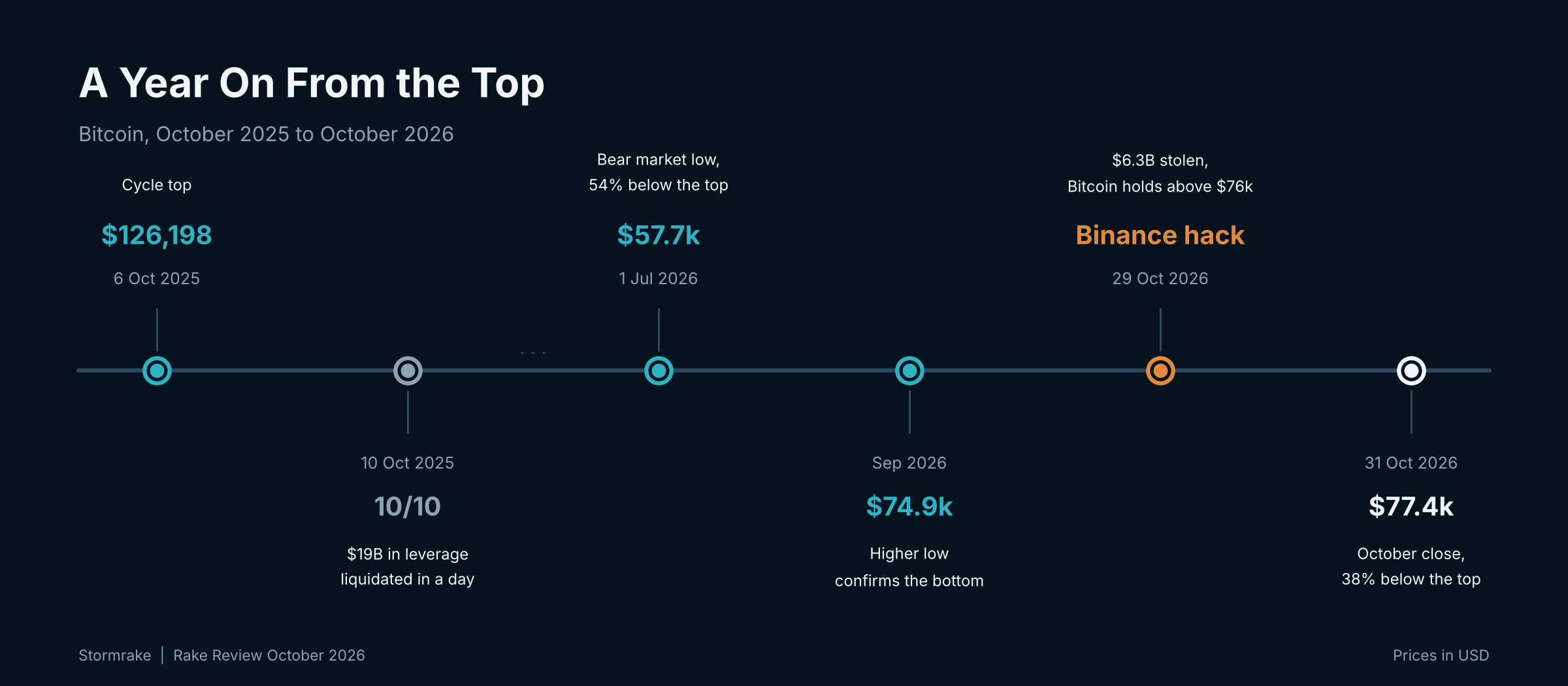
On 6 October 2025, Bitcoin touched $126,198.
Four days later, 10/10 happened. The largest liquidation event in crypto history wiped out around $19 billion in leverage in a single day. The market called it a reset.
It was the top.
The Date on the Calendar
What followed will be familiar to anyone who has been here before. Every bounce was sold. And as prices fell, investors reached for the one thing that had worked every time before: the calendar.
The pattern was hard to ignore. After the December 2017 top, Bitcoin bottomed almost exactly a year later. After the November 2021 top, the same again. Roughly twelve months from peak to trough.
So the market did the maths. Count forward from October 2025 and you land in October 2026. Analysts published the date. Traders set their alerts. Investors who had watched the last two cycles promised themselves they would not be caught out this time. They would wait for October, and they would buy the bottom.
It was a sensible plan. It had one flaw. Everyone had the same one.
July
The bottom did not wait for October.
On 1 July, Bitcoin fell to around $57,700. That was 54% below the high, and the lowest price in 21 months. The headlines said the cycle was broken. ETFs were bleeding. Fear was everywhere.
Here is the part that matters. Almost nobody believed it. By mid-July, price was already recovering. Even so, a poll of more than 20,000 people found 56% did not think the bottom was in. They had a date, and it was not July. Better to wait. Better to be sure.
Bitcoin did not wait with them.
From the July low to where it trades today, around $77,500, the gain is roughly 34%. That move went to the people willing to act when things felt worst. It did not go to the people waiting for the calendar to give them permission.
When Everyone Sees It Coming
The pattern itself was not wrong. The problem is that a pattern everyone can see rarely plays out on schedule. When enough people are waiting at the same door, the market tends to open a different one.
There is a second lesson too. This cycle’s drawdown was 54%. Previous bear markets took Bitcoin down roughly 77% and 86%. Anyone holding out for a repeat of the old washout was waiting on a template that may no longer fit a more mature market.
October, Again
Which brings us back to October. This was the month the bottom was supposed to arrive. It was also meant to be Uptober.
Instead, it stalled. Bitcoin spent most of the month drifting between $80,000 and $84,000. No breakout. Just quiet, until a record hack at Binance knocked it to a six-week low in the final days.
There is a familiar shape to that. In November 2022, the collapse of FTX sent Bitcoin to around $15,500. It felt like the end of crypto. It turned out to be the bottom of the cycle.
The Binance hack is not FTX. Binance stayed solvent, kept operating and is covering its customers’ losses. But it was exactly the kind of shock that, in a weaker market, drags prices to fresh lows. This time, the biggest exchange theft in history knocked Bitcoin around 4.5%, and left it well above July’s low and above its most recent higher low at $74,900.
There are still calls for $60,000 and below. We would be surprised to see it. Markets that shrug off their worst news are not still searching for a bottom. In our view, the bottom was set in July and confirmed in September. October only reinforced it.
For anyone who missed July, that matters. Bitcoin is still roughly 38% below its record high. The recovery from the low has been strong, but the market has not run away. The window many thought had closed over winter has not shut yet.
That is the uncomfortable thing about opportunity. It rarely feels like one at the time. In July, it felt like fear. In October, it felt like boredom, and then fear again.
And boredom, as history keeps showing, is where the real decisions get made.
When Nobody’s Watching
Ask anyone when they want to buy Bitcoin and the answer is usually the same: when it’s moving.
That’s when it’s in the news. That’s when friends are talking about it at the pub. That’s when the chart finally points up and to the right, and getting involved feels safe.
It is also, more often than not, when Bitcoin is at its most expensive.
Nobody Rings a Bell
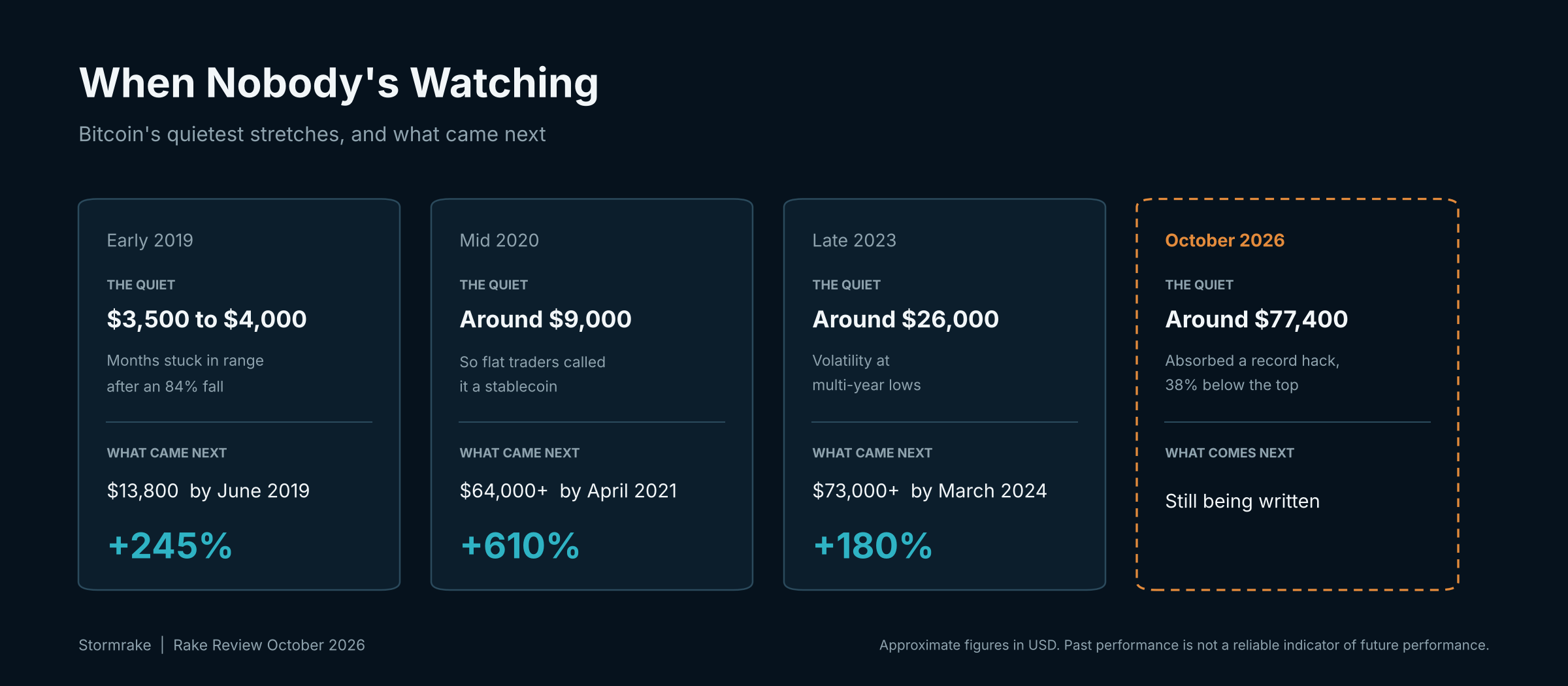
The strongest buying periods in Bitcoin’s history have one thing in common. Nobody noticed them at the time.
Early 2019. Bitcoin had just come off an 84% fall and spent months stuck between $3,500 and $4,000. No headlines. No excitement. Most people had stopped checking the price. By June, it was near $13,800.
Mid 2020. Bitcoin sat around $9,000 for weeks on end, so flat that traders joked it had become a stablecoin. By April 2021, it was above $64,000.
Late 2023. Bitcoin drifted around $26,000 through August and September, with volatility at multi-year lows. For a stretch, it moved less than the share market. Within six months, it had set a new all-time high above $73,000.
Each one felt like nothing at the time. Each one turned out to matter more than almost anything that followed.
Why Boring Works
The logic is simple. In a quiet market, the people still selling are mostly the ones who have given up. The people buying are the ones who don’t need excitement to act. Supply moves from impatient hands to patient ones.
Then something shifts. A macro surprise. A wave of inflows. A breakout. The chasers arrive, and they buy from the people who bought the boredom.
Chasing feels safer because it comes with confirmation. But confirmation has a cost, and it gets paid in the entry price.
Where That Leaves October
For most of the month, October was quiet. Bitcoin drifted slightly lower while attention sat elsewhere. Then Binance suffered the biggest exchange hack in history. Bitcoin dropped around 4.5% on the news, and closed the month down roughly 7%. The Uptober crowd went home disappointed.
But a market that absorbs a record hack and still sits roughly 38% below its record high is telling you something. It looks a lot more like the stretches that came before the big moves than the ones that came after them.
None of that means the next move is up, or that it’s close. Quiet periods can last longer than anyone expects, and history doesn’t repeat on command. What it does mean is that the groundwork is being laid now, quietly, by the people still paying attention.
So what did October deliver, and what could November bring?
October’s Shock Sets Up November’s Decision Point
October was quiet, until it wasn’t. Bitcoin spent most of the month consolidating, until the Binance hack triggered a late break below the range and had many calling for much lower prices. Uptober was not to be, with the month closing 7.2% down. But while the crowd calls for lower, we are entering what has historically been Bitcoin’s strongest month on average.
Since 2011, November has closed green in nine of fifteen years, with an average return of 36.6%. That figure is skewed by 2013, when Bitcoin returned roughly 454% in a single November. Remove that outlier and the record becomes eight green months from fourteen, with an average return of 6.79%. It is a big shift, taking November from the strongest month on average to the bottom four. Still, history points to a positive month.
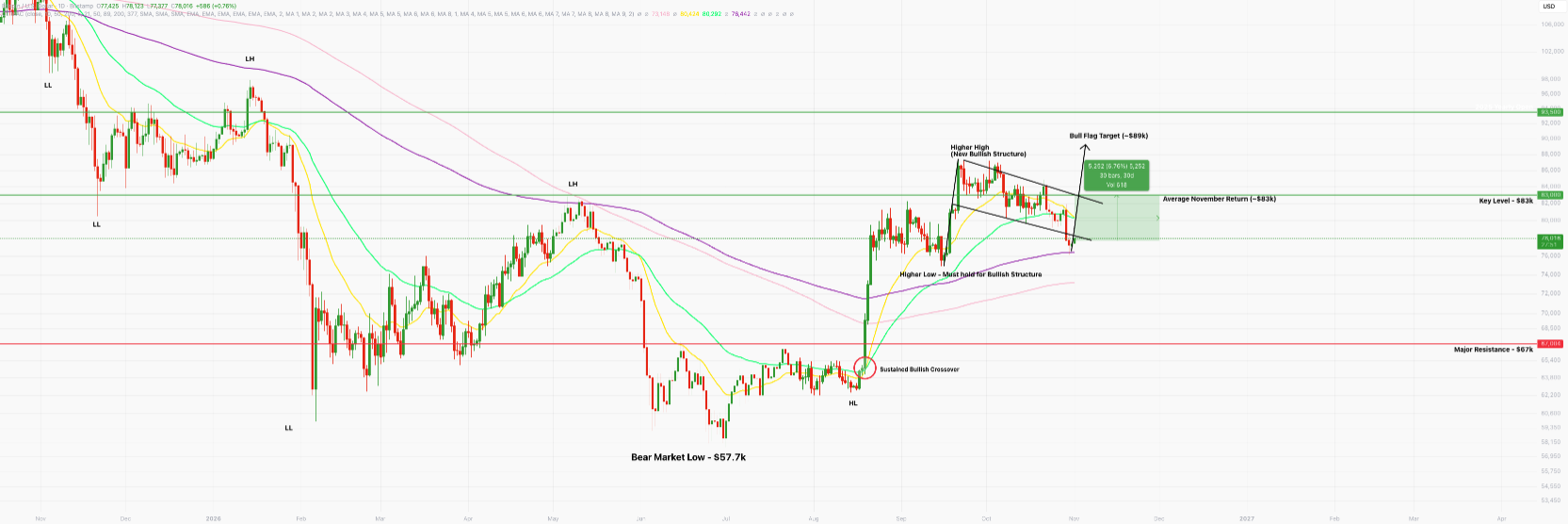
The chart above shows October’s pullback and consolidation. In the process, Bitcoin has formed a bull flag, a pattern that typically favours continuation higher. However, the late-month sell-off has pushed price just below the bottom of the flag channel, with support found at a longer-term moving average around $76.4k. The bulls need to reclaim the bottom of the flag as soon as possible. If the move below it is sustained, the pattern would be nullified and a retest of the higher low at $74.9k becomes likely. If the bulls do reclaim it and price breaks out above the top of the flag around $83k, which also lines up with November’s average return projection, Bitcoin could reach the bull flag target of approximately $89k, flipping green for the year along the way.
The bearish case is that bullish momentum is fading. The 21 EMA ($80.4k) and 50 EMA ($80.3k) have converged directly overhead, and a cross of the 21 below the 50 would confirm momentum has been lost. The bulls need to reclaim both to avoid that. The bears are targeting the current higher low at $74.9k. A break below it would create a new lower low, shifting the structure from bullish to neutral, with bearish momentum behind it. Notably, the Binance sell-off held above that level, keeping the higher low, and the bullish structure, intact for now.
Many are targeting that higher low and lower still. But as we have said countless times, Bitcoin has a funny way of doing the opposite of what the masses expect.
To summarise, for a strong November, the bulls need to reclaim the bottom of the flag quickly, then the 21 and 50 EMAs around $80.4k, before breaking out above the top of the flag at $83k and sustaining the move. The bears need to keep price below the flag, nullify the pattern and push for a lower low below $74.9k.
In The News:
Binance Hit by the Biggest Hack in Crypto History
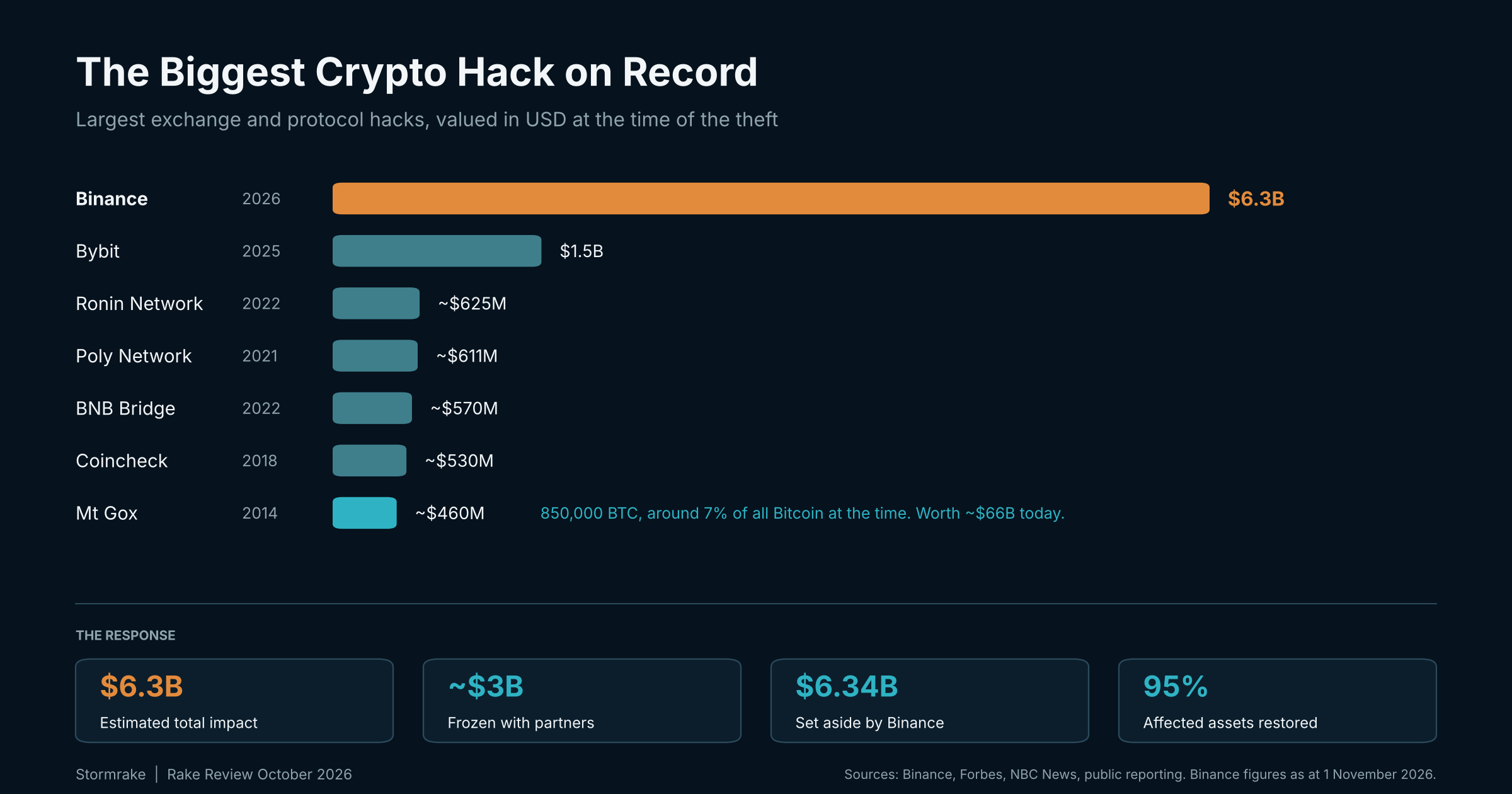
Late in the month, Binance, the world’s largest crypto exchange, confirmed it had been hacked, with an estimated impact of around $6.3 billion. That’s more than four times the previous record, the $1.5 billion stolen from Bybit in February 2025. Binance suspended withdrawals, said around $3 billion of the stolen assets had been frozen, and pledged to cover all user losses. Stablecoin issuers moved quickly, with Tether alone freezing more than $1.56 billion. Bitcoin fell around 4.5% to a six-week low of $76,368 before closing the month near $77,400. By 1 November, withdrawals were reopening in phases, and Binance said it had set aside more than $6.34 billion of its own funds to cover losses. For the largest exchange theft on record, that is a contained reaction. The market is betting Binance can absorb the loss and keep customers whole. Still, the hack is a reminder that assets held on any exchange carry the risk of that exchange. We covered the hack in detail in our special Morning Note, and clients with questions about how their assets are held can speak with their dedicated broker.
Fed Holds, But the Hawks Are Circling
The Federal Reserve held rates at 3.75% to 4.00% this month, its first pause since September’s hike. The decision was no surprise, but the vote was. Two members, Governor Lisa Cook and Cleveland Fed President Beth Hammack, dissented in favour of another 0.25% increase. The Fed also upgraded its view of the economy from “solid” to “strong”, while noting inflation remains elevated, with annual CPI running at 3.7% in September. Translation: this was a pause, not a pivot. A December hike is still on the table. For digital assets, that means liquidity is unlikely to loosen any time soon, and risk assets will need to find their footing without help from the Fed. The upside is that a hold was fully priced in, so markets avoided a shock.
Anthropic Goes Public
Anthropic, the company behind the Claude AI models, has filed to list on the Nasdaq under the ticker “ANT”. Its prospectus shows first-half revenue of around $16.3 billion, up from roughly $1.1 billion a year earlier. It also showed a first-half loss of $80.7 billion, largely on paper. Trading could begin as soon as mid-November, at a reported valuation of up to $2 trillion, with expectations it could rival SpaceX’s June listing as one of the largest IPOs in history. For digital assets, the deal is a test of investor confidence. A strong debut would signal investors are still hungry for growth and willing to back big, unproven bets. A weak one could cool sentiment across tech and digital assets alike. Either way, a raise of this size draws heavily on the same pool of capital crypto competes for.
US Midterms: Crypto Votes Too
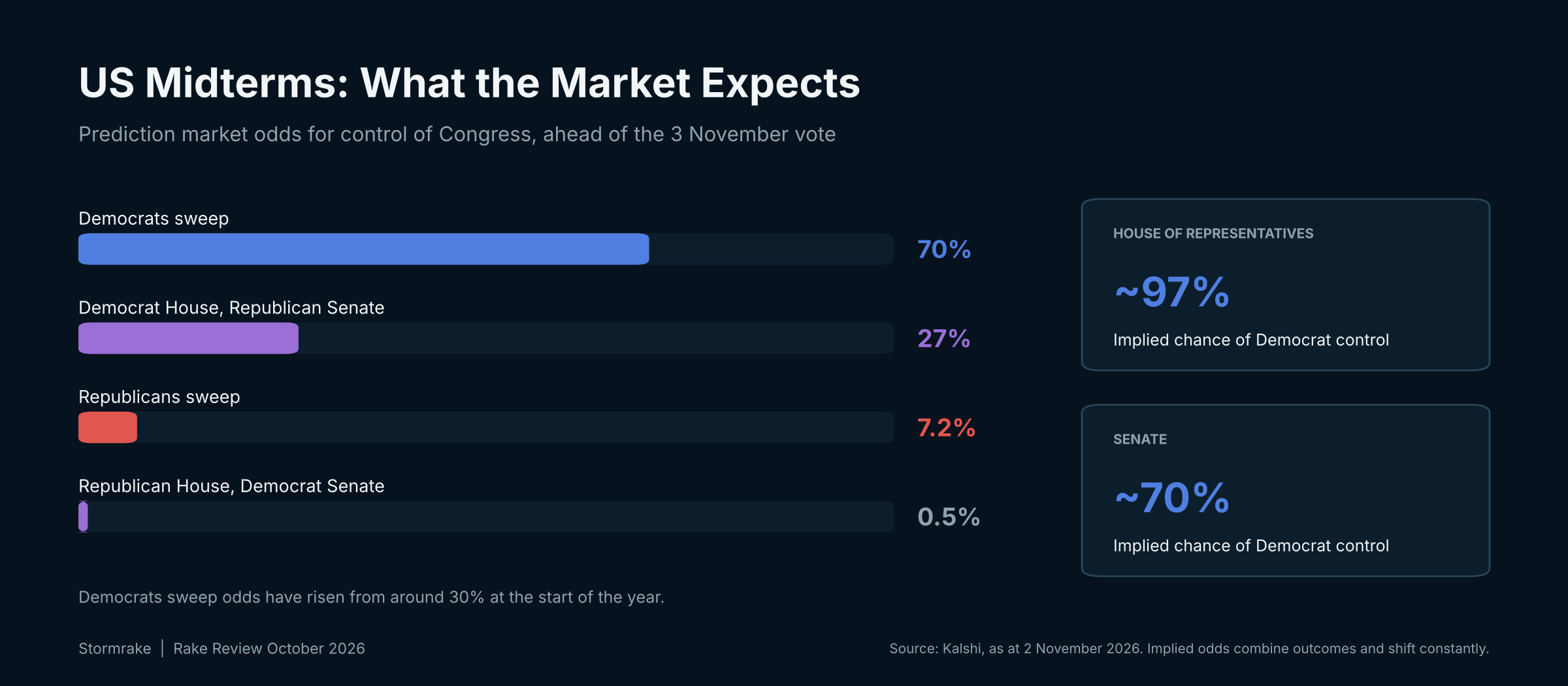
Americans head to the polls on 3 November, with all 435 House seats and 35 Senate seats up for grabs. Republicans currently control both chambers. Prediction markets are pricing roughly a 97% chance Democrats take the House, while the Senate is far closer: markets lean Democrat, but forecasters still see a path for either party. For digital assets, the stakes are real. The CLARITY Act, the industry’s key market structure bill, fell one vote short in the Senate in September, 49 to 50. Whoever controls Congress next year will decide whether it gets another shot. That is why crypto money is flowing into these races. The industry-backed Fairshake PAC is backing 32 House candidates across both parties, 19 Republicans and 13 Democrats, all of whom voted for the bill. That bipartisan split matters: crypto has become an issue that cuts across party lines rather than belonging to one side. In the short term, markets dislike uncertainty, and a split Congress could mean slower progress on regulation. Longer term, what matters for crypto is less which party wins and more whether the pro-crypto bloc in Congress grows or shrinks.
Market Update:
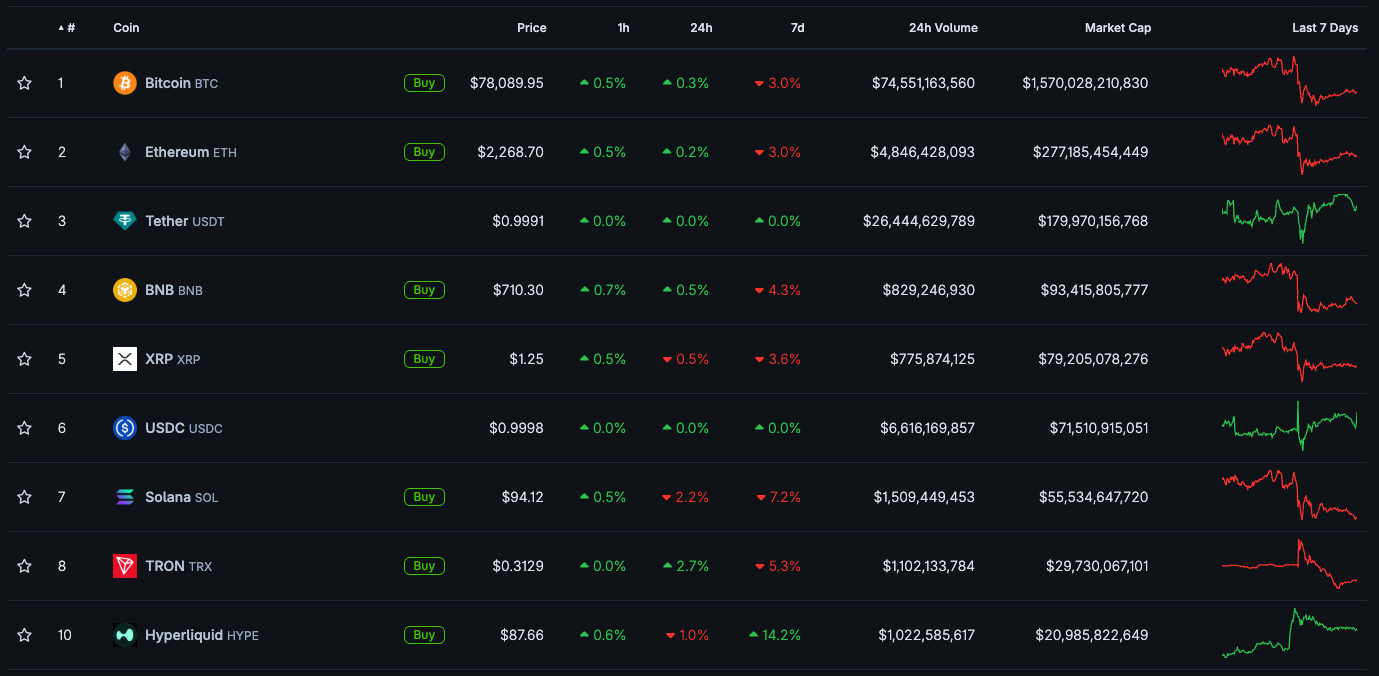
Here is the fast five of what you need to know about the market in October 2026:
-
Bitcoin decreased by 7.2% in October.
-
Ethereum decreased by 16.1% in October.
-
Hyperliquid replaces Zcash in the top 10.
-
PAXG fell by 6.6% in October.
-
The total crypto market cap decreased by 11.6% in October.
Video of the Month:

My Bank Blocked My Crypto Transfer. Who Controls My Money?
Money Markets & Mayhem | Mark Di Paola
Education: Why Nobody Can Make More Bitcoin
In October, a San Francisco start-up called Marathon Fusion claimed it had turned mercury into gold. The claim is unverified, the gold would be radioactive, and it is years away from any market. But it raises a question worth asking: what makes something scarce?
Two Kinds of Scarce
Gold is scarce because it is hard to find and expensive to dig up. Its scarcity is physical. That scarcity has worked for thousands of years. But physical scarcity has a weakness: it can, in theory, be engineered around.
Diamonds are the cautionary tale. Lab-grown stones are chemically identical to mined ones, and wholesale prices for them have fallen 90% to 95% since 2015. The diamond was always rare. Until it wasn’t.
Bitcoin’s scarcity is different. It is written into code. There will only ever be 21 million, and new coins are released on a fixed schedule that halves roughly every four years. No reactor, lab or mining breakthrough can change that.
Measuring Scarcity: Stock-to-Flow
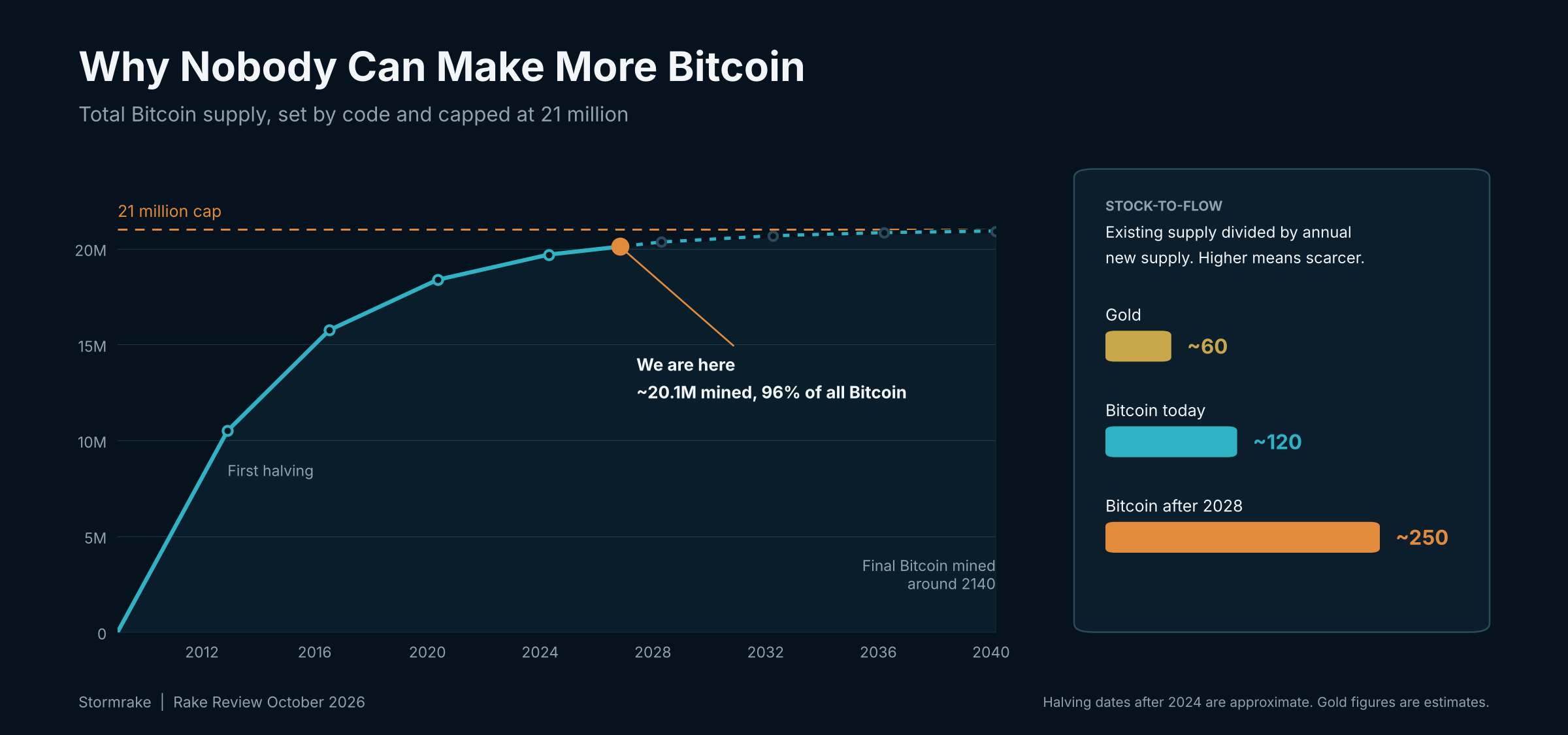
One way to measure scarcity is stock-to-flow. It compares how much of an asset already exists (the stock) with how much is produced each year (the flow). The higher the number, the harder the asset is to dilute.
Gold. Around 222,600 tonnes exist above ground, and roughly 3,600 tonnes are mined each year. That gives a stock-to-flow of about 60. In other words, it would take around 60 years of mining to double the world’s gold supply.
Bitcoin. Just over 20.1 million coins exist today, around 96% of all that will ever exist. Since the 2024 halving, around 164,000 new coins are issued each year. That gives a stock-to-flow of roughly 120, about double gold’s. After the next halving, expected in 2028, it roughly doubles again.
Supply That Doesn’t Respond
There is one more difference, and it may be the most important.
When the gold price rises, miners dig harder, old mines reopen and supply increases. Higher prices invite more supply.
Bitcoin doesn’t work that way. When the price rises and more miners join the network, Bitcoin automatically makes mining harder through what is called the difficulty adjustment. New coins keep arriving on schedule, no faster. However much demand there is, supply does not budge.
Scarcity Is Not the Whole Story
Scarcity alone does not create value. Plenty of things are rare and worth nothing. Value needs demand, and demand rises and falls. Price models built purely on stock-to-flow made bold predictions last cycle that did not play out.
What scarcity does is set the terms. If demand for Bitcoin grows, supply cannot rise to meet it.
A lab may one day make gold. Nobody will ever make more Bitcoin.
*All prices are denominated in USD unless stated otherwise*
Written by Alexandar Artis
Disclaimer
This information is general in nature and does not take into account your personal objectives, financial situation, or needs. Before acting, you should consider whether this information is appropriate for your circumstances and seek independent advice if necessary.
Digital assets are volatile and carry significant risk. Past performance is not indicative of future results. You may lose some or all of your investment.