
Discipline in Drawdowns and Market Structure Shifts

03 Feb 2026 01:31 PM By Stormrake

To receive the Morning Note in your inbox, subscribe here: https://stormrake.substack.com/
“Buying the dip” is one of the most cited ideas in investing, yet also one of the most poorly executed. The principle is sound. Accumulating high conviction assets during periods of weakness has historically built long term wealth. The problem is not the concept. It is the absence of structure.

Investors saw this clearly in 2022. Bitcoin declined from $69,000 to $15,000 over roughly twelve months. Every leg lower was labelled a buying opportunity. Many investors deployed capital too early and too aggressively, leaving no dry powder when valuations became genuinely distressed. The idea was correct. The sequencing and capital management were not.

We are seeing similar behavioural patterns today. Bitcoin is currently down approximately 39% from its peak. The path lower has been incremental rather than singular, which is typical of corrective structures. Without a staged allocation plan, investors risk becoming fully committed early in the drawdown cycle, removing flexibility if volatility persists.

On-chain data reinforces this point. A large proportion of short term holders are currently realising losses. This is not a fundamental signal. It is a behavioural one. Investors without predefined accumulation frameworks tend to capitulate at precisely the wrong time.

Clients working within structured allocation plans have approached this period differently. Capital has been deployed progressively, not emotionally. This is the distinction between reacting to price and executing a strategy.

Drawdowns are uncomfortable, but they are also the mechanism through which long term positions are built. Investors who accumulated Bitcoin between $40,000 and $50,000 in the prior cycle experienced a decline to $15,000. Today, even after a material pullback from recent highs, those positions remain substantially in profit. Volatility does not negate the thesis. It tests conviction and discipline.

The greater risk for many investors is not further downside. It is waiting for perfect confirmation, missing inflection points, and re-entering at structurally higher levels.

Macro Crosscurrents and Precious Metals Volatility

The last several sessions have delivered significant moves across asset classes. Precious metals, which had been trending strongly, have experienced sharp reversals. Silver in particular saw extreme short term volatility, with forced deleveraging evident across leveraged positions. Gold has also corrected meaningfully from recent highs.
These moves do not invalidate the role of precious metals. We remain constructive on gold and silver as long term hedges against currency debasement and systemic instability. Their role as monetary assets has endured for centuries.

However, the recent price action highlights structural characteristics that investors must understand:

1. Liquidity and execution are not uniform

Physical bullion markets do not operate with continuous price discovery and instant settlement in the way digitally native markets do. In periods of stress, spreads widen, dealer capacity becomes constrained, and transaction timelines extend. Investors relying on rapid execution may find the practical process slower than expected.

2. Paper price discovery vs physical settlement

Precious metals pricing is largely discovered in derivative and futures markets, while a large portion of investors hold physical product. This creates a structural disconnect between price formation and settlement mechanics during volatile periods.

3. Parabolic advances carry reversal risk

When any asset appreciates rapidly over a short timeframe, positioning becomes crowded and leverage increases. Corrections in such environments tend to be sharp. This is not a criticism of the asset class. It is a function of market structure.
None of this suggests metals cannot stabilise or recover. Markets rarely move in straight lines. The point is risk management. Investors entering after extended rallies face a different risk profile than those accumulating over long cycles.

Relative Structure: Bitcoin in the Current Cycle

While metals have been correcting from strength, Bitcoin is in a different phase of its cycle. A meaningful portion of speculative excess was already cleared during earlier drawdowns. From a positioning perspective, this shifts the risk-reward profile.

Bitcoin’s market structure offers characteristics that differ from physical commodities:

  • Continuous global trading

  • Instant settlement and transferability

  • Deepening institutional liquidity

  • Increasing integration into portfolio allocation frameworks

These features do not eliminate volatility. They change how liquidity and execution behave under stress.

The current environment is therefore less about asset tribalism and more about structure and timing. Precious metals continue to serve a role as monetary hedges. Bitcoin increasingly functions as a digitally native counterpart with different settlement and liquidity mechanics.

For disciplined investors, the opportunity lies in allocation, not ideology. Assets move in cycles. Capital should be managed accordingly.

Key Takeaways

  • Corrections reward structure, not impulse

  • Precious metals remain valid hedges but exhibit execution and market structure limitations during stress

  • Parabolic moves increase reversal risk across all asset classes

  • Bitcoin is correcting from prior excess rather than from recent euphoria

  • Staged capital deployment remains the most rational approach

Markets are not about being early or late. They are about managing probability and preserving optionality. Invest accordingly.

Stormrake Spotlight: Pax Gold (PAXG) ($4,819)
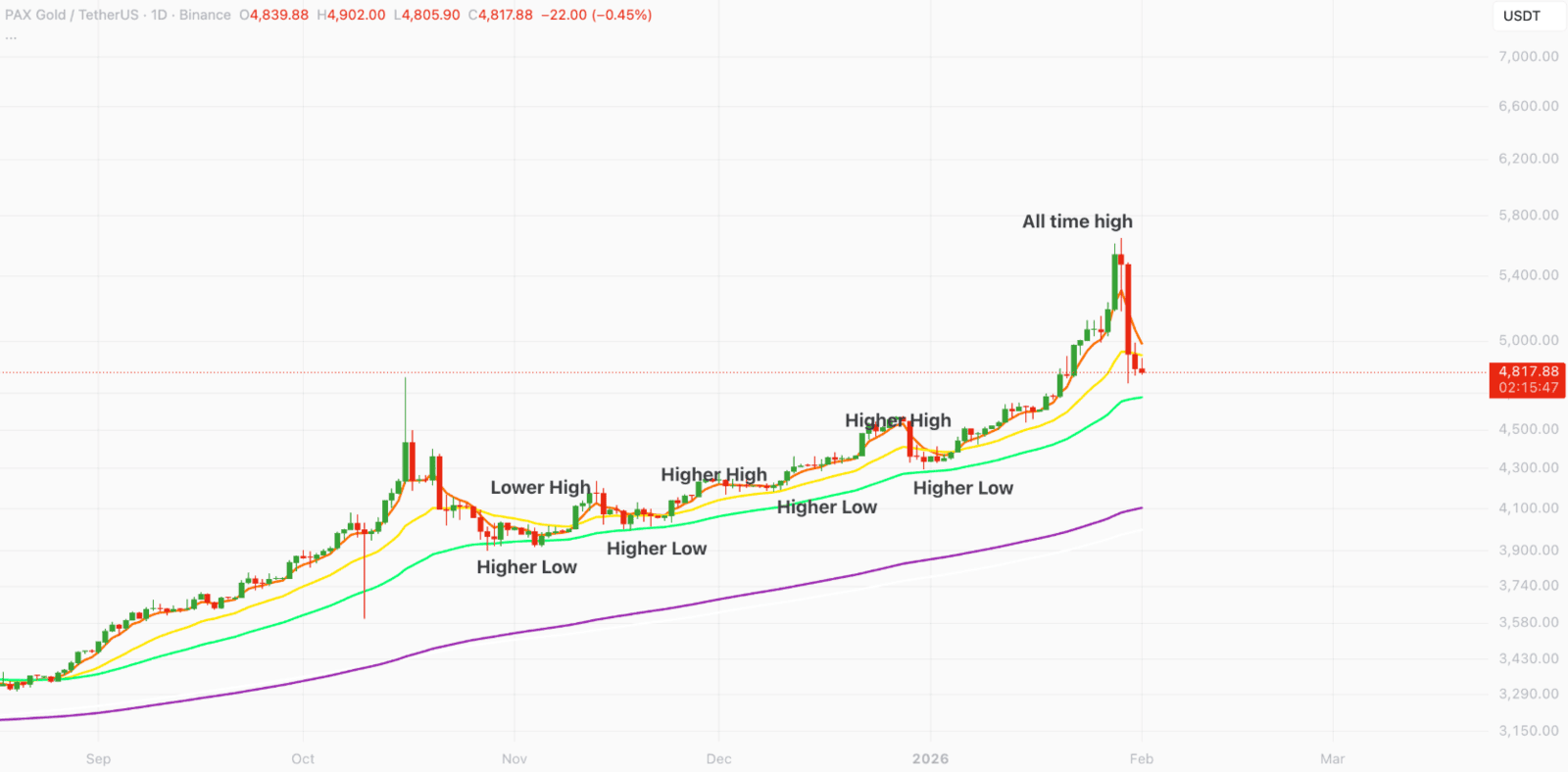
PAXG had a difficult end to the week, falling roughly 10%, alongside silver’s sharp drawdown of nearly 30% in a single day. Despite the severity of the retracement, PAXG has simply returned to price levels last seen on 22 January and remains green on the year. Today’s market open is expected to be volatile, making risk management and vigilance essential.

BTC/USD Key Levels and Price Action:

With traditional markets closed over the weekend, Bitcoin became the primary asset absorbing liquidation pressure. Over the weekend, BTC fell nearly 9%, with selling pressure intensifying amid heightened uncertainty and volatility across markets. Now trading firmly below November’s low, attention shifts to the 2025 low at $74.5k. This region contains significant historical support and is likely to act as the next key battleground, with the potential to form the base of a new consolidation range.

BTC Total ETF Flows for 1 Feb: (data not available at the time of writing)

(ETF flow data is sourced from https://farside.co.uk/btc/ and reflects figures at the time of writing.)
To receive the Morning Note in your inbox, subscribe here: https://stormrake.substack.com/

*All prices are denominated in USD unless stated otherwise*

Written by Alexandar Artis and James Ryan

Create a brokerage account today

No Advice Warning 

The information in this newsletter is general only. It should not be taken as constituting professional advice from the author - Stormrake PTY LTD.
Stormrake is not a financial adviser and does not provide financial product advice. You should consider seeking independent legal, financial, taxation or other advice to check how the information relates to your unique circumstances. Stormrake is not liable for any loss caused, whether due to negligence or otherwise arising from the use of, or reliance on, the information provided directly or indirectly, by this newsletter.
 

Disclaimer 

All statements made in this newsletter are made in good faith and we believe they are accurate and reliable. Stormrake does not give any warranty as to the accuracy, reliability or completeness of information that is contained here, except insofar as any liability under statute cannot be excluded. Stormrake, its directors, employees and their representatives do not accept any liability for any error or omission in this newsletter or for any resulting loss or damage suffered by the recipient or any other person. Unless otherwise specified, copyright of information provided in this newsletter is owned by Stormrake. You may not alter or modify this information in any way, including the removal of this copyright notice.

Copyright © 2024 Stormrake Pty Ltd, All rights reserved

Stormrake