To receive the Morning Note in your inbox, subscribe here: https://stormrake.substack.com/

In mid July we wrote about Albanese calling superannuation a “national asset” at the AFR Superannuation Lending Roundtable, and urging fund executives to put more member money to work in Australia. We closed that note by making the case for Bitcoin as unencumbered, sovereign property. Centralised pools of capital are vulnerable to policy change and state ambition in a way that self custodied property is not, and we argued that mattered.
Six weeks on, the same framing has appeared in three more places. The case has not weakened.
The UK, Japan And Europe Are On The Same Path
Britain is furthest along, and the only one of the four past rhetoric. Seventeen pension providers agreed to put 10% of their defined contribution default funds into private markets by 2030, half of that into UK assets. Behind that voluntary accord sits the Pension Schemes Bill, which lets ministers mandate the allocations if the targets are missed. Reeves fought the Lords for that power and won it in April, then said she doubts she will ever need it. Possibly true. Also beside the point. It now exists in law rather than in a speech.
Japan and Europe are still at the encouragement stage. On 17 July, Takaichi told parliament the government would pursue measures encouraging households and GPIF, the largest pension fund on earth at roughly US$1.81 trillion, to lift allocations to Japanese assets. The yen firmed on the remarks alone. Europe’s Savings and Investments Union targets the trillions sitting idle in European bank deposits.
Why It Is Happening?
Same driver everywhere. Heavy debt, ageing populations, and long lists of things governments want built. The constant underneath is fiat currency, and every one of these governments runs on a unit that has lost value steadily for decades. That is what makes the arithmetic bite. Spending obligations keep growing, the currency funding them keeps weakening, and the cheapest capital left is the money savers have already been compelled to set aside. Australia’s pool is around $4.3 trillion, funded by a compulsory 12% of every wage.
Nobody confiscates anything. You set a target, and legislate a backstop in case it is missed.
Being Precise About The Concern
Nobody is taking anyone’s super. Australian funds remain bound by the sole purpose test and trustee duties. No mandate has been announced, and the industry pushed back on the national asset framing within days. Governments have long used incentives rather than instruction, packaging toll roads and similar assets to attract funds. That is defensible.
The concern is narrower. The distance between “we encourage” and “we require” is shorter than it looks, and Britain has just shown how it gets closed.
The Concentration Problem
For most Australians, the wage, the mortgage and the super balance are all leveraged to the same economy. A domestic allocation target does not diversify that. It concentrates it further, at the exact point in the balance sheet where the individual has the least say.
This is what we meant in July by institutional capital being vulnerable in ways sovereign property is not. Bitcoin carries no trustee, no allocation committee and no default setting that can be adjusted when a treasurer needs capital. Its supply schedule does not respond to fiscal pressure. It is one of the few holdings genuinely uncorrelated to a balance sheet already stacked on one country.
Where Self Custody Fits, And Where It Does Not
Be honest about the limits, because plenty of people are not. Self custody does not exit you from the superannuation system. The 12% is compulsory. And if you hold Bitcoin inside an SMSF, reporting is entirely the trustee’s responsibility. The fund lodges its own annual return and arranges its own independent audit each year, crypto included. None of this is invisible.
What direct ownership removes is the intermediary whose mandate can be rewritten. Bitcoin requires no permission and carries no counterparty liability, so there is nothing in the structure for a policy target to act on. That is a property of the asset rather than a legal shield, and it works on the wealth you hold outside the system far more than the wealth already inside it.
Which is the point. Four governments have signalled within a year that they view these pools as instruments of national policy. The question worth asking is what proportion of your wealth you actually direct, and which way that number is heading.
To discuss direct spot property ownership, contact your Stormrake broker.
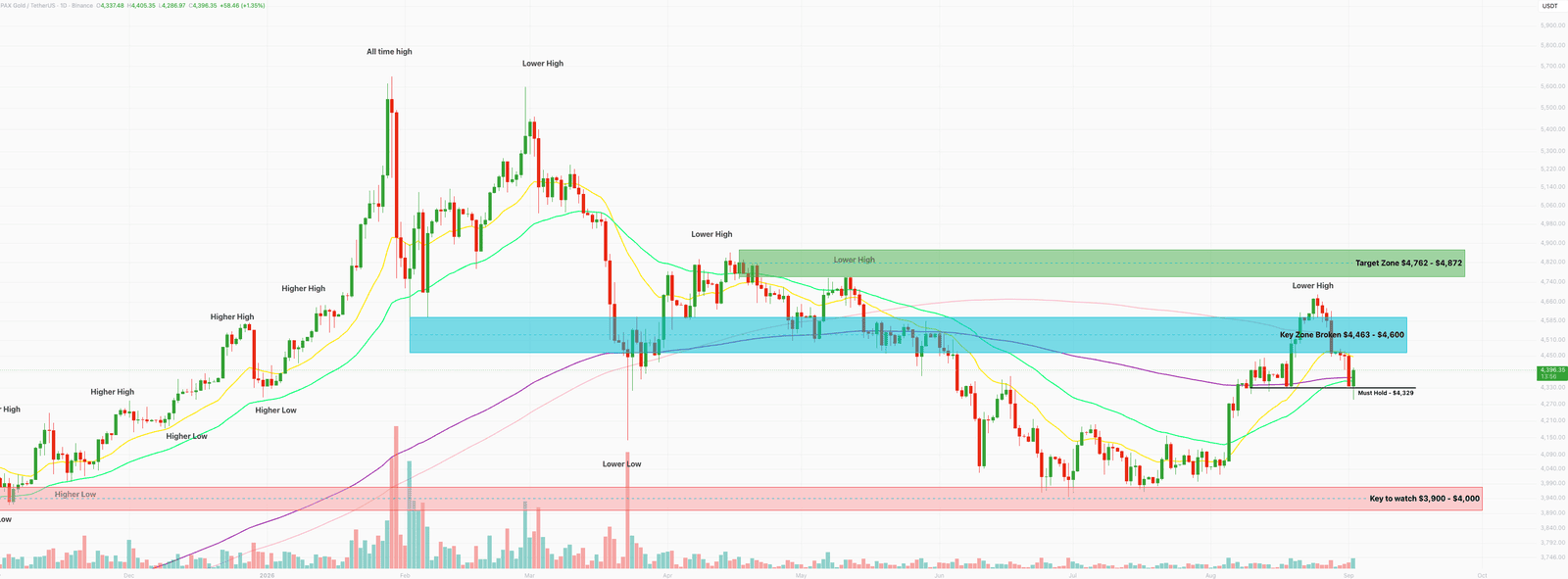
Stormrake Spotlight: Pax Gold (PAXG) ($4,396)
Stormrake Spotlight: Pax Gold (PAXG) ($4,396)