To receive the Morning Note in your inbox, subscribe here: https://stormrake.substack.com/

If you have been within the investment space or finance over the last few days to weeks, you may be familiar with the name Leopold Aschenbrenner. A 24 year old former OpenAI researcher took the investment world by storm after writing a 165 page essay titled “SITUATIONAL AWARENESS: The Decade Ahead,” and named his hedge fund after it. Since launching in July 2024, the fund posted gains of over 1,000%, at one point managing as much as $45 billion in assets. Then, within the space of a few weeks, it was worth $10 billion.
The assets that took him to the top were the same assets that took him down. Aschenbrenner’s fund was concentrated in AI infrastructure names, chip makers and data centre plays like SK Hynix, CoreWeave, Nebius Group, Sandisk and Micron. When the AI trade was running, those positions were printing. But the fund had also layered in leverage of up to 400% on these positions, meaning every dollar of capital was controlling four dollars of exposure. When the AI rally stalled and volatility returned, the same leverage that turbocharged the gains turbocharged the losses. Bearish bets on software names like Adobe went the wrong way at the same time, compounding the damage. It was safe to say he was early to the AI rally. But being early and being right on direction means nothing if the structure underneath you cannot survive a drawdown.
As the saying goes: when the tide goes out, it exposes who has been swimming naked.
It is also worth noting Aschenbrenner’s background before he ever ran a fund. Before Situational Awareness, he worked with Sam Bankman-Fried at FTX, helping run the FTX Future Fund, a charity operated out of a Bahamas penthouse. FTX, of course, was one of the largest leverage and risk management blowups of the previous bear market.
We have seen this story before, and not just in AI stocks. Think back to October 2025, when the crypto market saw close to $20 billion USD of leveraged positions wiped out in a single day. At the time, it was treated as the most violent deleveraging events in the asset class’s history, a headline that dominated crypto media for weeks. Compare that to Aschenbrenner’s fund alone shedding roughly $35 billion, more than the entire crypto market’s worst day, in a matter of days, and it barely registered outside of financial media as a footnote to the broader AI stock correction. The pattern is identical: capital piles into a winning thesis, leverage gets added to amplify the returns, and the position becomes a forced seller the moment the market turns. The difference is scale. What was a seismic, market-defining event for crypto was, for traditional finance, a single fund’s bad month. That gap is the point. Crypto is still a fraction of the size of the market it is set to disrupt, and there is a long runway of growth still ahead of it.
It shows you that even those considered to be at the top of the game eventually lose to leverage. It is a tale as old as time, and one we have seen again and again, from Long-Term Capital Management to Archegos to now Situational Awareness.
That is why at Stormrake we advocate for spot holdings of Bitcoin. Leverage is a major danger and does not help preserve wealth. If anything, it adds danger to the very thing you are trying to protect.
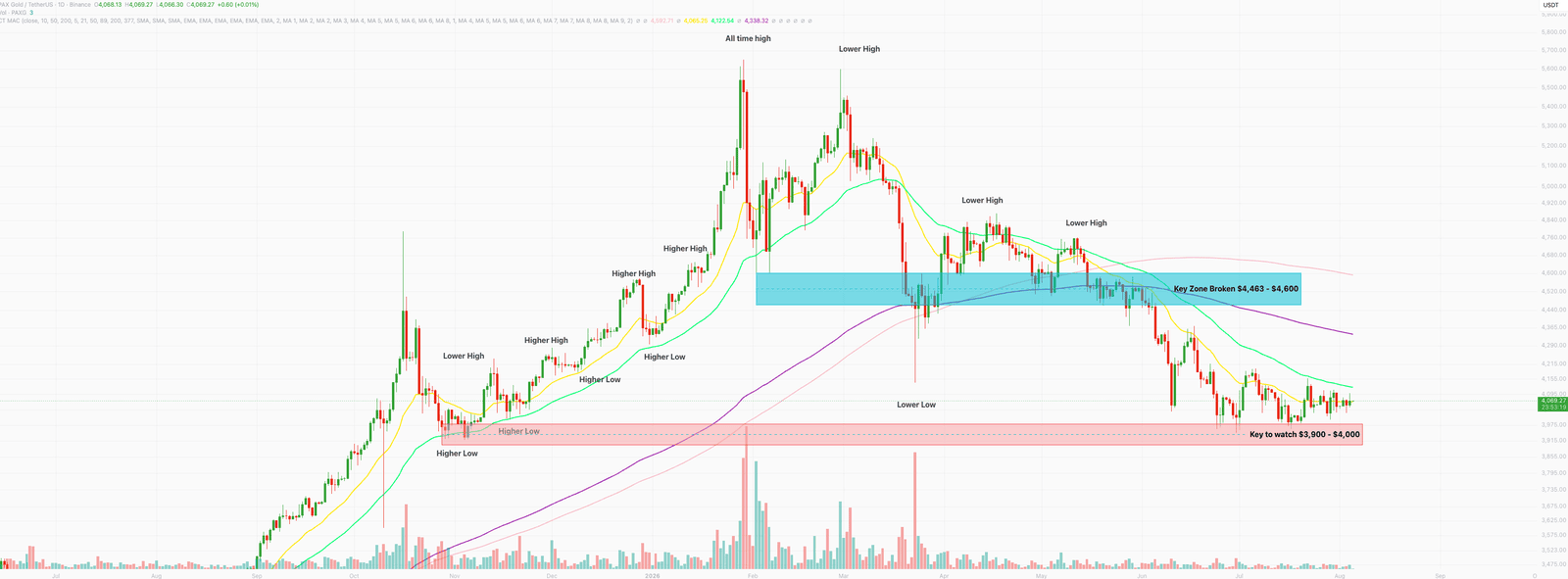
Stormrake Spotlight: Pax Gold (PAXG) ($4,069)
Stormrake Spotlight: Pax Gold (PAXG) ($4,069)