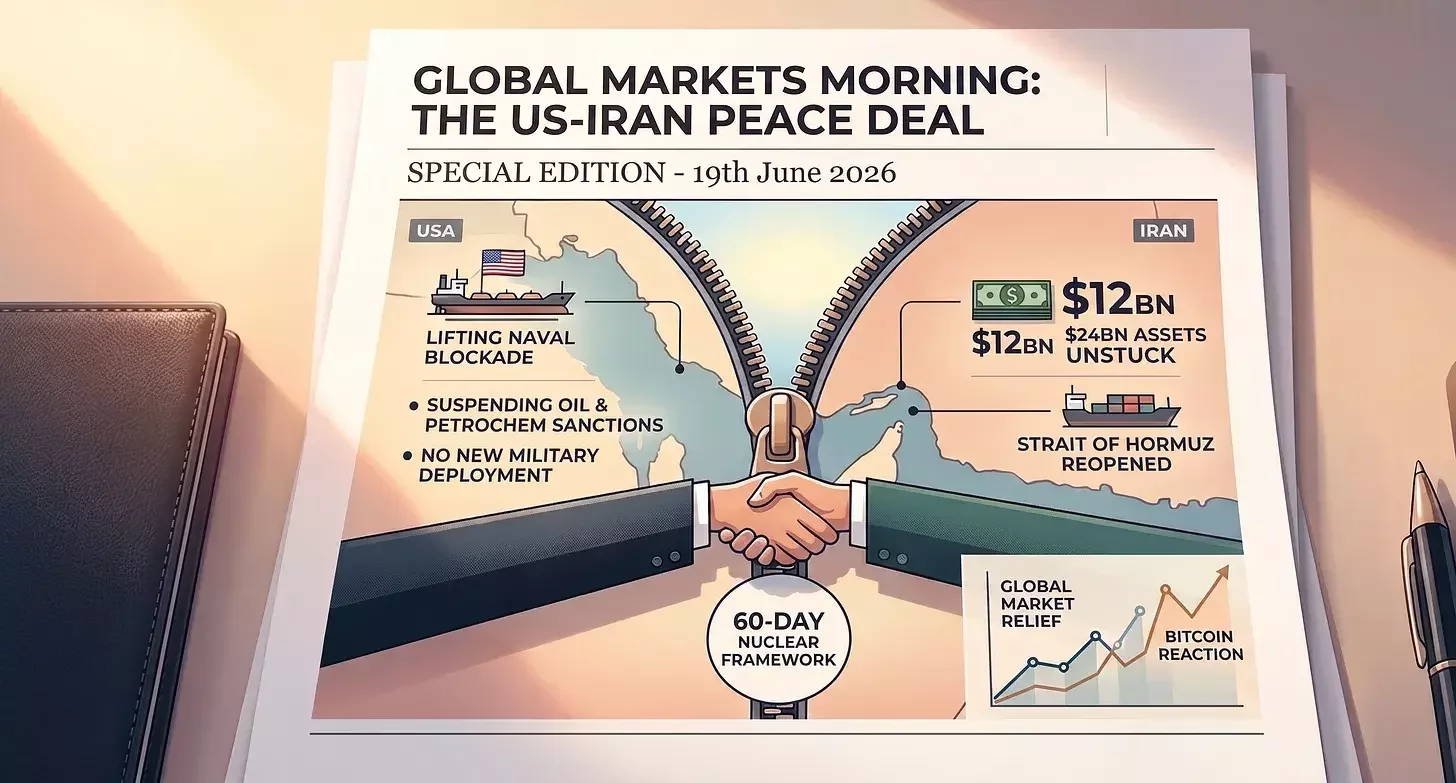
The public announcement of a Memorandum of Understanding (MOU) between the United States and Iran has shifted the macro landscape for June 2026. Following months of energy market instability sparked by the closure of the Strait of Hormuz, mediated negotiations have successfully brokered a formal peace framework, with a public signing ceremony scheduled for today - Friday, 19th of June, in Geneva.
The immediate market reaction has provided a textbook study in investor behaviour. Upon the news, Bitcoin climbed from sub $64,000 to a two week high just above $67,000 with trading volumes running at 1.6x the 30-day average. In traditional sectors, Brent crude slid toward $83 a barrel as traders actively removed the geopolitical risk premium baked in since late February.
Inside the Peace Deal Proposition
While the full text remains tightly held ahead of the Geneva assembly, the core proposed terms of the agreement establish an entirely new operating model for the region:
Strait of Hormuz Reopening: Trump authorised the toll free opening of the strait immediately upon announcing the accord. Iran has formally committed to safe international shipping passage, though state officials have indicated the regime will introduce special service fees rather than standard pre war tolls.
Cessation of Military Operations: Both nations have agreed to a permanent halt to offensive operations. While Israel is not a formal party to the text, Prime Minister Netanyahu stated he remains in full agreement with the White House that Tehran must never acquire nuclear weapons.
Blockade and Nuclear Commitments: The restrictive US naval blockade enforced on Iranian ports since 13 April 2026 is to be dismantled immediately. In return, Tehran must deliver verifiable assurances that no nuclear material will be used for weapons, leaving specific verification timelines for ongoing pre-implementation discussions.
Sovereignty and Outstanding Disputes: The MOU includes a written declaration from the United States explicitly respecting Iranian sovereignty. However, complex structural issues, specifically sanctions relief and the release of billions in frozen assets held abroad, are explicitly deferred to subjects of further negotiation beyond the initial framework.
This baseline introduces a natural layer of near term friction. Trump has already publicly disputed Iranian state media accounts of the deal, warning that their public characterisations have nothing to do with the actual terms agreed to in writing. This discrepancy remains a vital risk vector that savvy allocators are monitoring closely.
Headline Mania Versus Balanced Capital Flows
While this week’s market bounce is highly constructive, the upside remains measured relative to the sheer scale of the news. Active participants will remember the April ceasefire fake out, which briefly sent Bitcoin to $78,000 before fracturing entirely. This accumulated investor scepticism is exactly why headline driven rallies can easily overshoot fundamental value, frequently turning late retail buyers into exit liquidity for earlier market participants.
The broader macroeconomic configuration, however, extends well beyond a simple geopolitical relief trade. Lower energy costs significantly mitigate global inflationary pressures, paving a smoother path for central banks. As expected this week on the 17th of June FOMC meeting, Federal Reserve Chair Kevin Warsh held interest rates in the 3.5% to 3.75% range - aimed at removing a critical upside risk to consumer prices. Furthermore, spot Bitcoin ETF inflows snapped back to $85.8 million on 15 June, signalling that institutional allocation mandates were simply waiting for geopolitical uncertainty to clear before reentering the market.
Critical Hurdles and Asymmetrical Risk Lines
From a technical perspective, the immediate landscape remains nuanced. Bitcoin continues to trade below its key longer term moving averages on the daily chart. A clean, sustained breakout above $68,000 is vital to confirm that this local relief is transitioning into structural momentum. Conversely, failure to hold the $62,000 to $63,000 support zone on a pullback will quickly put recent macro lows back in focus.
Active traders must also manage the asymmetrical downside risk of an implementation failure before or after the Geneva signing. Multiple risk vectors remain open: potential interpretation disputes over written terms, nuclear verification timelines, and the unresolved complexities of sanctions relief. Because the market has already heavily discounted the positive prospects of a durable deal, any breach of terms would trigger an immediate, unhedged downside risk across all risk assets.
Reviewing spot allocations during this brief window between rumor-driven volatility and verified structural change remains highly relevant. Connect with your dedicated Stormrake broker today to evaluate current market structures and align your overall digital asset holdings with the evolving macro environment ahead of the formal Geneva signing
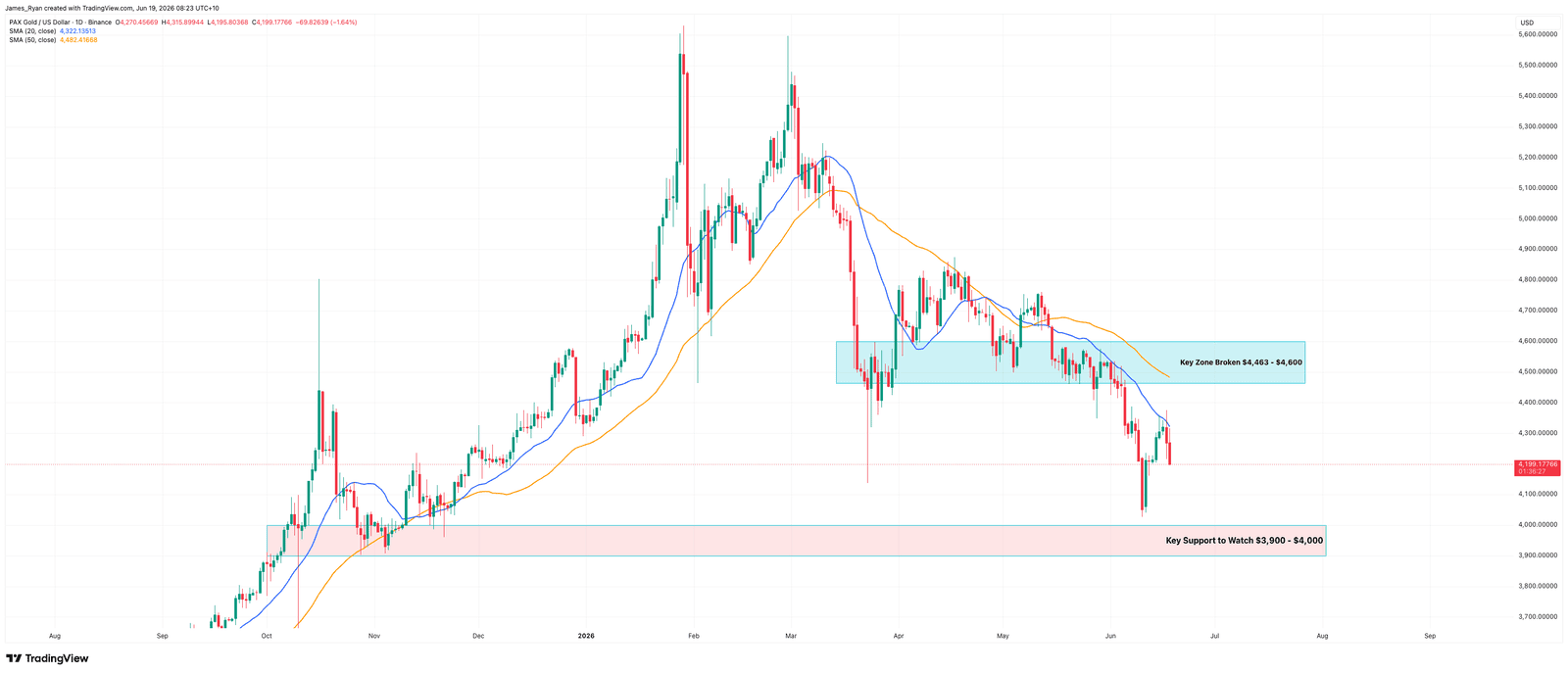
Stormrake Spotlight: Pax Gold (PAXG) ($4,199)