What This Means for Your Bitcoin
For long term Bitcoin holders, the math has now officially changed. Under current rules, a $10,000 profit on BTC held for over a year sees only $5,000 added to your taxable income.
The New Calculation: From July 2027, you will instead index your purchase price to inflation. For example, if you bought $100 of BTC and it rose to $110 while inflation was 2%, you would be taxed on the $8 gain above the indexed cost of $102, rather than just $5 under the old 50% discount.
Inflation Dynamics: While this protects you against currency devaluation, if Bitcoin outpaces inflation significantly, your taxable gain — and the associated tax bill — could be notably higher than under the old 50% discount.
The Transition Window: The new regime only applies to gains arising on or after 1 July 2027. For assets held before this date, the 50% discount still applies to gains accrued up to 30 June 2027.
A Closing Window: The transition period creates a unique window for investors. Assets acquired before the July 2027 deadline still qualify for the 50% discount on gains accrued up to that point. As the market moves toward a more complex model, current rules offer a level of simplicity that is officially on a countdown.
Valuation Requirements: Investors will need to document the market value of their holdings as at 1 July 2027 to establish a new cost base for the indexation period.
SMSF Stability: At this stage, there is no expected change to the CGT discount for superannuation funds. This makes Self-Managed Super Funds (SMSFs) a vital tool for maintaining long-term financial sovereignty.
This is not a call to sell or buy or provide any tax advice, but a reminder that the environment is evolving. At Stormrake, we view Bitcoin as a tool for financial autonomy. While tax laws shift, the underlying value proposition of a borderless, permissionless asset remains unchanged.
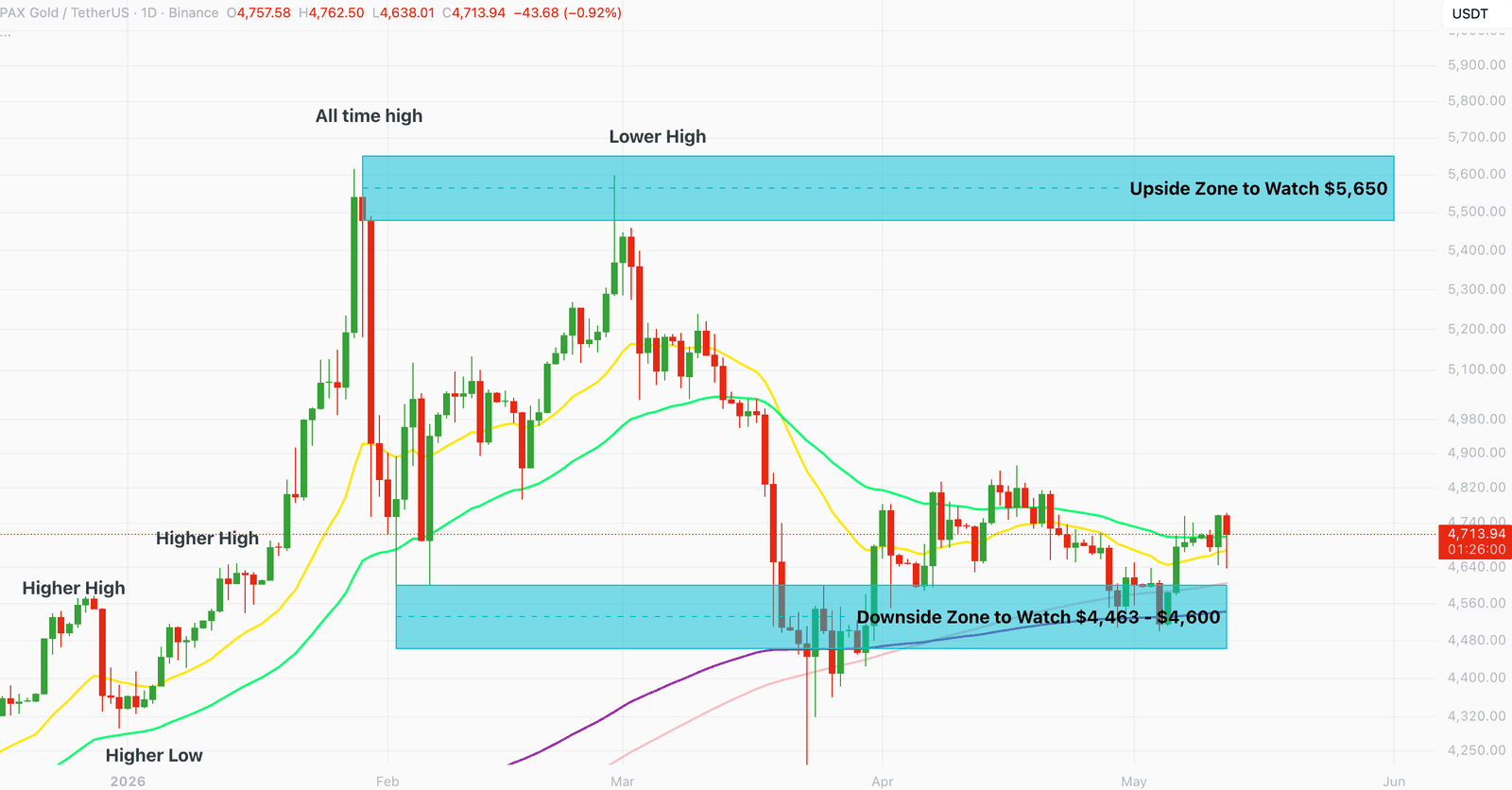
Stormrake Spotlight: Pax Gold (PAXG) ($4,713)