To receive the Morning Note in your inbox, subscribe here: https://stormrake.substack.com/
Money as we know it will never be the same following the conflict in the Middle East. Since the start of the conflict and the closure of the Strait of Hormuz, we have covered how Iran has been accepting alternative currencies to the US dollar for safe passage. This includes fiat such as the yuan, but more interestingly and far more game changing, Bitcoin and Tether.
Since the agreed ceasefire, the strait is not necessarily open and remains effectively shut, as no oil or gas tankers have crossed the Strait of Hormuz, according to the New York Times.
For safe passage, Iran has reportedly demanded that Bitcoin be used for settlement. According to the Financial Times, Iranian authorities have set the toll at $1 per barrel of oil. It has also been reported that Iran has been charging around $2 million per ship.
Now let’s break down the maths. Prior to the closure of the strait, approximately 20 million barrels flowed through daily. At $1 per barrel, that equates to $20 million required for passage. For this exercise, we will assume Bitcoin is the chosen settlement currency.
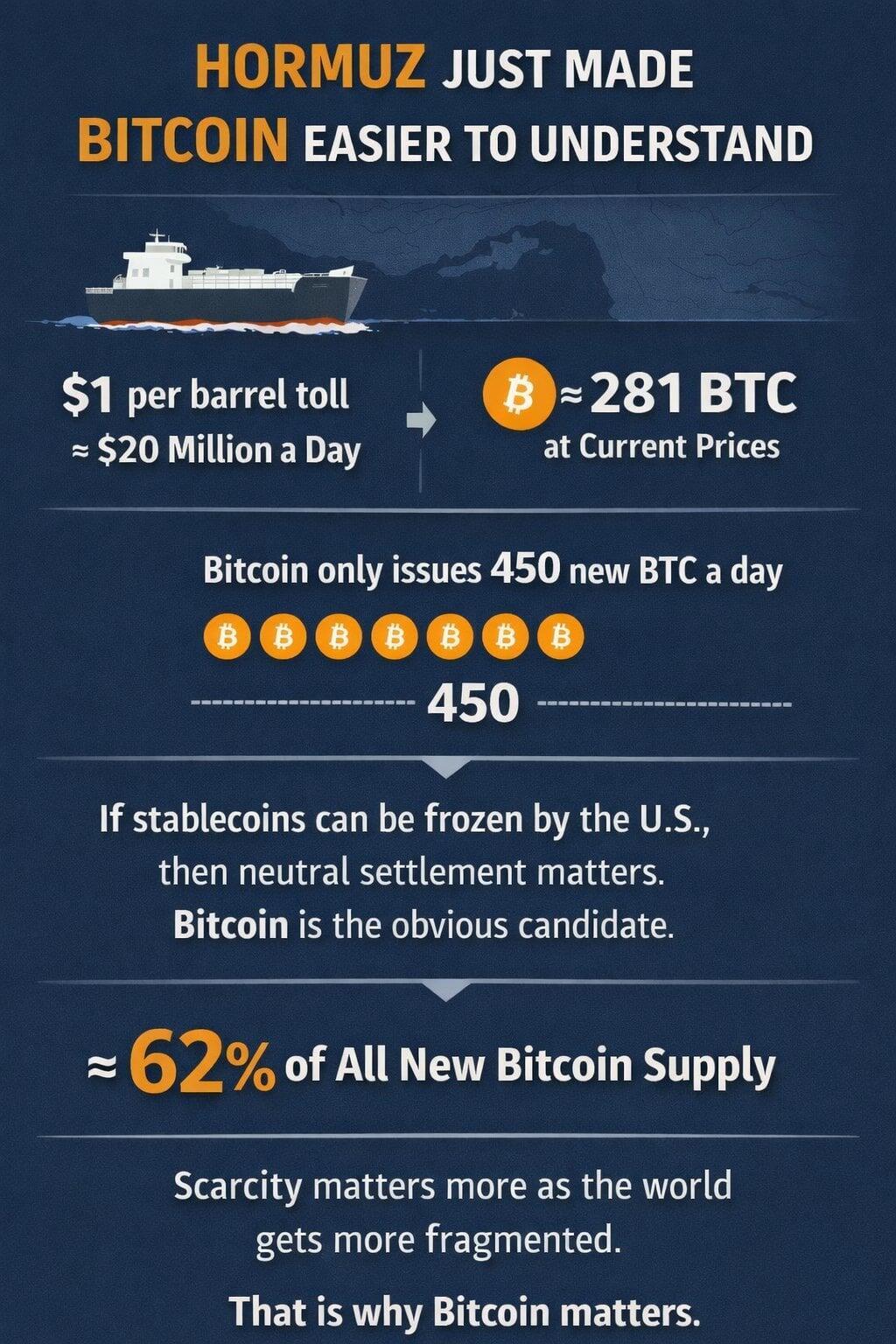
At current prices, $20 million equates to approximately 281 BTC. With only around 450 BTC issued daily through mining, this means roughly 62% of new daily supply would be required to facilitate passage through the strait.
This introduces a clear supply imbalance. A single real world use case is absorbing the majority of new issuance and, based on simple supply and demand dynamics, creates structural upward pressure on price.
A return to the US dollar looks increasingly unlikely. Even a key US ally, Saudi Arabia, did not renew its petrodollar agreement in 2024, while other nations continue to move away from the dollar. As we highlighted recently, China has been offloading US Treasuries, with holdings down nearly 50% over the past decade. Russia has also been actively avoiding settlement in US dollars, alongside other major economies.
Countries are increasingly seeking neutral settlement layers that cannot be frozen or controlled by issuing governments. This is where Bitcoin excels and where it is beginning to capture meaningful global market share.
Why Would they use Bitcoin?
Sovereign money: Bitcoin cannot be frozen or blocked by any government, unlike fiat currencies. It is a truly permissionless global payment system.
Instant settlement: Moving $2 million through traditional banking rails can take days. Bitcoin enables settlement within minutes.
Real world utility: Bitcoin has evolved significantly. From a digital gold narrative to a high beta risk asset, it is now emerging as a global settlement layer, actively being used in energy markets.
Energy link: The use of Bitcoin in oil transit directly links it to global energy flows. Bitcoin is now facilitating the movement of one of the world’s most valuable resources.
All of this is happening while Bitcoin is trading at $70k.
Just over six months ago, Bitcoin was at $126k. It is now over 40% below that level, yet its use case, narrative, and adoption have expanded significantly. We have seen smart money re-enter the market throughout March, and now Bitcoin is being used in global trade flows by major players.
The fact that Bitcoin remains at $70k is remarkable and presents what could be a generational accumulation opportunity. The maths above highlights a clear imbalance where demand is beginning to outpace supply, and when that happens, price tends to move in one direction.
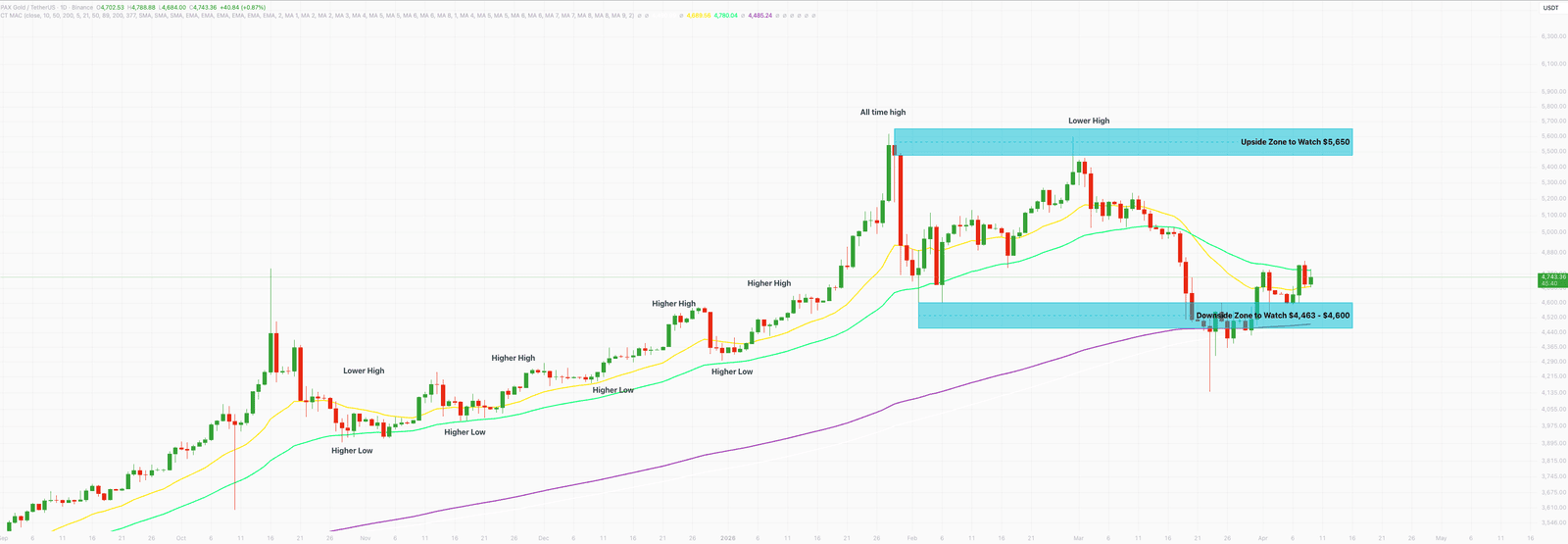
Stormrake Spotlight: Pax Gold (PAXG) ($4,743)
Stormrake Spotlight: Pax Gold (PAXG) ($4,743)