To receive the Morning Note in your inbox, subscribe here: https://stormrake.substack.com/
Following the escalation of conflict in the Middle East, Bitcoin’s narrative is undergoing a quiet but important transformation.
For the last couple of cycles, Bitcoin was easy to categorise. It traded like a high-beta tech asset, moving closely with equities and responding almost mechanically to shifts in liquidity and risk sentiment. When markets rallied, Bitcoin outperformed. When markets sold off, it amplified the downside.
This relationship was measurable.
At its peak between 2022 and 2024, the correlation between Bitcoin and the S&P 500 pushed above 0.6. In simple terms, correlation is measured on a scale from -1 to +1. A reading of +1 means two assets move perfectly in sync, 0 means no relationship, and -1 means they move in completely opposite directions. A 0.6 correlation is significant. It implies a strong tendency for Bitcoin and equities to move in the same direction, reinforcing the idea that BTC was effectively trading as a leveraged extension of traditional markets.
That framework is now breaking down.
As geopolitical tensions intensified through February and March, traditional safe haven flows behaved as expected. Capital rotated into gold, which surged toward record highs, while equities struggled under uncertainty and inflation pressure.
Bitcoin, however, did not follow a single script.
The initial reaction still aligned with risk assets, but what followed marked a clear divergence. While equities remained subdued, Bitcoin began to attract consistent inflows, driven not by sentiment, but by structure.
In the first two weeks of March alone, spot Bitcoin ETFs recorded $1.47 billion in net inflows. This came at a time when broader markets lacked direction, highlighting a key shift in how capital is approaching BTC.
This is not speculative demand. It is allocation. Collectively, Bitcoin ETFs now control roughly 6.5% of total supply.
That level of ownership introduces a new dynamic.
These flows are not reacting to short-term market noise. They are driven by portfolio construction, rebalancing mandates, and increasingly, corporate treasury strategies enabled by updated accounting standards. This creates a persistent bid that operates independently of equity market performance.
And this is where the correlation break becomes visible.
While the S&P 500 has fallen amid the escalating conflict, Bitcoin has continued to absorb capital. The correlation has not disappeared, but it has weakened significantly, now fluctuating between 0.28 and 0.49.
More importantly, it has become unreliable. Bitcoin is no longer consistently moving in step with equities because it is no longer being treated as the same type of asset.
At the macro level, its true alignment is becoming clearer.
Bitcoin continues to show a stronger relationship with global M2 money supply, holding around a 0.43 correlation. This suggests that Bitcoin is not detaching from macro forces, but rather anchoring itself more directly to global liquidity conditions instead of equity market performance.
This is a crucial shift.
Equities are driven by earnings, growth expectations, and margin pressure. Bitcoin is increasingly driven by scarcity, capital flows, and monetary expansion. As ETF demand absorbs supply and institutional participation deepens, these factors begin to dominate price behaviour.
Even the comparison with gold reinforces this evolution.
Gold reacted first to geopolitical stress, as it traditionally does. Bitcoin lagged, and the correlation briefly turned negative, challenging the digital gold narrative. But as flows accelerated and liquidity expectations stabilised, Bitcoin began to re-align with the broader macro theme.
Not as a direct safe haven, but as a second-phase asset.
This is the emerging identity.
Bitcoin is no longer just a leveraged Nasdaq trade. It is evolving into a distinct macro asset, one that sits at the intersection of liquidity, institutional allocation, and digital scarcity.
The correlation break is not noise.
It is a signal that the market is starting to understand what Bitcoin is becoming.
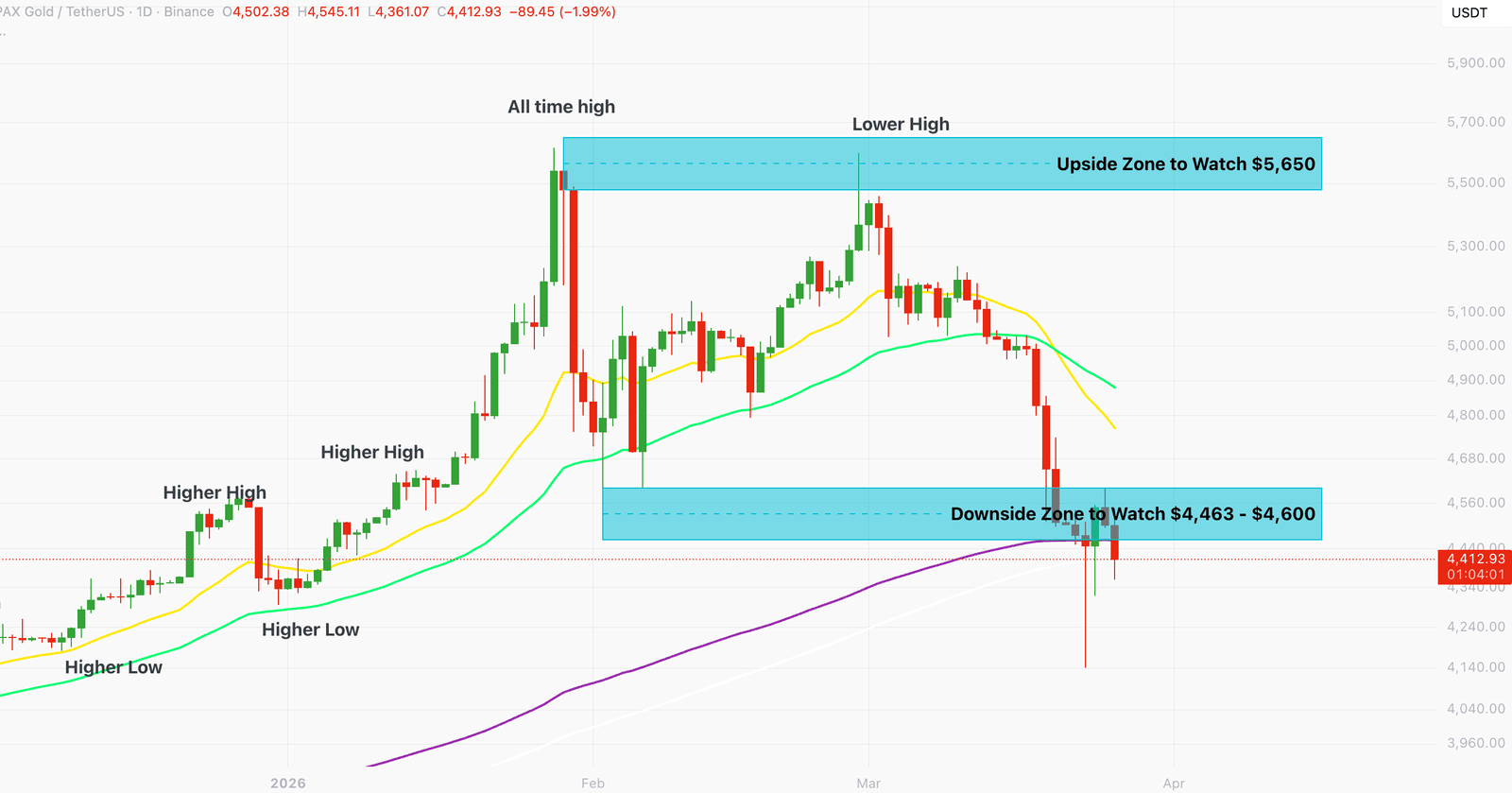
Stormrake Spotlight: Pax Gold (PAXG) ($4,412)
Stormrake Spotlight: Pax Gold (PAXG) ($4,412)