To receive the Morning Note in your inbox, subscribe here: https://stormrake.substack.com/

A recent study covered by Bloomberg is worth sitting with for a moment. Citing new survey data from Betterment, it showed that 24% of Americans have redirected money earmarked for investing into sports betting at least once in the past year. Among Gen Z, that figure jumps to 52%. Even more striking, a quarter of Gen Z respondents said they treat sports betting as a deliberate part of their long term financial strategy, more than double the overall population rate of 12%.
Millennials are not far behind, with 31% having diverted investing funds into betting and 14% calling it part of their financial plan. Gen X and Boomers, by comparison, barely register.
The reporting included an example that made the trend feel less abstract. A 32 year old from Huntington, New York, described how he applies the same discipline to sports betting that he once reserved for stock picking. He does research before placing wagers, sticks to $100 a time, and this year has turned a profit of roughly $2,500, enough to fund a holiday. His own words were telling: he sees it as being smart about gambling, not as a hobby.
So What Actually Separates Investing From Gambling
The instinctive answer is that investing involves an underlying asset with a claim on future cash flows or utility, while gambling is a bet on a discrete outcome with no productive value attached. A share in a business represents part ownership of real earnings. A bet on a football match represents nothing beyond the result of that match.
That distinction holds up reasonably well in theory. In practice, it has been getting blurrier for years, and prediction markets are the clearest example. Platforms now let people take positions on elections, interest rate decisions, weather events, award shows and celebrity gossip. Wrap it in the language of markets and odds, and suddenly wagering on the outcome of a political race looks and feels a lot like taking a view on a stock. The mechanics are functionally identical to sports betting. Only the framing has changed.
The Uncomfortable Comparison
Here is where it gets harder to draw a clean line. How different is a same game multi/parlay from buying a penny stock with no revenue, no product and a market cap built entirely on story? How different is going in on a memecoin from putting $100 on an underdog at long odds? Both are bets on a low probability, high payout outcome, priced by sentiment rather than fundamentals.
The uncomfortable truth is that a large share of activity inside crypto already sits closer to gambling than investing. The memecoin cycle on Solana was pure speculation where 99.99% lost, and the data on the vast majority of altcoins outside Bitcoin is not kind. Most of them spend most of their existence grinding lower, a slow bleed toward zero punctuated by short bursts of hype. Buying into that cycle on the hope of catching the next 100x is not fundamentally different from a multi/parlay. It might be dressed up as investing, but the behaviour underneath is speculation on an outcome, not allocation to an asset with a thesis behind it.
None of this is a moral judgement on people who bet or trade small and speculative positions. The point is simply that the label someone puts on the activity, investing or gambling, often matters less than the process behind it.
What Actually Makes Something Investing
The real dividing line is not the asset. It is the approach. Investing means having a thesis you can explain, a time horizon measured in years rather than a weekend, and a position sized so that being wrong does not derail your plan. Gambling, whatever the venue, is defined by the opposite: no thesis beyond hope, no horizon beyond the next result, and sizing driven by emotion rather than a plan.
That is the real test worth applying to any allocation, sports bet, prediction market position, penny stock or altcoin included, but time horizon on its own is not enough. A long holding period is a necessary feature of investing, not a sufficient one. Holding a zero revenue altcoin or a failing penny stock for two years without a genuine thesis does not turn the position into an investment, it simply turns a short term gamble into a long term bagholding exercise.
The sharper question is whether the position has a claim on something productive: earnings, cash flows, revenue or structural utility that can compound over time. That is what gives an allocation a genuine chance of a positive outcome. A bet on a sports result, a same game parlay or a token with no revenue and no adoption path is a wager on a discrete or zero sum outcome, and stretching the holding period to two years does not change the underlying maths. It only delays the result.
This is also why Bitcoin sits apart from most of what gets lumped in with it under the crypto umbrella. Its fixed supply schedule, growing adoption through spot ETFs, and emerging role as a neutral global settlement layer give it a structural thesis that most of the market does not have. Positioning around Bitcoin does not rely on a single catalyst or a discrete outcome. It rests on a case for genuine long term value, which is the actual definition of investing, and it is worth remembering the difference the next time the line between the two starts to blur.
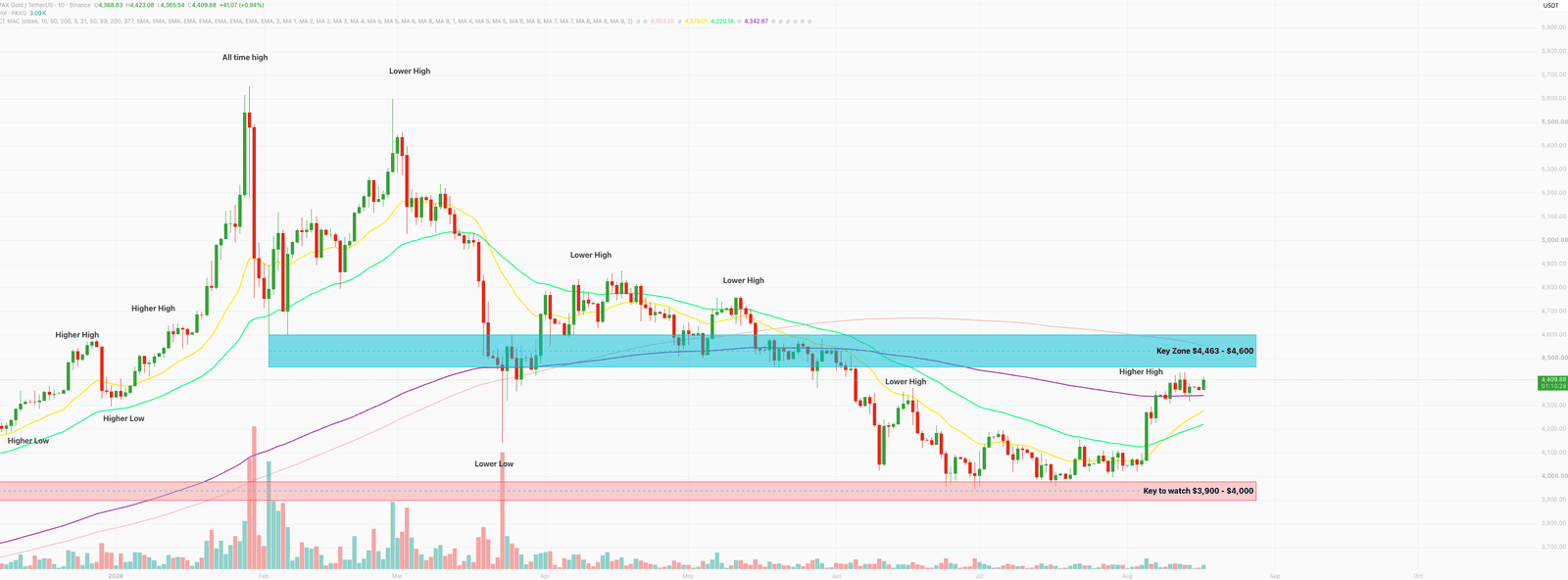
Stormrake Spotlight: Pax Gold (PAXG) ($4,409)
Stormrake Spotlight: Pax Gold (PAXG) ($4,409)