To receive the Morning Note in your inbox, subscribe here: https://stormrake.substack.com/
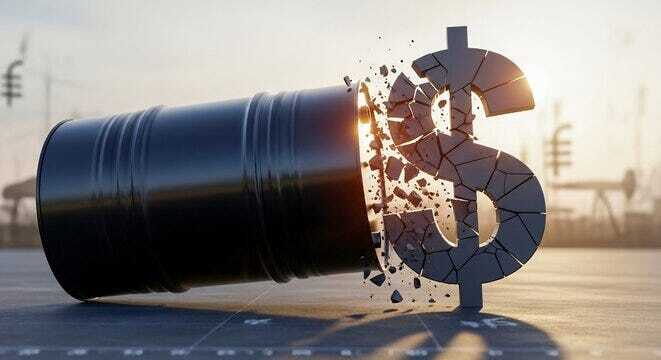
The petrodollar era is no longer defined by dominance, but by dilution.
Since the Strait of Hormuz restrictions began tightening, what was once a theoretical shift has become operational reality. Iran is no longer passively bypassing the dollar system, it is actively enforcing alternatives, and Bitcoin is increasingly sitting alongside this shift as a parallel rail. Tankers moving through one of the world’s most critical oil corridors are now, in select cases, required to settle in Chinese Yuan or through non-SWIFT channels, while BTC and stablecoins underpin the flows that cannot access traditional finance.
This marks a shift from circumvention to coercion.
The implications are structural. For decades, the global oil trade has been anchored to USD settlement, reinforcing a closed loop where energy demand supported dollar liquidity, which in turn fed back into US Treasuries. That loop is no longer intact.
Instead, flows are fragmenting.
China’s CIPS network is absorbing a growing share of cross-border energy transactions, while mBridge is enabling direct settlement between central banks without touching the US financial system. Volume across these rails has already seen a meaningful uptick this year, particularly across BRICS-aligned trade corridors.
Critically, this is not happening in isolation.
Saudi Arabia’s decision not to renew its exclusive dollar agreement in 2024 removed the political anchor of the petrodollar system. The UAE is actively settling trades with China using alternative infrastructure. Iran is now enforcing it at a geographic chokepoint.
The result is a transition from a single dominant system to a multi-polar settlement landscape.
The Yen also enters this equation.
As Japan contends with prolonged currency weakness and rising import costs, there is a growing incentive to diversify settlement exposure, particularly across energy markets. While not a direct challenger to USD dominance, the Yen’s increased utilisation in bilateral trade adds another layer to the fragmentation of global currency flows.
This is how the system shifts. Not through collapse, but through erosion of exclusivity.
Beneath this sovereign-level transition, a second layer is accelerating.
Bitcoin is becoming embedded within the mechanics of trade where traditional rails fail.
While state-level oil contracts are increasingly leaning toward Yuan settlement, the operational layer tells a different story. Sanctioned or semi-sanctioned actors are turning to Bitcoin and stablecoins to facilitate the parts of trade that cannot clear through banks.
This includes ship-to-ship transfers, offshore refuelling, and maritime insurance across shadow fleets. These functions are essential, and increasingly, they are being settled on-chain.
Iran’s integration of crypto mining into its energy strategy reinforces this dynamic. Rather than exporting oil alone, energy is being monetised digitally, bypassing financial restrictions entirely. On-chain flows linked to Iran have already reached significant scale, and the trajectory remains upward.
Bitcoin’s role here is not headline-driven, but it is critical.
It operates as neutral infrastructure in an environment where trust is fragmented and access is restricted. It does not replace fiat systems, it complements and, in some cases, circumvents them.
From a macro perspective, this matters.
As global trade becomes less centralised, the demand for neutral, permissionless settlement layers increases. Bitcoin sits directly in that category, not as a competitor to sovereign currencies, but as a parallel system that gains relevance as fragmentation expands.
Market structure continues to reflect this backdrop.
Bitcoin remains well supported, with buyers stepping in at key levels despite broader macro uncertainty. The resilience in price action suggests underlying accumulation, particularly as this geopolitical narrative strengthens.
This is not a sudden repricing event. It is a gradual shift in how global value moves.
The petrodollar is not dead, but it no longer stands alone.
And in a world where capital flows across multiple systems, Bitcoin is increasingly positioned at the intersection of them all.
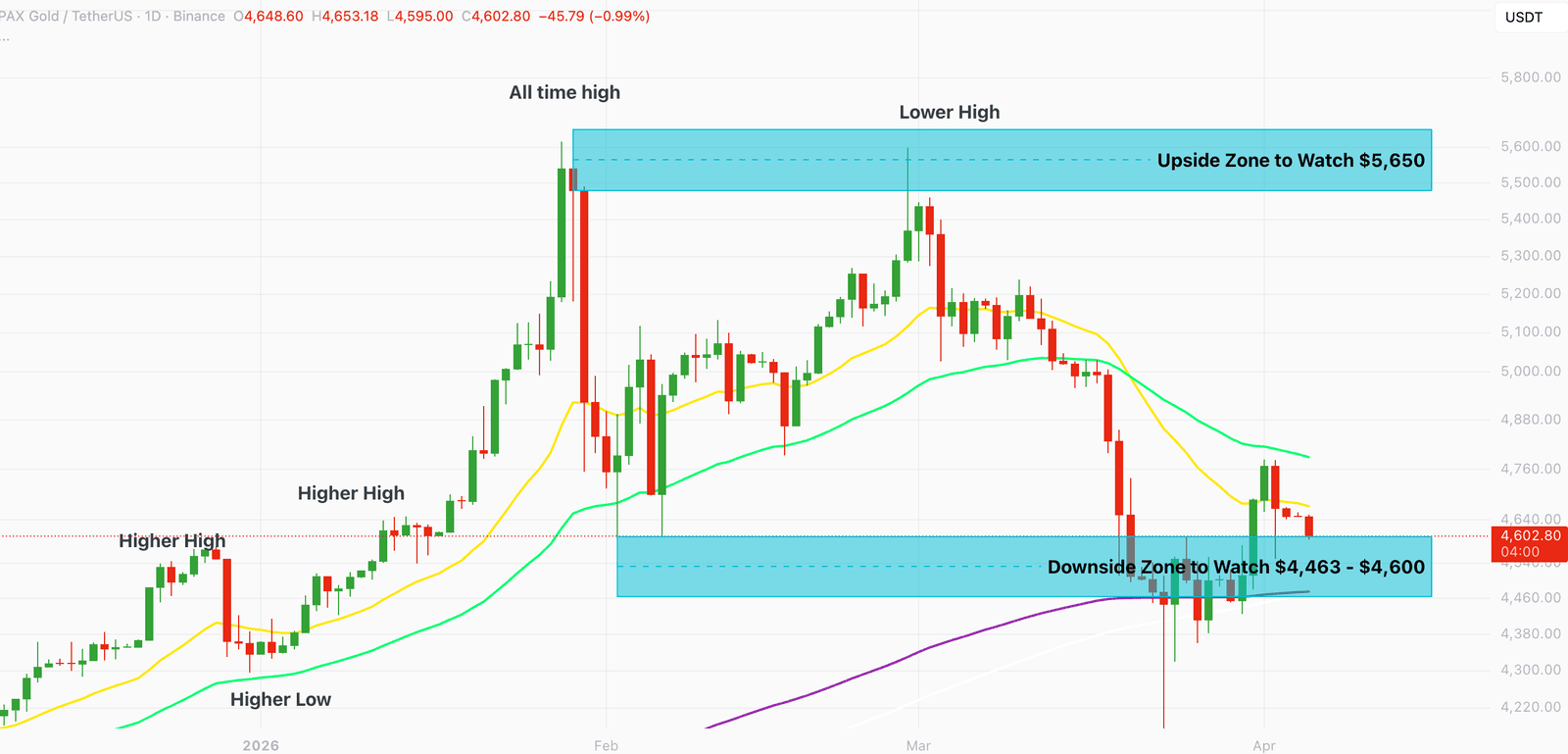
Stormrake Spotlight: Pax Gold (PAXG) ($4,602)
Stormrake Spotlight: Pax Gold (PAXG) ($4,602)