

Two Declarations of Independence Across Two Centuries

07 Jul 2026 10:19 AM By Stormrake

To receive the Morning Note in your inbox, subscribe here: https://stormrake.substack.com/

On 4 July 1776, a group of colonists signed a document declaring that governments derive their legitimacy entirely from the consent of the governed. They asserted that when an institution permanently breaks that trust, individuals possess the inherent right to construct a new paradigm. Two centuries later, on 3 January 2009, a pseudonymous programmer mined a block of cryptographic code that made no public speeches and signed no formal names. However, this block carried the exact same underlying thesis. The institutions entrusted with systemic power over global capital and human liberty had repeatedly violated their mandates, necessitating a parallel alternative that completely bypassed the requirement for institutional permission. Separated by 233 years, both events address the identical structural failure mode: the inevitable decay of unaccountable central authorities and the subsequent systems built by individuals in response.

Owning What's Yours, Then and Now

Stripping the American founding document down to its core operational design reveals a line for line echo within the Bitcoin genesis block. Mined at the absolute peak of the 2008 global financial crisis, that first block contained a single embedded message quoting the London Times headline regarding a secondary banking bailout. This remains the only explicit prose Satoshi Nakamoto ever hardcoded into the ledger, serving as a permanent critique of modern monetary intervention.

This historical convergence manifests across several key operational vectors:

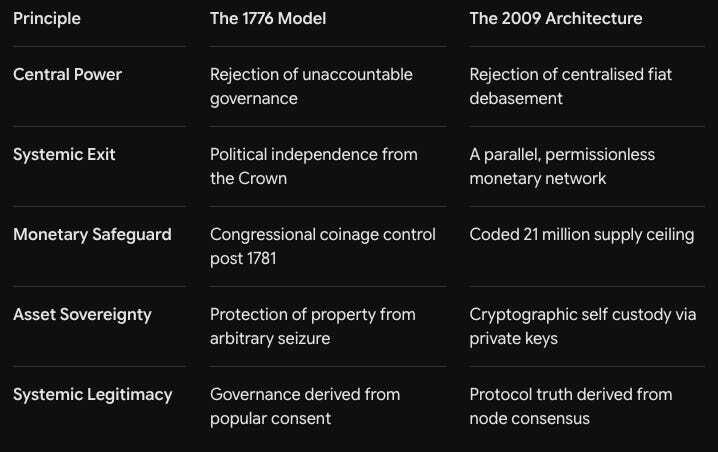
  • Consent and Consensus: The historical grievance regarding taxation without representation focused squarely on power exercised without systemic accountability rather than simple tax rates. Bitcoin addresses this by replacing political cycles with continuous cryptographic consensus. The network only adopts structural upgrades if individual node participants actively choose to run the modified code, ensuring no centralised entity can impose arbitrary rules.

  • Mitigation of Central Authority: The authors of the American constitution built a delicate matrix of checks and balances because they deeply distrusted concentrated power. The architecture of digital asset scarcity takes this logic to its ultimate conclusion by removing the central authority entirely, eliminating any single point of failure or chancellor discretion.

  • The Right to Exit: The right to exit represents the most radical assertion of the 1776 declaration. Bitcoin transforms this philosophical permission structure into functional software. Allocators dissatisfied with debasing fiat regimes do not need to petition central banks for policy reform; they can seamlessly rotate capital into a parallel monetary framework.

  • Absolute Self-Custody: True liberty remains fundamentally tied to property rights and the preservation of personal labour. Cryptographic self-custody serves as the modern technical expression of this principle, enabling individuals to hold a sovereign asset that no third party intermediary can freeze, seize, or reverse without their explicit private key.

  • Sound Money: The early American republic witnessed the complete collapse of the Continental currency, which was printed without restraint to fund war efforts and became entirely worthless by 1781. This hyper-inflationary disaster prompted constitutional restrictions on paper issuance. Bitcoin secures this exact lesson through absolute mathematical limits, hardcoding a fixed supply cap of 21 million units that no emergency legislative session can alter.

233 Years Apart, Same Argument
One Fixed the System, One Replaced It

While the philosophical motivations align, a critical structural distinction exists between these two historical models. The forefathers of 1776 attempted to construct a more perfect government, establishing accountability through legal constraints and institutional checks. Conversely, the deployment of decentralised software removes the requirement for human institutions entirely. One approach sought to manage authority through design, while the other engineered the absolute omission of central authority. This tension highlights why spot digital property operates as a pure counterweight to legacy financial systems.

For macro allocators, evaluating these historical timelines provides essential clarity during periods of escalating global intervention. When trust in legacy institutions breaks down, markets do not merely register complaints; capital actively constructs and migrates to robust alternatives. Securing unencumbered spot property remains the most direct execution path to isolate wealth from the ongoing decay of centralised balance sheets. The trading desk at Stormrake remains fully equipped to facilitate large scale spot property acquisitions, ensuring your financial autonomy is anchored directly in cryptographic certainty rather than institutional discretion.

Stormrake Spotlight: Pax Gold (PAXG) ($4,178)
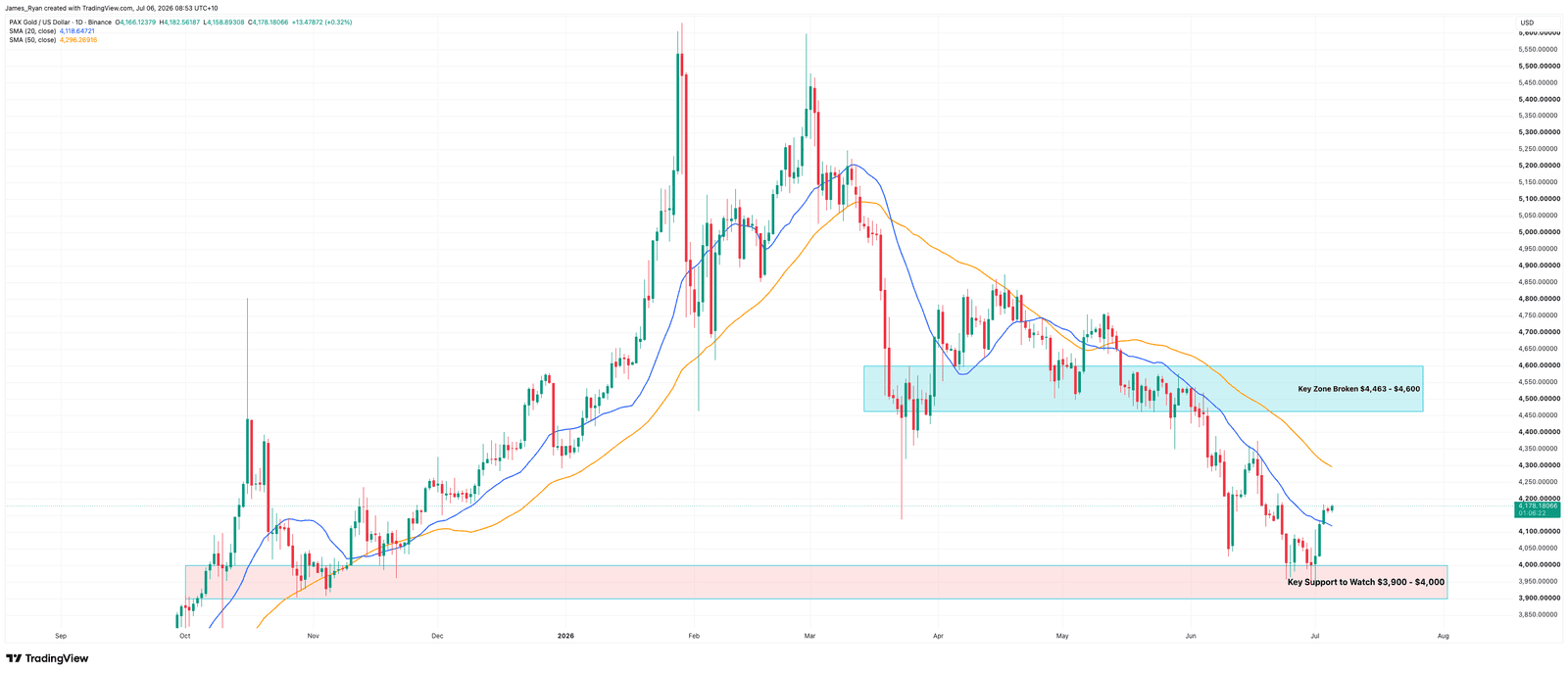
PAXG continues to hold above the $4,100 local resistance - a great sign that short-term trend is beginning a reversal back up as price currently sits at a healthy $4,178 and in the green for the day thus far. If momentum can persist, the next headwind area before some profit taking may occur would be the ~ $4,300 to $4,400 zone as there’s significant liquidity waiting at those prices.

BTC/USD Key Levels and Price Action:

Bitcoin has bucked the trend once again, with significant continued upwards momentum from the bulls as the bears failed to produce the breakdown below $57,000 last week. With price already back at $63,800 and quickly climbing - that’s how fast things can turn the other way when everyone online is ultra-bearish: We said those buying windows don’t last long, and this is exactly what we meant. Good news for those that missed buying sub-$60K however; we’re currently at local resistance, sitting at the $63,861 mark. If we get another smaller dip back into the ~$61,000 potential higher-low pocket, your asymmetric upside opportunity becomes exceptional. Second chances are rare in this market - if they come, don’t squander it.
To receive the Morning Note in your inbox, subscribe here: https://stormrake.substack.com/

*All prices are denominated in USD unless stated otherwise*

Written by James Ryan

Create a brokerage account today

No Advice Warning 

The information in this newsletter is general only. It should not be taken as constituting professional advice from the author - Stormrake PTY LTD.
Stormrake is not a financial adviser and does not provide financial product advice. You should consider seeking independent legal, financial, taxation or other advice to check how the information relates to your unique circumstances. Stormrake is not liable for any loss caused, whether due to negligence or otherwise arising from the use of, or reliance on, the information provided directly or indirectly, by this newsletter.
 

Disclaimer 

All statements made in this newsletter are made in good faith and we believe they are accurate and reliable. Stormrake does not give any warranty as to the accuracy, reliability or completeness of information that is contained here, except insofar as any liability under statute cannot be excluded. Stormrake, its directors, employees and their representatives do not accept any liability for any error or omission in this newsletter or for any resulting loss or damage suffered by the recipient or any other person. Unless otherwise specified, copyright of information provided in this newsletter is owned by Stormrake. You may not alter or modify this information in any way, including the removal of this copyright notice.

Copyright © 2024 Stormrake Pty Ltd, All rights reserved

Stormrake