To receive the Morning Note in your inbox, subscribe here: https://stormrake.substack.com/
When you think of major nations that host Bitcoin miners, your mind typically goes to the likes of the USA, Russia, or China. These are nations capable of producing and mining Bitcoin at scale, driven by lower energy costs, access to capital, and regulatory frameworks rather than ideology or headlines.
To some people’s surprise, Iran is actually a notable contributor to Bitcoin mining. While it is not on the same scale as some of the aforementioned nations, it is estimated to account for roughly 2–5% of the global Bitcoin hash rate.
Iran is one of the most profitable places on Earth to mine Bitcoin, primarily due to incredibly cheap, government subsidised electricity. It is estimated that Bitcoin mining generates over $1 billion in annual revenue for Iran and local miners. Earlier this year, it was estimated that miners in Iran could produce one Bitcoin for around $1,320. This compares with significantly higher costs in the US and Europe, where mining can range between $40k and $75k per coin.
Beyond cheap electricity, Bitcoin mining also offers strategic advantages for countries like Iran that face international sanctions. Mining allows energy rich nations to effectively convert excess electricity into a globally transferable digital asset. Unlike traditional commodities, Bitcoin can be moved across borders without relying on the international banking system, making it an attractive tool for sanctioned economies seeking alternative revenue streams. In this sense, Bitcoin mining becomes not just an industrial activity, but a form of geopolitical financial infrastructure.
Impact of the ongoing conflict on Bitcoin mining:
Iran’s mining infrastructure has been directly affected by the ongoing conflict. It is estimated that around 700,000 Bitcoin mining rigs have gone offline. At the same time, internet connectivity across Iran has reportedly dropped by 99%.
Because miners must remain connected to the global Bitcoin network in order to validate blocks and receive rewards, this effectively freezes their ability to mine regardless of how cheap their electricity may be.
However, this disruption has not yet had a meaningful impact on global mining activity. If Iranian miners remain offline for an extended period, the Bitcoin network will undergo a “difficulty adjustment”. This is a self correcting mechanism built into the Bitcoin protocol designed to maintain an average block time of roughly 10 minutes.
If block production slows beyond this threshold, the network automatically adjusts the mining difficulty. This occurs every 2,016 blocks, which is roughly every two weeks. In this case, the adjustment would likely reduce mining difficulty slightly, making it easier and more profitable for other miners around the world until the network returns to its normal pace.
Will this impact Bitcoin’s price?
Some rumours have circulated suggesting that a collapse in Iranian Bitcoin mining could negatively impact Bitcoin’s price. However, as mentioned above, the difficulty adjustment mechanism would bring mining conditions back into balance.
While there could be short term volatility, it is extremely unlikely that this situation alone would have any substantial impact on Bitcoin’s price.
Bitcoin has evolved well beyond the stage where mining disruptions are the primary driver of price action. Instead, it has increasingly moved in line with broader risk assets and global macro sentiment. Over the past 24 hours we have actually seen a strong move across the crypto market despite the conflict continuing to escalate and showing little sign of slowing.
This resilience is a very positive signal for the crypto market and represents a much needed bounce following recent weakness.
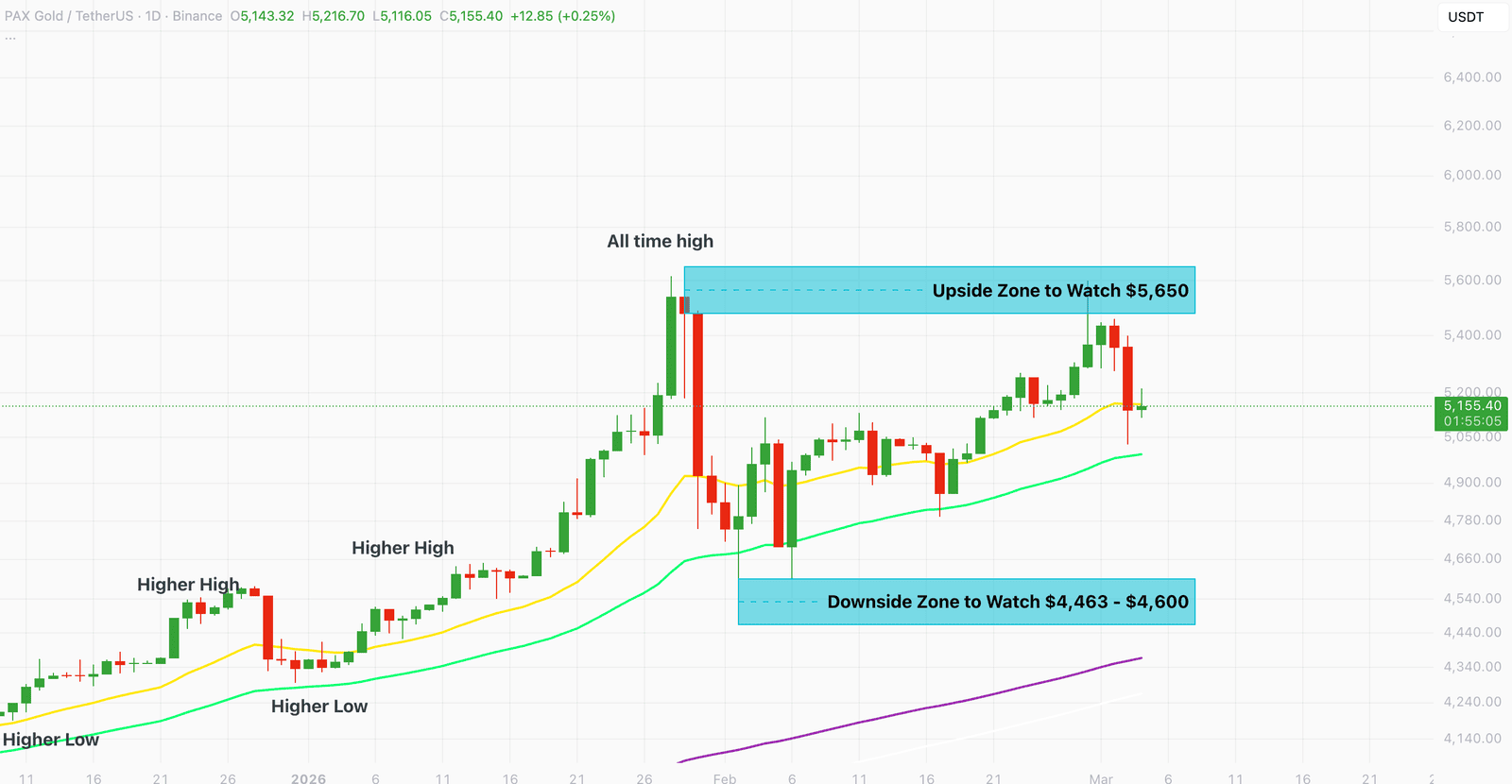
Stormrake Spotlight: Pax Gold (PAXG) ($5,155)
Stormrake Spotlight: Pax Gold (PAXG) ($5,155)