To receive the Morning Note in your inbox, subscribe here: https://stormrake.substack.com/

At a superannuation roundtable in Sydney, Prime Minister Anthony Albanese outlined a controversial vision for Australia’s $4.5 trillion superannuation pool. Rather than treating this massive pool of liquidity purely as a retirement fund for individual citizens, the government argued that it should be mobilised as a national asset to support domestic economic ambitions and international diplomacy. Westpac chief executive Anthony Miller publicly pushed back against this narrative, warning the state against directing private retirement capital. This debate highlights a fundamental question for asset allocators globally: who ultimately commands the capital that is nominally yours?
What Albanese Actually Argued
Albanese noted that large pension investments provide valuable international leverage, characterising the deployment of hard money as an effective tool for soft power. The Prime Minister pointed to AustralianSuper’s recent commitment of up to $500 million to Indian infrastructure, announced alongside Prime Minister Narendra Modi, as evidence that pension capital already delivers diplomatic influence for the nation. Not everyone in the room shared that framing - AustralianSuper chairman Don Russell pushed back on the idea directly, describing the India investment as a portfolio diversification and returns decision first, with any soft-power effect a byproduct rather than the objective. Former Victorian premier Dan Andrews supported the institutional realignment Albanese was pushing for, urging the use of state finance vehicles to steer capital into specific sovereign capabilities such as housing, domestic energy transition, water security, and infrastructure.
This political desire to repurpose private funds arrives just as the institutional pension complex prepares for its first real demographic liquidity test. Westpac’s chief executive countered by arguing that the local corporate bond market has already expanded three times larger over the past year without political intervention, in his view, evidence that markets mature efficiently at their own pace without needing to be directed. More importantly, super funds have historically operated without treating liquidity as an active risk, because incoming contributions have consistently outpaced redemptions.
The Bigger Number Behind the Argument
That structural stability is shifting rapidly. UBS forecasts that by 2033, sector withdrawals via pensions and lump sums will exceed incoming contributions across the entire landscape. This demographic inversion is accelerated by the fact that approximately 1 million citizens are projected to retire before 2035. Major funds like Aware Super, which manages $230 billion in assets, are already actively de-risking portfolios and rotating into fixed income to prepare for these redemptions. APRA’s own stress testing modelled an extreme but plausible macro shock that could cut aggregate balances by as much as 25% - a scenario the regulator said the system withstood without breaking, though the exercise itself underlines how much less room for error the sector will have as the demographic shift accelerates.
The core vulnerability stems from the mandatory nature of centralised retirement complexes. Because participation is legally compulsory, individual savers have no authentic exit option and cannot opt out of these institutional structures. The battle over direction is fought between the state and financial intermediaries, whilst the individual owner’s voice is represented purely by proxy.
We The People
This structural dynamic underscores the case for holding unencumbered, sovereign property. While institutional systems are inherently vulnerable to policy changes, state mandates, and sudden demographic liquidity constraints, Bitcoin operates as an entirely independent alternative. As absolute sovereign property, Bitcoin provides individuals with complete discretionary control over their wealth. It requires no intermediate permission, carries zero counterparty liabilities, and cannot be directed by state ambition. In an era where centralised pools of capital are increasingly viewed as tools for national engineering, securing digital property that exists entirely outside the legacy political apparatus becomes paramount for long-term wealth preservation.
To cut through the noise of institutional capital capture and secure true financial sovereignty, contact your dedicated Stormrake broker today to discuss direct spot property ownership.
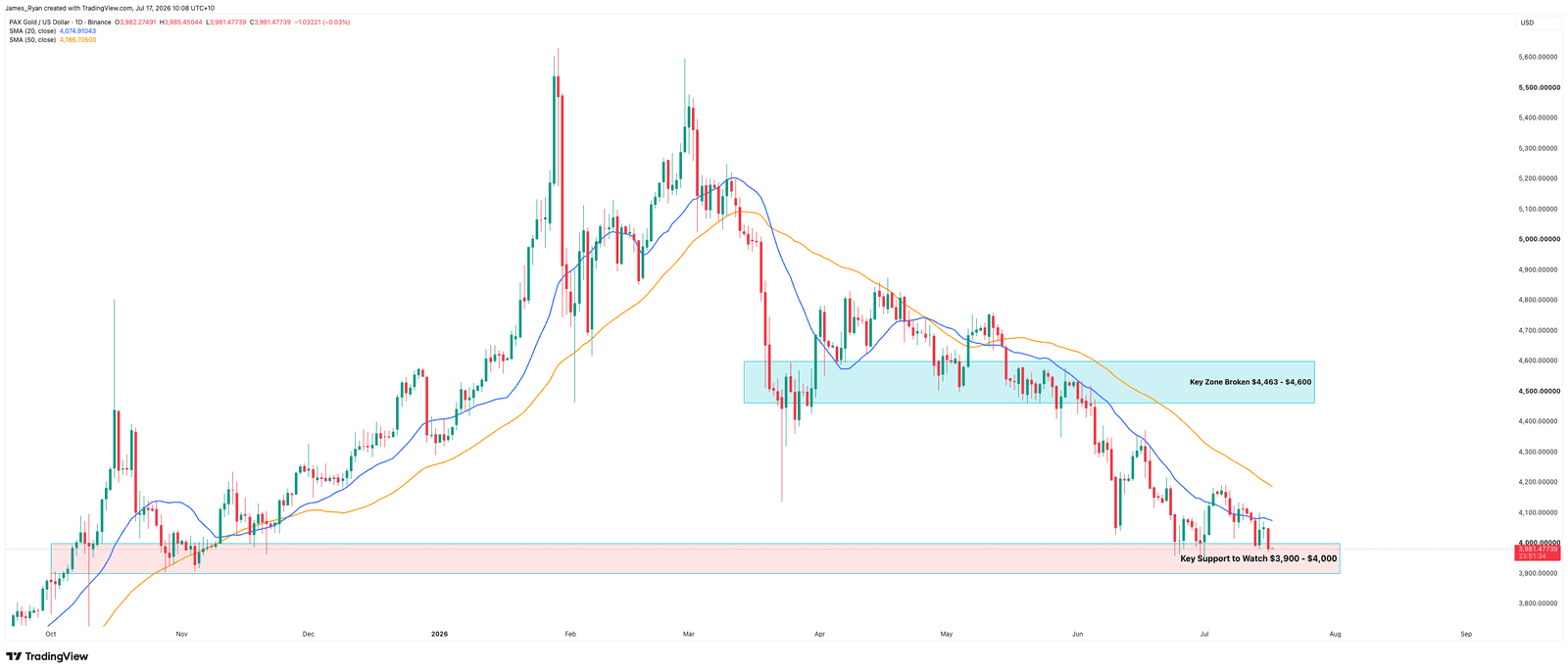
Stormrake Spotlight: Pax Gold (PAXG) ($3,981)
Stormrake Spotlight: Pax Gold (PAXG) ($3,981)