To receive the Morning Note in your inbox, subscribe here: https://stormrake.substack.com/
Markets are entering a new phase where tokenised access, institutional demand, and macro uncertainty are all colliding.
The latest developments around tokenisation are not just incremental, they signal a structural shift. The SEC’s approval of a Nasdaq rule change enabling the trading of tokenised equities and ETFs, including S&P 500 and Nasdaq-100 components, marks a clear transition from experimentation to implementation. These blockchain-based shares remain fully interchangeable with traditional securities, preserving the same rights, liquidity, and market structure, while introducing a new layer of post-trade efficiency.
This is not simply about bringing equities on-chain. It is about removing time constraints from financial markets.
When equities move to 24/7 trading, the expectation quickly follows that capital should move just as freely. This is where legacy systems begin to show friction. Settlement delays, restricted hours, and fragmented global rails stand in contrast to an emerging system that is always on and borderless by design.
Bitcoin sits directly within this transition. Not as a replacement for banks, but as the next layer in financial evolution. A neutral, decentralised asset that operates without downtime, increasingly aligned with a world where markets no longer close.
This shift is already being reflected in market performance. HYPE is now up 66% year-to-date, significantly outperforming the broader digital asset market, with only oil posting stronger gains over the same period. The move highlights how capital is beginning to price in infrastructure tied to this next phase of market evolution.
While this structural shift builds in the background, institutional demand remains firmly in play. Spot Bitcoin ETFs recorded a seventh consecutive day of inflows on March 17, bringing the total to approximately $1.2B since March 9. This comes despite recent price pullback, suggesting that capital continues to accumulate rather than retreat.
At the same time, macro conditions remain complex. Fed Chair Jerome Powell has warned that rising energy prices, driven by escalating geopolitical tensions, could push inflation higher. Developments in the Middle East continue to add uncertainty, reinforcing the possibility that rate cuts may be delayed.
In parallel, emerging restrictions on capital movement in regions such as the UAE offer a more subtle but important signal. Reports of tighter controls on fund withdrawals and weakening real estate conditions, with prices reportedly down 37% since the conflict began, highlight the risks of capital being constrained within traditional systems. While not a direct driver of recent price action, these dynamics reinforce the appeal of neutral, borderless assets.
This leaves markets at an intersection.
On one side, a rapidly evolving financial system built on tokenised access and continuous liquidity. On the other, a macro environment where capital controls, inflation risk, and geopolitical instability continue to introduce friction.
The shift underway is not just towards tokenised assets, but towards a system that does not switch off. Bitcoin is not replacing the existing framework, it is becoming part of what comes next.
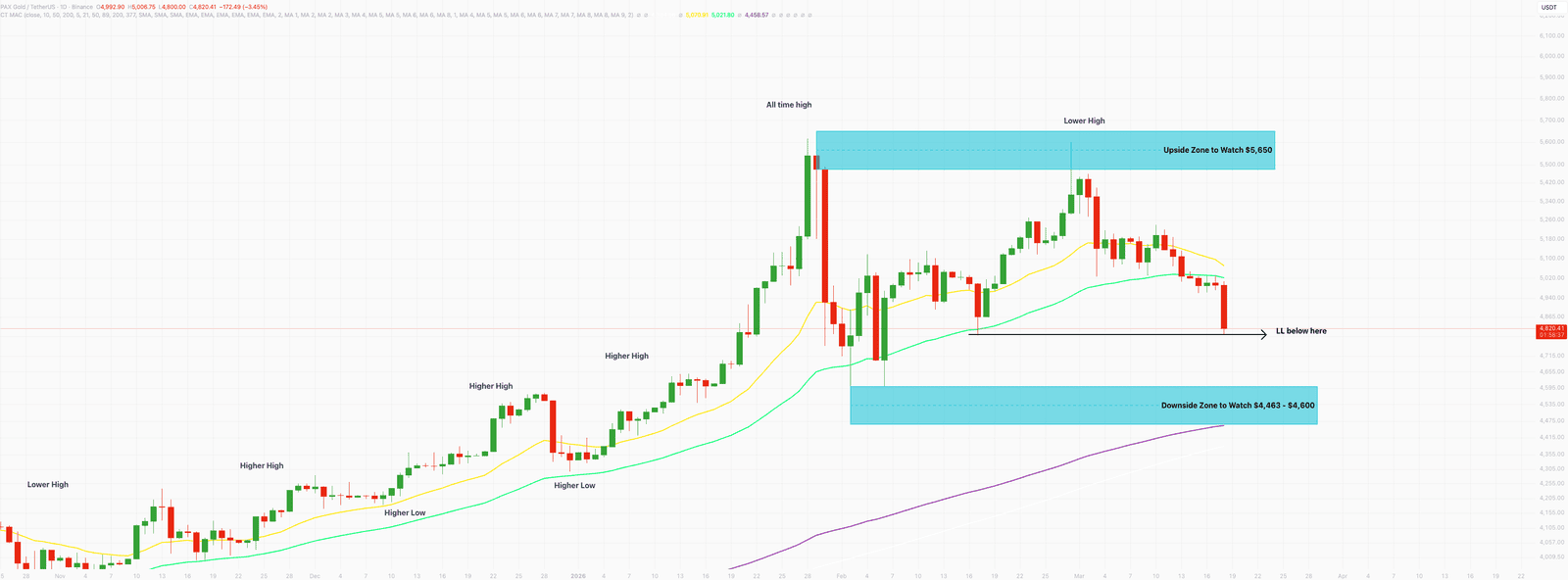
Stormrake Spotlight: Pax Gold (PAXG) ($4,820)
Stormrake Spotlight: Pax Gold (PAXG) ($4,820)