To receive the Morning Note in your inbox, subscribe here: https://stormrake.substack.com/

To dollar cost average or lump sum? It is one of the most debated questions when it comes to accumulating assets. Both strategies have their advantages. Neither is built for everyone. So let us break down which has historically produced the strongest outcomes and which type of investor each approach suits best.
A dollar cost averaging strategy refers to breaking up capital into smaller allocations and investing over a set period of time, regardless of price. The goal is to smooth entries, reduce volatility impact and remove emotion from the decision making process.
A lump sum investment is exactly what it sounds like. An investor deploys 100% of their capital at a chosen time and then rides out the position. This can be extremely rewarding if timed well. However, it requires conviction and discipline, especially if the purchase is made near a market peak, which in crypto can mean significant drawdowns.
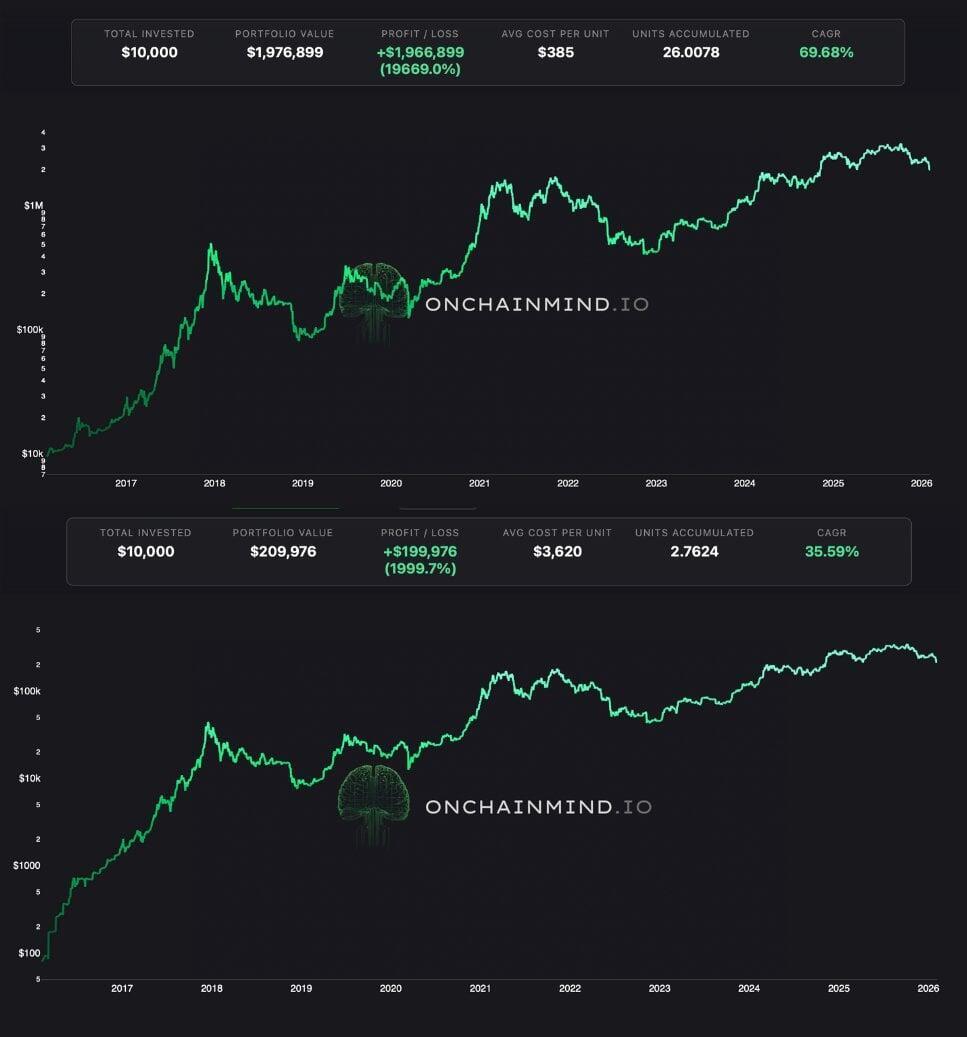
For this experiment, we compare two portfolios over time using historical data sourced from On-Chain Mind. One investor allocates $10,000 in a single purchase. The other deploys $10,000 using a DCA strategy. We evaluate performance based on total Bitcoin accumulated, current dollar value and compound annual growth rate, or CAGR.
Buying Bitcoin 10 Years ago:
Looking back a decade highlights the power of time in the market for lump sum investors. A $10,000 investment in 2016 would have acquired just over 26 BTC. At current prices, that portfolio would be worth nearly $2 million, delivering a CAGR of over 69%.
In comparison, a $10,000 DCA strategy over the same period would have accumulated 2.76 BTC. That would now be valued at over $200,000, with a CAGR of 36%. While still impressive, the final portfolio value is roughly one tenth of the lump sum outcome.