To receive the Morning Note in your inbox, subscribe here: https://stormrake.substack.com/
Following the recent revelations surrounding alleged manipulation by Jane Street, attention has shifted towards something more fundamental, Bitcoin’s fixed supply cap.
If you are unfamiliar with the Jane Street situation, I encourage you to read yesterday’s Morning Note, where we outlined the allegations regarding short term selling pressure at the US session open and the firm’s reported involvement in the Terra collapse in 2022.
In brief, Jane Street allegedly applied consistent selling pressure as US markets opened, contributing to short term price drops and creating potential re entry opportunities at lower levels. The claims suggest this activity was not limited to spot Bitcoin, but also involved derivative exposure through ETF products and leveraged instruments, amplifying the impact on broader market structure.
Separate from the manipulation debate, which should not surprise anyone given similar behaviour exists across all major financial markets, the latest criticism now centres on scarcity itself. We know Bitcoin has a hard cap of 21 million coins. The question being raised is whether so called paper Bitcoin undermines that limit.
Paper Bitcoin and How It Differs From Spot Bitcoin
Paper Bitcoin refers to financial instruments that track the price of Bitcoin without requiring ownership of the underlying asset. These include futures, options, certain ETF structures, and other derivatives.
Paper Bitcoin is effectively a price IOU. It gives exposure to Bitcoin’s movements, but it is not the same as owning BTC in self custody.
Spot Bitcoin is different. When you purchase BTC and hold it in self custody, you own a portion of the finite supply enforced by the protocol. No ETF, derivative contract, or leveraged instrument can alter that issuance schedule. Synthetic exposure can expand within financial markets, but the underlying asset itself remains unchanged.
Investors use different vehicles for different reasons. Spot holders are typically focused on long term ownership and conviction. Paper Bitcoin is often used for hedging, leverage, short term trading, or gaining exposure without managing custody. That distinction is important.
The 2022 Lesson

If anything, 2022 demonstrated the fragility of synthetic exposure rather than any weakness in Bitcoin’s monetary design. The bear market was intensified by excessive leverage, with institutions holding positions they did not directly own. When price declined, forced liquidations followed and several major players became insolvent.
Spot holders experienced drawdowns, but they were not liquidated and did not face the same counterparty risks. The protocol did not change and the issuance schedule did not expand. Leverage amplified volatility, it did not dilute scarcity.
Price Influence Is Not Supply Inflation
Much of the confusion stems from price discovery. Derivatives markets can influence short term price action. Futures open interest can expand rapidly, and liquidations can exaggerate both downside and upside moves. Financial products can shape short term market structure.
However, influencing price is not the same as creating new coins. A futures contract does not mint Bitcoin. It is an agreement between counterparties referencing price. When leverage unwinds, synthetic exposure disappears. The underlying asset remains intact.
This dynamic is not unique to Bitcoin. Silver faced over a decade of alleged price suppression through heavy derivative short positioning, whilst institutions accumulated physical supply. Financial instruments influenced price behaviour for years, but they did not create additional silver. The same principle applies here.
The Core Reality

Bitcoin’s scarcity is enforced by code, not by financial engineering. You can create unlimited contracts referencing the asset, but you cannot increase its programmed limit.
Paper Bitcoin represents exposure. Spot Bitcoin represents ownership.
Short term volatility can be amplified by leverage and derivatives activity, but the core monetary properties remain unchanged. Over time, ownership of the underlying asset matters far more than synthetic positioning layered on top of it.
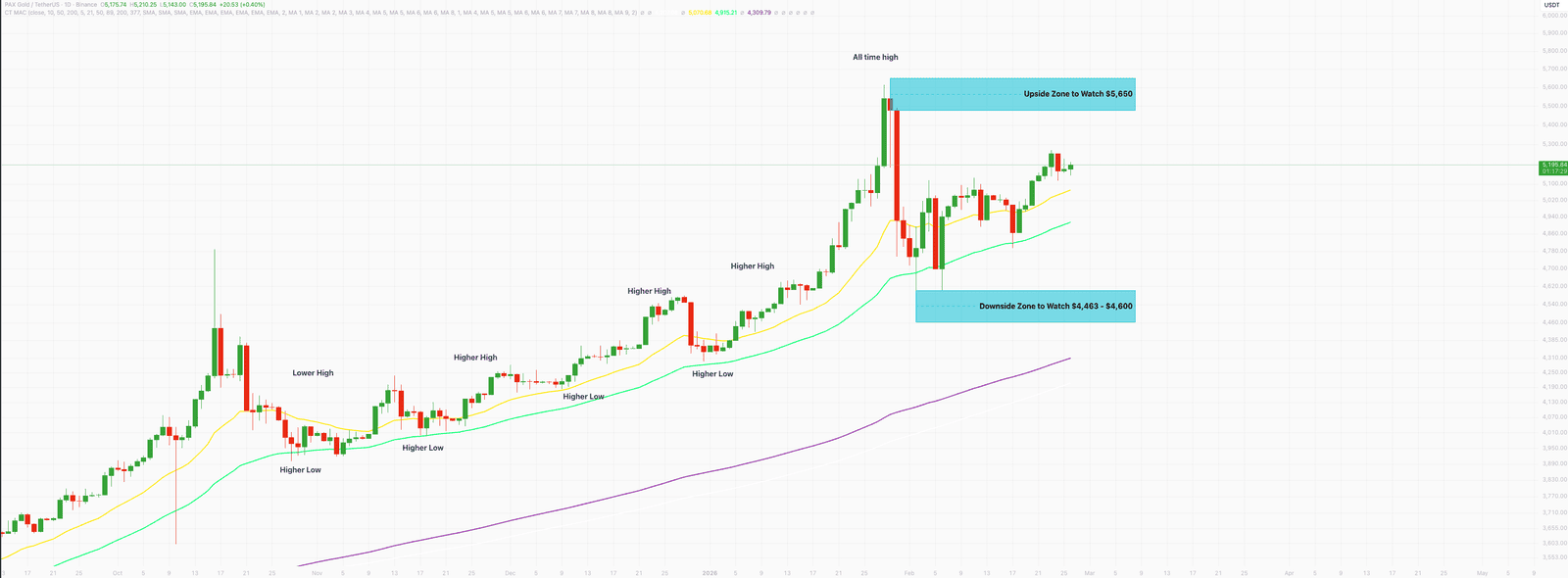
Stormrake Spotlight: Pax Gold (PAXG) ($5,195)
Stormrake Spotlight: Pax Gold (PAXG) ($5,195)