To receive the Morning Note in your inbox, subscribe here: https://stormrake.substack.com/
Bitcoin is beginning to behave differently.
The ongoing escalation in the Middle East is putting pressure across global markets. Oil prices are rising, the US dollar is strengthening, and bond yields continue to climb as capital moves toward traditional safety. Historically, that combination has been negative for Bitcoin.
A stronger dollar has typically pushed BTC lower, rising oil prices tend to signal risk off conditions, and higher yields usually pull capital toward bonds rather than alternative assets.
Yet Bitcoin is currently holding near $74,000, its highest level since before the conflict escalated.
All three macro pressures are present at the same time, and Bitcoin is rising anyway.
A Shift in How the Market Sees Bitcoin
What we may be witnessing is Bitcoin slowly repricing from a speculative risk asset toward something closer to a neutral reserve asset.
This idea has existed in theory for years. Bitcoin as politically neutral collateral. Bitcoin as a hedge during geopolitical instability.
But theory rarely survives real market stress, and this time it may be different.
War has a tendency to accelerate financial change. What might have taken years of debate can happen within weeks when capital starts searching for neutral ground.
Bitcoin may be entering that phase.
Demand Is Rising While Supply Tightens
The structural data behind the move is becoming harder to ignore.
Over the last week, the Bitcoin spot ETFs has seen $763.4M in inflows, marking back to back weeks of positive demand. Zooming out slightly further, ETFs have accumulated more than $2.1B in BTC over the past three weeks, the first sustained inflow streak since September.
At the same time, supply on exchanges continues to shrink. Exchange reserves have fallen to their lowest level since 2019, meaning fewer coins are available for immediate selling pressure.
Large holders are also accumulating, with wallets holding 100 BTC or more reaching a record 20,031.
Rising institutional demand combined with tightening liquid supply is typically the foundation for sustained price expansion.
Quiet Decoupling

Market correlations are also beginning to shift. Bitcoin’s correlation with the S&P 500 has dropped below 0.5, suggesting BTC is no longer moving in lockstep with equities. At the same time, its volatility has been lower than several major macro assets during the recent geopolitical shock.
Oil is volatile. Equities are falling. The dollar is surging. Bitcoin, comparatively, has been calm. Sometimes markets move because of narrative. Other times they move because capital is simply looking for the least chaotic place to sit.
Right now, Bitcoin may be that place.
If that dynamic continues, we may be witnessing the early stages of a broader structural shift in how Bitcoin is perceived by global capital.
One could call it a regime change.
Because if Bitcoin can rally while the dollar rises, oil spikes, and yields climb, then the macro playbook that governed BTC for the past five years may no longer apply.
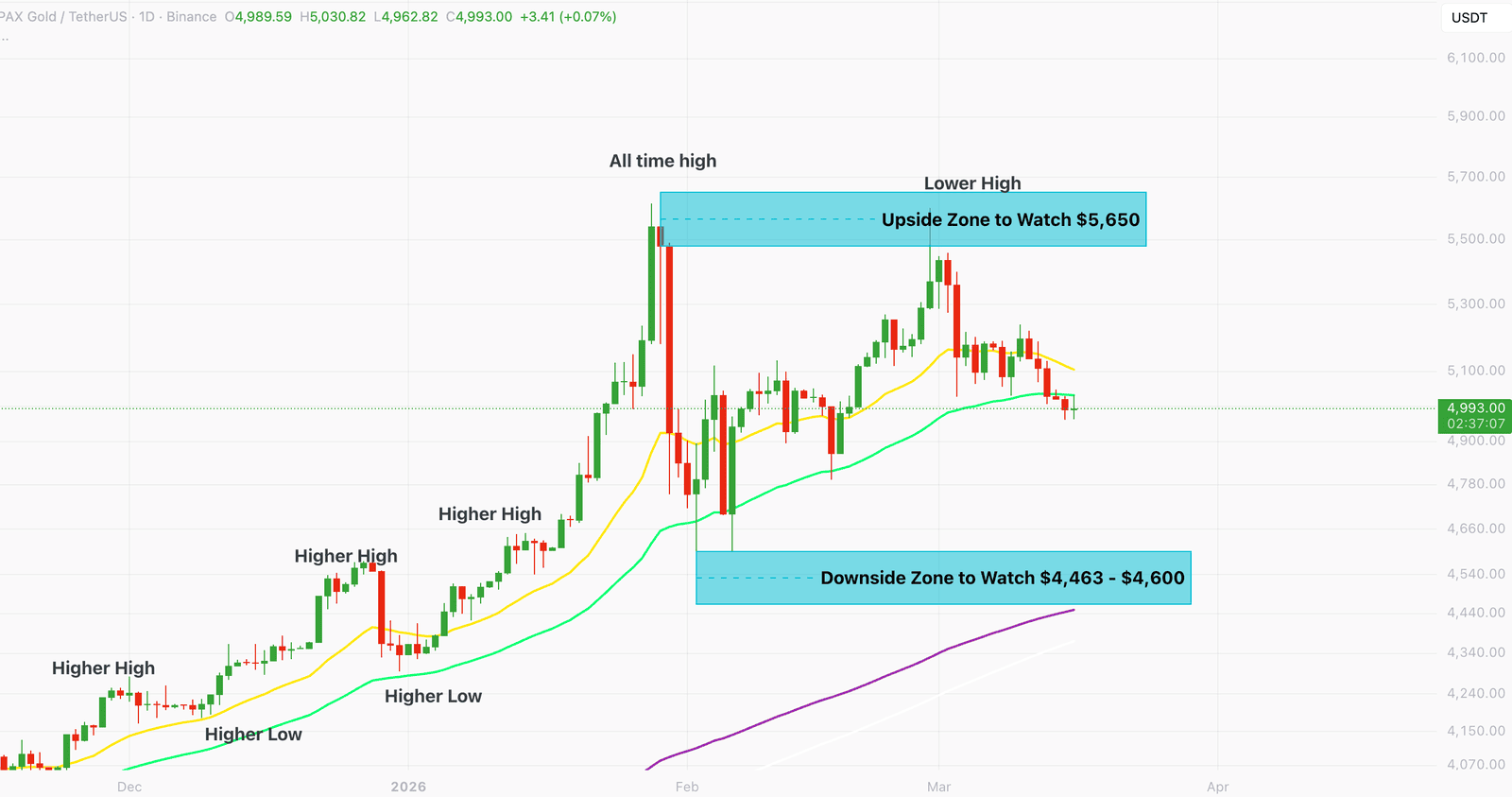
Stormrake Spotlight: Pax Gold (PAXG) ($4,993)
Stormrake Spotlight: Pax Gold (PAXG) ($4,993)