To receive the Morning Note in your inbox, subscribe here: https://stormrake.substack.com/
The long-held Australian narrative of unstoppable real estate growth is facing a significant structural challenge. Data highlighted by ABC News reveals that the domestic housing market has entered a visible correction phase, underscored by a sharp collapse in auction clearance rates. National clearance rates have plunged to approximately 50.4 per cent, marking the lowest final results witnessed since the early economic disruptions of the 2020 pandemic.
This drop places market activity firmly within the technical band historically associated with negative capital growth across major capital cities like Sydney and Melbourne. A profound mismatch now exists between the pricing expectations of stubborn vendors and the realities faced by constrained buyers. Persistent interest rate hikes, cost of living pressures, and recent federal budget adjustments to property taxes have severely impaired borrowing capacity, causing buyers to withdraw from the arena.
The Illiquidity Trap of Legacy Capital
The unwinding of the housing boom exposes the foundational risks embedded within traditional brick-and-mortar investments. Real estate requires immense debt leverage, carries heavy maintenance frictions, and subjects investors to direct sovereign policy risk. Recent adjustments to negative gearing and capital gains tax discounts demonstrate how quickly the regulatory landscape can turn against property holders.
When a localised market enters a downturn, capital becomes effectively trapped due to the illiquid nature of the asset class. Sellers are forced to either accept steep capital discounts or hold onto depreciating assets while navigating elevated mortgage servicing costs. This vulnerability highlights the danger of relying on geographically captive, debt-dependent assets as the primary vehicle for long-term wealth preservation.
The Real Price of Real Estate
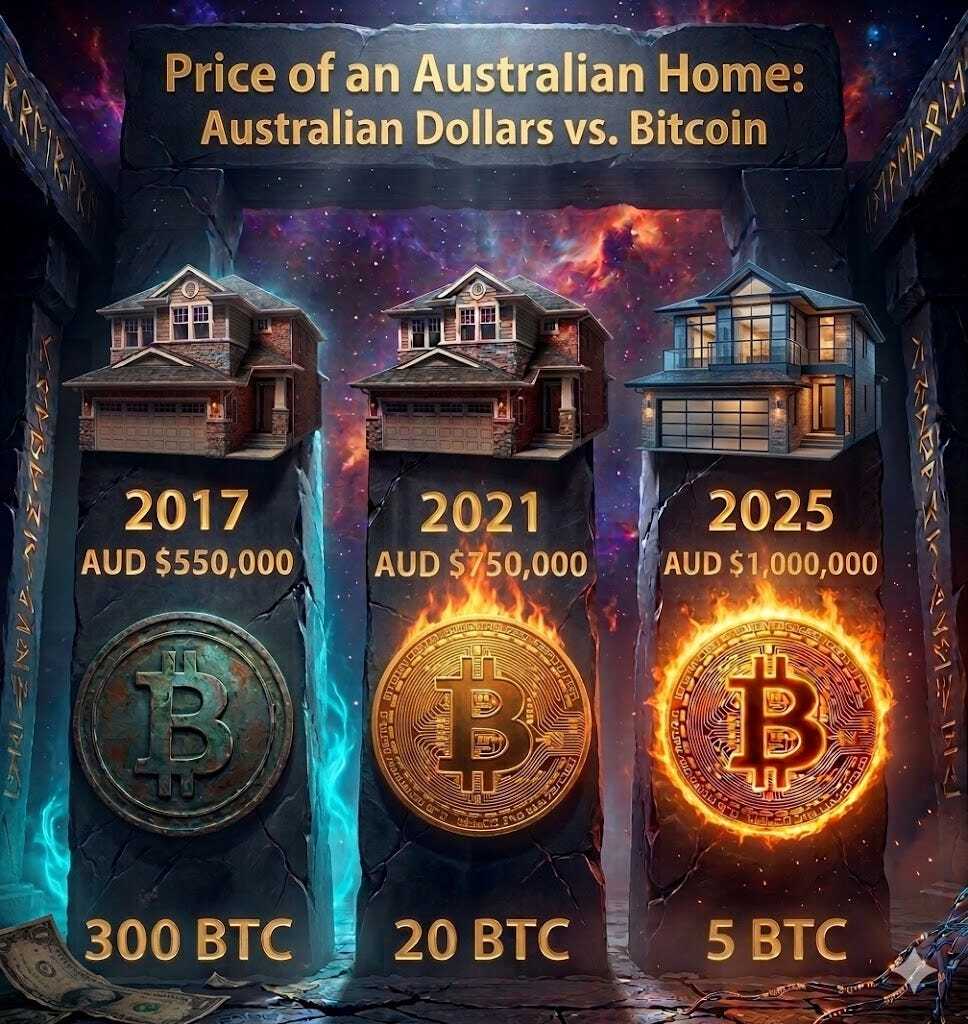
Measuring legacy assets against Bitcoin exposes the ultimate denominator illusion. In 2017, an average Australian home cost AUD $550,000, requiring ~ 300 BTC. By 2021, the fiat price inflated to AUD $750,000 while the Bitcoin cost collapsed to ~ 20 BTC. By 2025, property commanded AUD $1,000,000+ to own, yet required a mere ~ 5 BTC in contrast.
While everyday market participants take on expanding debt burdens to chase rising nominal prices, capital stored in a finite digital asset secures an unparalleled expansion of global purchasing power. This stark divergence demonstrates that physical property is simply reflecting the systematic dilution of the fiat currency used to price it.
The Apex Asset of the Future
This domestic real estate stagnation provides a stark contrast to the structural advantages of Bitcoin. Bitcoin serves as the ultimate evolution of property, offering absolute digital scarcity without any of the geographic bondage, maintenance costs, or localised policy risks associated with physical real estate.
While property investors are constrained by the decisions of local central banks and domestic fiscal policies, Bitcoin operates on a borderless, global liquidity matrix. It remains largely immune to arbitrary legislative adjustments on prehistoric asset classes - such as negative gearing overhauls. As a pristine settlement asset, Bitcoin provides instantaneous global liquidity, allowing capital to move effortlessly away from localised macroeconomic headwinds. Long-term value retention belongs to assets that can be seamlessly transferred, divided, and defended without counterparty or state intervention.
The Long-Term Verdict
The potential on-going cooling of the Australian housing market signals a broader psychological rotation away from rigid, debt-burdened legacy assets. Forward-thinking capital is increasingly recognising the inefficiencies of physical property in a rapidly digitising world.
As the illusion of guaranteed real estate returns fades, the capital allocation thesis shifts decisively in favour of borderless, un-correlated apex assets. Bitcoin stands as the premier beneficiary of this unprecedented wealth transfer, poised to absorb global liquidity as traditional wealth vehicles continue to buckle under macroeconomic pressure.
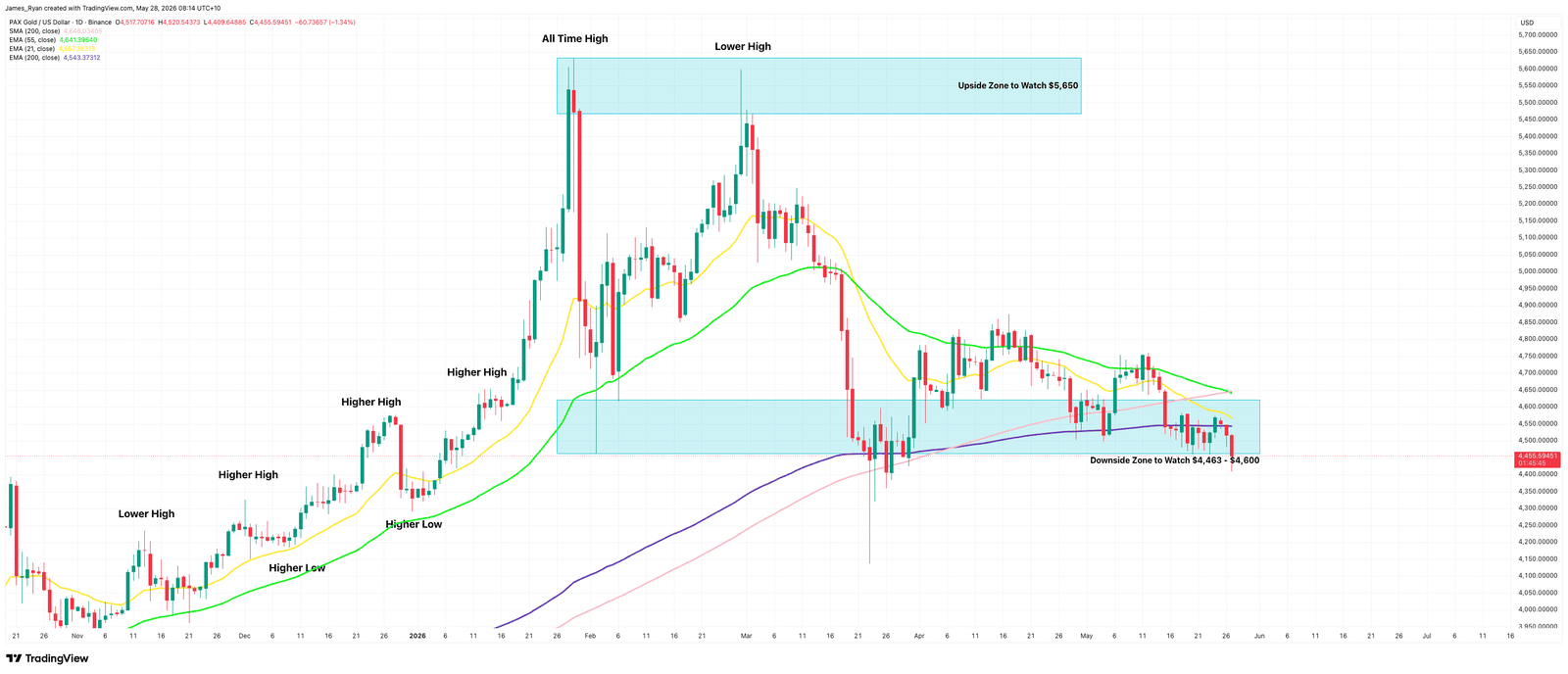
Stormrake Spotlight: Pax Gold (PAXG) ($4,454)
Stormrake Spotlight: Pax Gold (PAXG) ($4,454)