In the arena of digital asset allocation, market participants frequently fall victim to a classic cognitive trap: the pursuit of perfect execution at the expense of macro positioning. This phenomenon usually manifests as investors sitting on the sidelines, waiting for a minor pullback to optimise their entry price while ignoring the broader secular trajectory.
When analysing an asset with an asymmetric return profile, this hyper focus on short term price fluctuations represents a fundamental misunderstanding of risk management.
The Three Possible Outcomes
To understand the mathematical inefficiency of waiting for lower prices during a secular expansion, we can look at three distinct outcomes for an investor looking to secure a full unit allocation, assuming a current spot price of $60,000 (give or take) and a conservative long term target of $400,000 within a decade from now.
The Optimal Timing Outcome:
The investor correctly forecasts a local retracement, and the price drops to $45,000. Capital is successfully deployed at the absolute bottom. When the asset eventually achieves its ten year macro target of $400,000, the total return equates to $355,000. In this best case scenario, perfect market timing saved the allocator exactly $15,000.
The Sidelined Capital Outcome:
The anticipated retracement fails to materialise. The market maintains its upward trajectory, leaving the hesitant investor with zero allocation. Regardless of how high the price climbs over the next ten years, the realised return remains exactly zero. The opportunity cost is the entire macro expansion.
The Pragmatic Allocation Outcome:
The investor rejects the timing game and deploys capital at the current market price of $60,000. When the asset reaches $400,000, the total return is $340,000. By paying a temporary market premium, the investor has guaranteed exposure to the macro trend.
Asymmetry of Choice
When these scenarios are compared side by side, the structural flaw of waiting on the sidelines becomes obvious.
In the absolute best case scenario, successful market timing saves an investor a marginal $15,000. In the worst case scenario, the pursuit of that minor saving costs the investor an entire lifetime allocation.
The math demonstrates that the downside of being wrong vastly outweighs the upside of being right. Trying to time a highly volatile asset class to save a small fraction of capital introduces a catastrophic risk: missing the generation defining move entirely.
Execution and Forward Positioning
Securing direct spot property is an exercise in managing probability rather than predicting exact local coordinate bottoms. For allocators focused on multi year wealth preservation, the priority must always be securing unencumbered exposure to absolute scarcity rather than risking complete exclusion for a minimal discount.
The professional trading desk at Stormrake remains fully prepared to assist with large scale spot execution models, allowing market participants to establish strategic positions under true market conditions without the friction of the timing paradox.
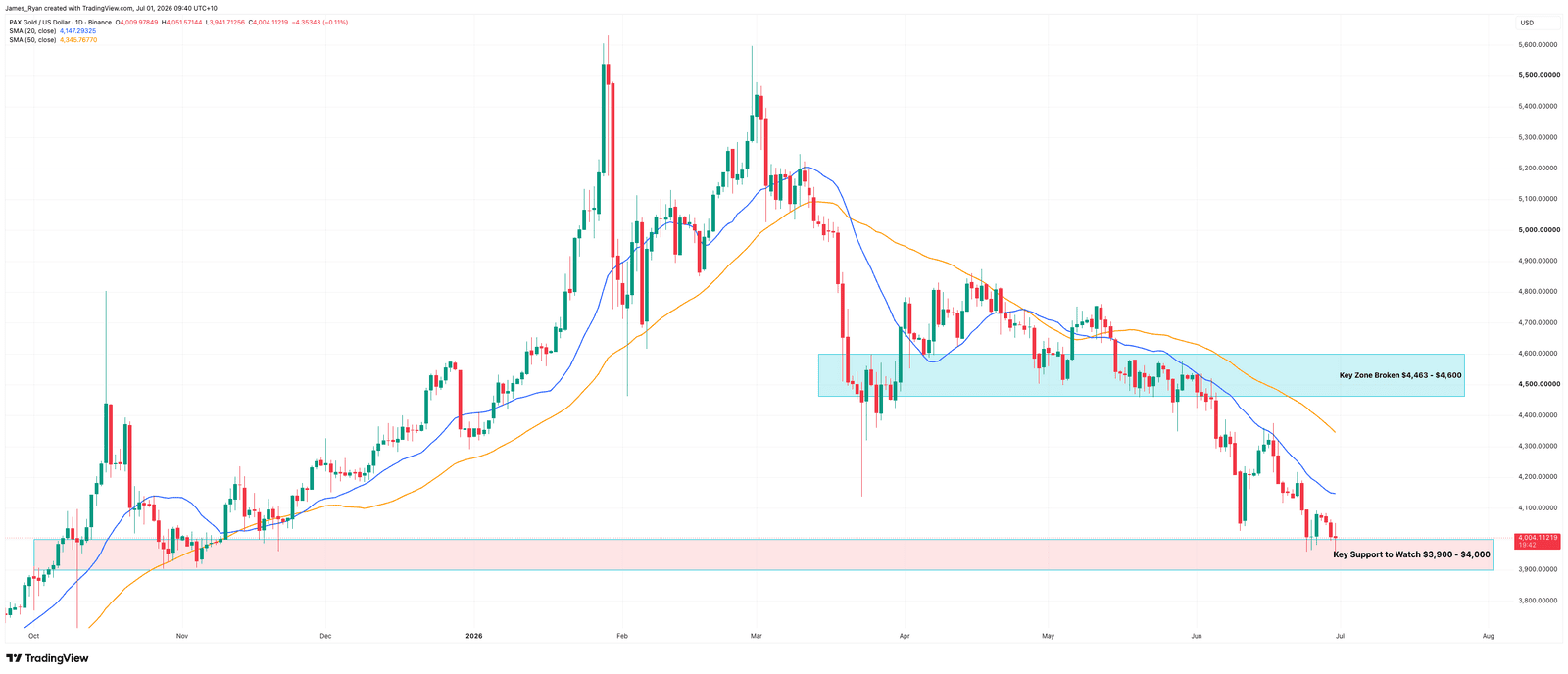
Stormrake Spotlight: Pax Gold (PAXG) ($4,004)