To receive the Morning Note in your inbox, subscribe here: https://stormrake.substack.com/

Australian housing has compounded for nearly four decades without a genuine bear market. Since 1991, national prices have never fallen for more than two consecutive years, downturns have averaged just 12 months and 4.3%, while growth phases have averaged 41 months and 34%. The 30-year average sits around 6.4% to 7.25% nominal per year. Bitcoin, by contrast, has had four brutal multi-year drawdowns already, each one followed by a recovery larger than the one before it.
The Data Doesn’t Lie
The comparison is worth running. As at 30 June 2026, the national median dwelling value sits at $937,722 AUD, Sydney at $1,265,608, Melbourne at $808,486. Bitcoin currently trades around $63,000 USD, roughly $89,000 AUD. Take a conservative scenario: Bitcoin reaches $200,000 USD (~$282,500 AUD) within this cycle’s typical three to four year window, a 3.17x return, below the scale of each of its three prior expansions. To match that, national housing would need to reach roughly $2.98 million, Sydney $4.02 million, requiring sustained growth of around 33.5% per year for four years, or 47% per year over three. The best sustained stretch in this market’s modern history, 1998 to 2003, delivered around 10% a year. Nothing in housing’s own history comes close to what matching Bitcoin’s next leg would actually require.
Sydney and Melbourne are already sliding, and leverage makes that sting fast. Sydney’s median has fallen roughly 3.7% since its January 2026 peak, Melbourne around 4.2% since December 2025, the steepest quarterly Melbourne house fall in almost four years. Combined capital prices fell for the first time in over three years this year, ending the longest growth run since 2012 to 2015. NAB has lifted its 2026 national decline forecast to 5%, Morgan Stanley has flagged a possible 10% fall, which would be the largest in at least 40 years.
Leverage is a Risk, Regardless of the Asset Class
Here’s where leverage turns a modest correction into a real problem. A buyer using the government’s 5% deposit scheme is borrowing 95% of the property’s value, which is roughly a 20 to 1 leverage bet. A price fall of just over 5% is enough to wipe out their entire equity. This isn’t hypothetical, nine of the ten postcodes with the highest uptake of the First Home Buyer Guarantee have already recorded declines since the start of 2026, and an estimated 50,000 recent first home buyers nationally are facing this exact squeeze. A 5% deposit buyer isn’t making a cautious entry into the market, they’re taking a 20 to 1 leveraged position on an asset that was already historically expensive before this year’s correction began, with almost no equity cushion to absorb a downturn well within the market’s normal range.
From 10 August 2026, SMSFs can no longer use limited recourse borrowing arrangements to buy residential property, existing loans are grandfathered and commercial borrowing is unaffected, but the strategy that let a modest SMSF balance leverage into a much larger residential purchase has been legislated shut. As things stand, no equivalent restriction applies to holding Bitcoin inside an SMSF, the existing rules around the sole purpose test, diversification and valuation remain unchanged. One asset class inside super just lost one of its most effective growth levers. The other remains exactly as accessible as it’s always been.
One Door Closes, One Stays Open
Housing’s strength has never been speed, it’s been the near-total absence of a real bear market for four decades. Bitcoin’s strength is the opposite, drawdowns brutal enough to reset the base for genuinely explosive recoveries. Matching even a conservative Bitcoin target isn’t asking housing for a strong year, it’s asking for four years of growth roughly five times faster than this asset has ever sustained. Layer on the leverage many first home buyers are actually carrying right now, and the risk-adjusted picture looks worse still: a highly leveraged bet on an already expensive asset, with a margin of error measured in single-digit percentages, at the exact moment forecasters are debating how much further this correction runs. With SMSF residential leverage options narrowing while Bitcoin remains fully accessible inside super, evaluating digital asset allocations within superannuation represents an increasingly relevant consideration for trustees.
Stormrake works directly with SMSF trustees to structure compliant Bitcoin exposure inside super, covering regulatory requirements, secure custody, and reporting. If you hold an SMSF and want to discuss how this operational structure works, your dedicated Stormrake broker is ready to assist - contact them today.
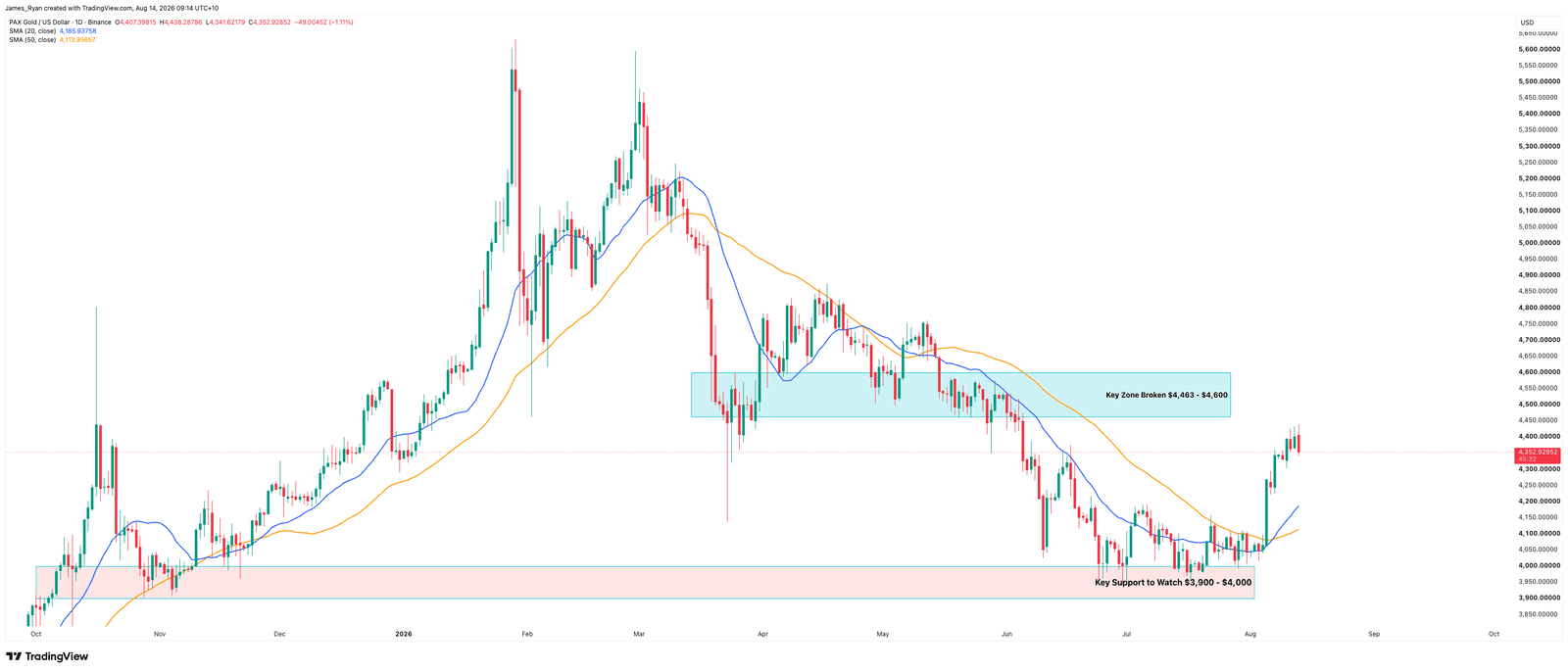
Stormrake Spotlight: Pax Gold (PAXG) ($4,352)
Stormrake Spotlight: Pax Gold (PAXG) ($4,352)