
The US Debt Path Is Breaking the System

29 Jan 2026 11:23 AM By Stormrake

To receive the Morning Note in your inbox, subscribe here: https://stormrake.substack.com/
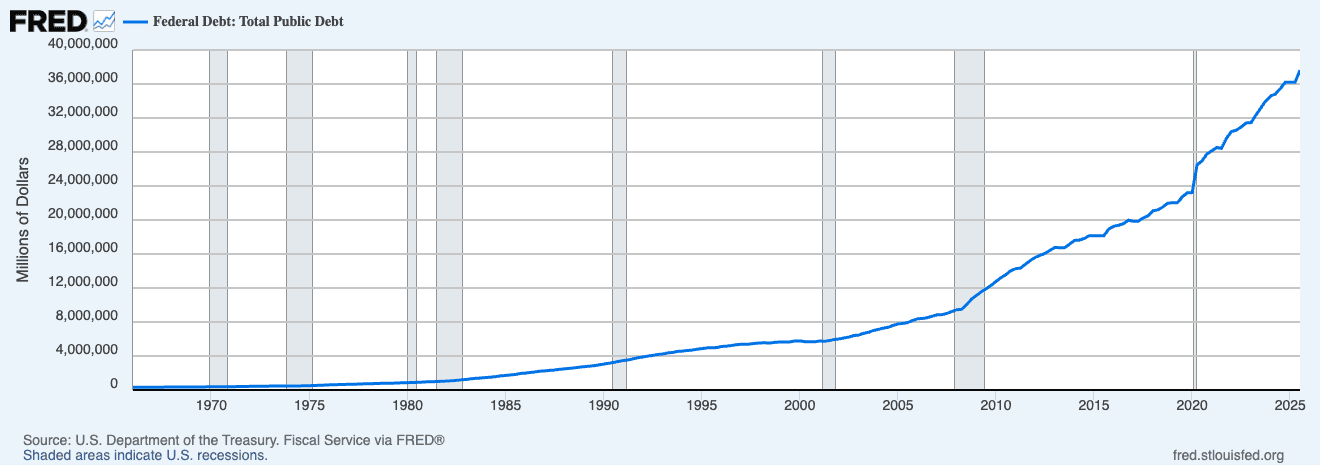
In our first Morning Note of 2026, we covered the scale of US government debt and the fact that over a third of it is due to mature this year. US national debt currently stands at approximately $38.5 trillion, a remarkable figure and one that has grown by more than 50% since the start of the decade, when total debt sat closer to $23 trillion.

For years, those who recognised the unsustainable trajectory of US government borrowing have sought refuge in hard assets such as gold, silver and Bitcoin. As debt levels have risen, money creation has accelerated, inflation has remained structurally elevated, and the purchasing power of the US dollar has continued to erode.

Over the same period, hard assets have materially outperformed fiat currencies. Since the start of the decade, gold is up approximately 250%, silver has risen around 550%, and Bitcoin has appreciated by more than 1,200%. This is not coincidence. It reflects a growing recognition of monetary debasement and fiscal fragility.

Perhaps the most important confirmation of these concerns, however, came not from market participants but from the Chair of the US Federal Reserve, Jerome Powell, himself.
Following the decision to hold interest rates steady, which was widely expected by markets, Powell directly addressed the issue of US government debt. The line that dominated headlines was:

“The level of U.S. debt is not unsustainable… But the path is unsustainable.”

This distinction matters. While the sheer size of US government debt is already a major concern, the greater risk lies in its trajectory. Persistent deficits, rising refinancing costs, and political constraints are making meaningful fiscal reform increasingly difficult.

Against this backdrop, aggressive fiscal expansion, including further debt issuance and refinancing at higher interest rates, risks compounding the problem. As borrowing costs rise and deficits persist, the national debt continues to grow faster than the economy itself. This places increasing pressure on a critical metric, the debt to GDP ratio.
US Debt to GDP Ratio (Source: https://fred.stlouisfed.org/series/GFDEGDQ188S)
The US debt to GDP ratio now sits above 120%. This ratio measures government debt relative to economic output and is commonly used as an indicator of fiscal sustainability. For context, Australia’s debt to GDP ratio remains closer to 40%.

High debt to GDP ratios do not automatically lead to collapse or hyperinflation, particularly for countries that issue debt in their own currency. However, history shows that once nations reach these levels, policy responses often involve financial repression, currency debasement, or a gradual loss of confidence, rather than clean and painless adjustments.

Extreme cases such as Weimar Germany, Argentina, Venezuela and Zimbabwe suffered hyperinflation not simply because debt was high, but because debt was compounded by currency mismatches, collapsing productive capacity, political instability, or external obligations that could not be serviced.

A more instructive comparison is the United Kingdom after the Second World War. British debt surged to around 250% of GDP, and while the country avoided hyperinflation, it experienced decades of devaluation, capital controls, and relative economic decline. Sterling gradually lost its status as the world’s reserve currency and was replaced by the US dollar.

Now, in 2026, the US finds itself at an inflection point. Debt levels continue to rise, refinancing costs are materially higher than in the previous decade, and the Federal Reserve has openly acknowledged that the current fiscal path is unsustainable.

This reality strengthens the case for hard assets, not just as inflation hedges, but as protection against long term currency debasement and a gradual erosion of monetary credibility. It also raises uncomfortable questions about the future role of the US dollar as the world’s dominant reserve currency.

History is clear. Fiat currencies do not last forever. They weaken, and are eventually replaced. The global economy has lived through dozens of monetary regimes, and each ultimately failed for the same reason, unchecked expansion of supply.

This is why the case for Bitcoin continues to strengthen. Its fixed supply, decentralised nature, and immunity to political interference position it as a credible long term monetary alternative in a world increasingly defined by fiscal excess.

It is for this reason that many investors have already begun positioning themselves accordingly. It may not be too late, but the window to do so before broader adoption accelerates is narrowing. As with all monetary transitions, those who recognise the shift early tend to benefit the most.

Stormrake Spotlight: Pax Gold (PAXG) ($5,447)

PAXG was the clear outperformer overnight, rallying nearly 5% in the last 24 hours following Jerome Powell’s comments. As risk appetite faded, investors rotated aggressively into defensive assets, with tokenised gold benefitting the most.

This move is shaping up to be the largest single day candle for PAXG since March 2020, highlighting the speed at which capital is repositioning when confidence in fiat weakens.

BTC/USD Key Levels and Price Action:

Bitcoin is attempting to unwind the bearish price action seen over the weekend, with bulls working to sustain a move above the key $88,888 level. An overnight push above $90,000 ultimately failed, but momentum has since shifted back in favour of buyers.

Despite this recovery, the broader structure remains range bound and neutral. Conviction is likely to remain muted until price either reclaims the upper range convincingly or breaks lower with volume.

BTC Total ETF Flows for 28 Jan: (data not available at the time of writing)

(ETF flow data is sourced from https://farside.co.uk/btc/ and reflects figures at the time of writing.)
To receive the Morning Note in your inbox, subscribe here: https://stormrake.substack.com/

*All prices are denominated in USD unless stated otherwise*

Written by Alexandar Artis and James Ryan

Create a brokerage account today

No Advice Warning 

The information in this newsletter is general only. It should not be taken as constituting professional advice from the author - Stormrake PTY LTD.
Stormrake is not a financial adviser and does not provide financial product advice. You should consider seeking independent legal, financial, taxation or other advice to check how the information relates to your unique circumstances. Stormrake is not liable for any loss caused, whether due to negligence or otherwise arising from the use of, or reliance on, the information provided directly or indirectly, by this newsletter.
 

Disclaimer 

All statements made in this newsletter are made in good faith and we believe they are accurate and reliable. Stormrake does not give any warranty as to the accuracy, reliability or completeness of information that is contained here, except insofar as any liability under statute cannot be excluded. Stormrake, its directors, employees and their representatives do not accept any liability for any error or omission in this newsletter or for any resulting loss or damage suffered by the recipient or any other person. Unless otherwise specified, copyright of information provided in this newsletter is owned by Stormrake. You may not alter or modify this information in any way, including the removal of this copyright notice.

Copyright © 2024 Stormrake Pty Ltd, All rights reserved

Stormrake