To receive the Morning Note in your inbox, subscribe here: https://stormrake.substack.com/

Vladimir Putin signed Russia’s “On Digital Currency and Digital Rights” law yesterday, creating the country’s first fully regulated cryptocurrency market. From September 1, licensed exchanges, brokers, custodians and depositories, all supervised by the Bank of Russia, will let both retail and qualified investors trade approved crypto assets, with retail buyers capped at roughly $3,800 per year per intermediary after passing a competency test. Crypto is classified as an investment asset, not currency; domestic payments in crypto remain banned. Firms have until July 2027 to bring existing operations into compliance.
The framing matters as much as the mechanics. This is not deregulation for its own sake, it’s state capture of a market Russians were already using at scale. In the fortnight after the 2022 invasion, peer to peer ruble to Bitcoin trades tripled as the currency cratered under sanctions. That was never a blip: Chainalysis puts Russia’s crypto inflows at $379 billion between July 2024 and June 2025, up 48% year on year, overtaking the UK as Europe’s largest crypto market. Russia had already carved out an experimental regime for crypto in cross border trade back in 2024. This new law formalises and expands that channel into permanent market structure, the exact route Western sanctions have spent years trying to close.
Iran has followed a similar playbook. Following years of US sanctions, Tehran began accepting Bitcoin and other digital assets for safe passage through the Strait of Hormuz via a state run maritime insurance scheme called Hormuz Safe. Different execution to Russia, same underlying logic: crypto as the workaround once conventional banking access is cut off.
The contrast with Washington is stark. The Digital Asset Market Clarity Act, the most advanced US market structure bill in history, cleared the House in July 2025 and the Senate Banking Committee in May, will not get a Senate floor vote before the August 7 recess. Majority Leader Thune has confirmed there isn’t time left for debate, amendments and cloture before the chamber breaks. Polymarket odds on 2026 passage have collapsed from 82% in February to roughly 28% today; Kalshi’s “before Dec 1” market has fallen sharply over the past fortnight too, from around 60% in late July down to 17% as of this morning. Miss the window and the bill waits until at least September, with Senator Lummis warning a slip this year could push comprehensive US legislation out as far as 2030 once midterm cycle gridlock sets in.
Two sanctioned economies have moved faster on crypto policy than the country whose currency crypto still largely prices against. That irony is real, but it doesn’t change the setup in front of us. Bitcoin is trading around $65,000, roughly 50% below its October 2025 all time high of $126,000. Every 40 to 50% correction in Bitcoin’s history since 2014 has been followed by a new all time high, and this drawdown is already shallower than the 73 to 84% washouts of prior cycles, a sign of a maturing, more institutionally anchored market rather than a broken one.
Clarity delays don’t remove the long term case, they just push the window out. Sovereign demand isn’t waiting on Washington. Russia and Iran are proof that states will find their own rails with or without US legislation, and that same institutional and sovereign appetite is still queued up behind Clarity, ready to move the moment it lands. Drawdowns like this one, deep enough to shake out weak hands but shallow enough to reflect real structural maturity, have historically been the best entry points in Bitcoin’s history. They do not last. The dominoes are lining up. Whether you’re positioned before they fall is the only question that matters from here.
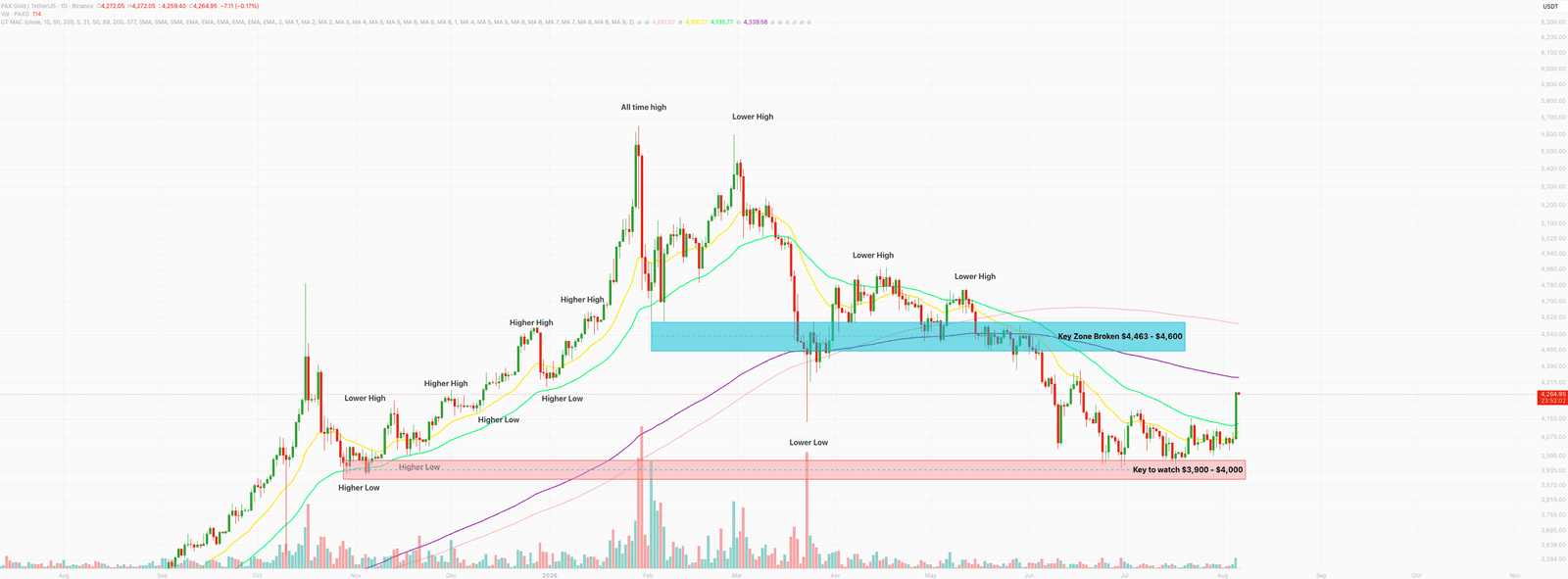
Stormrake Spotlight: Pax Gold (PAXG) ($4,266)
Stormrake Spotlight: Pax Gold (PAXG) ($4,266)