Bitcoin, BOJ Yields, and the Yen: The Next Financial Tug-of-War

19 Jan 2026 04:49 PM By Stormrake

Between the deluge of Japanese Bond Market volatility, yields spiking to highs not seen since the 2008 Global Financial Crisis, a potential new Fed chairman and the re-opening of the US Government after the longest shutdown in history; we’re at a pivotal crossroad that’ll set us up for a monstrous 2026 and beyond. Bitcoin has seen significant volatility recently, both to the downside and upside in a very short period of time. While the uninformed and over-leverged investors have mostly been chopped up with recent price-action, we’re exceedingly pleased with how our clients at Stormrake have ridden out the waves of volatility with certainty and confidence knowing where all these short-term macro-headwinds take Bitcoin’s price in the long-run. Our long-term thesis for Bitcoin’s future hasn’t changed despite all the recent headlines and Crypto twitter doom-posting narratives that’re to be expected when people get flushed out at bottoms; not knowing the true value of what they’re holding. We’ve seen it during the 2017 bear market after the altcoin ICO bubble popped, also during the Terra Luna and FTX collapse of 2022. Once again, we’re cutting the wheat from the chaff while the market takes some time here to test the resolve of all its participants, both big and small bag holders alike. Those that remain steadfast with their pre-defined strategies and hold resolute to their future goals have always been greatly rewarded in time. Bear markets are where the future bitcoin millionaires are made, but as is the case with everything in life - nothing good comes easy. Patience and consistently by adding to position sizing has and always will be key to take full advantage of the opportunities that present themselves during this volatile time period. Understanding the macro-economic conditions, especially the Japanese Bond market and the potential strengthening of the US Dollar will play an important role in determining the direction and trend of risk-on assets such as Crypto in the short to medium term. Let’s take a look at how the Bond market is fairing across the pond in the land of the rising sun.
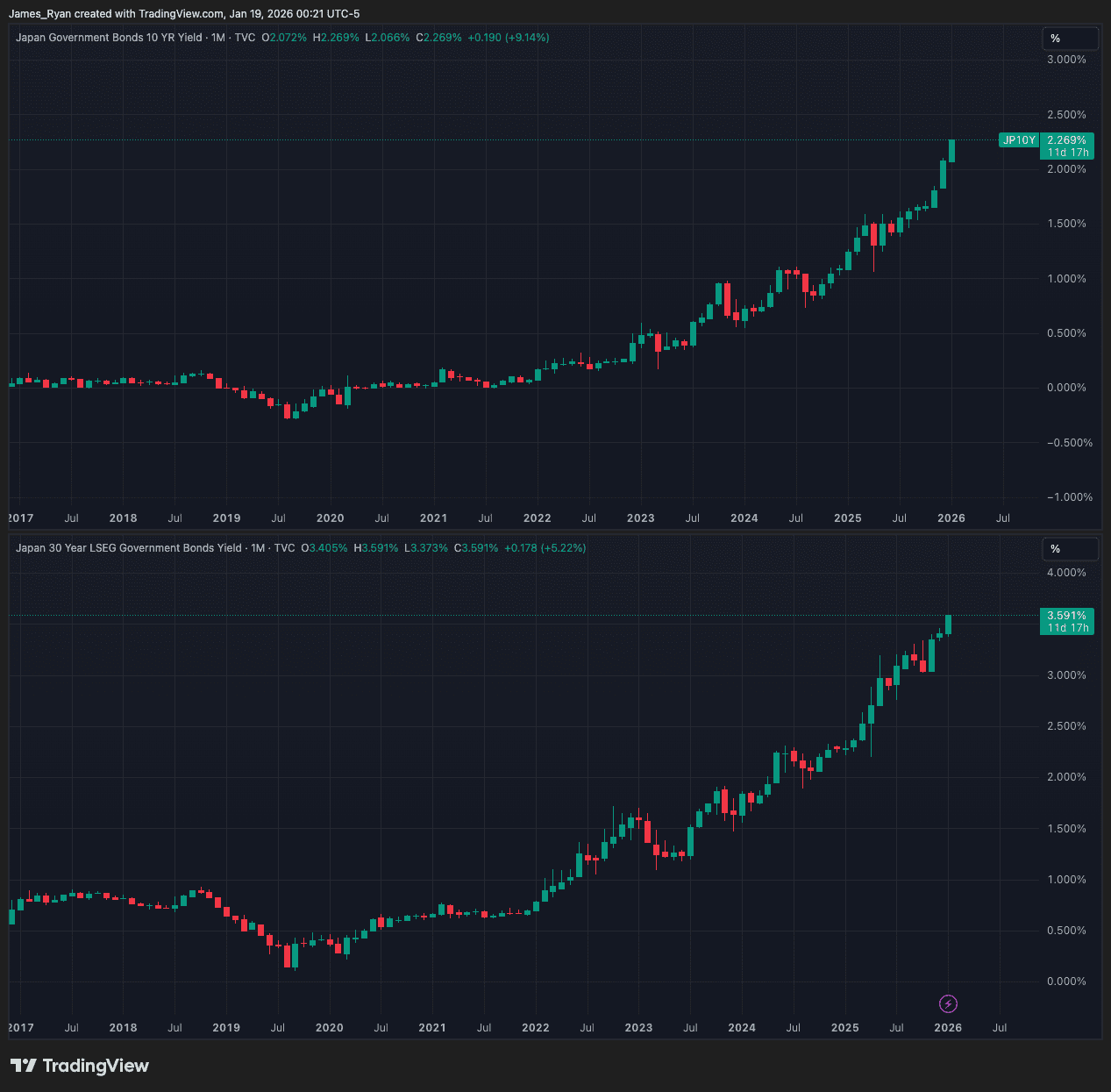
As Japanese yields are starting to teeter into all-time high territory, the market is reacting with bearish sentiment until this starts to un-wind. The yield spiking is a direct result of the direct selling pressure to offload treasuries given the somewhat hawkish pivot for Japan to unwind its Yield Curve control in the last few years and catch up with the rest of the developed world by having relatively higher rates to combat inflation.
This is particularly significant for global markets because Japan has long been a source of cheap credit. As the Bank of Japan moves toward unwinding its Yield Curve Control (YCC) and allowing yields to rise, it creates a ripple effect in global liquidity. The unwind of these policies reduces the availability of inexpensive capital for carry trades, where investors borrow in yen to buy higher-yielding assets in other countries. With rising yields in Japan, borrowing costs for these trades increase, forcing investors to deleverage and sell off risk assets, including equities and cryptocurrencies. This tightening of liquidity puts downward pressure on risk-on assets, leading to heightened volatility and bearish sentiment across global markets.

Now apply that same principle directly to the strengthening US dollar versus a weakening Japanese yen. This is a systemic tightening of global financial conditions that directly impacts the appetite and capacity for risk, as opposed to a simple currency move.

A strengthening USD relative to the yen represents a deepening imbalance in the global funding system. For decades the yen has been the base currency for cheap leverage. Investors borrow in JPY at near-zero rates, convert to USD, and deploy the capital into higher-return assets: US equities, Emerging-Market assets, credit products, and increasingly Bitcoin.

When the USD strengthens significantly against the yen, the first-order of effect is straightforward: yen-denominated liabilities grow more expensive in USD terms, while USD-denominated assets must work harder to cover the same debt. This pushes leveraged players, especially carry traders, into a corner. They can no longer rely on exchange-rate stability to keep profits intact.

As the USD/JPY pair rises, anyone who borrowed yen to buy risk assets suddenly finds that the funding currency is weakening, and the asset currency is strengthening. In theory this sounds favourable, but only when the move is slow and orderly. A sharp or persistent USD surge tells the market something different: that liquidity conditions globally are tightening, that the Bank of Japan is losing control of yield compression, and that the probability of policy intervention or higher funding costs is rising. This is where the structural stress begins.

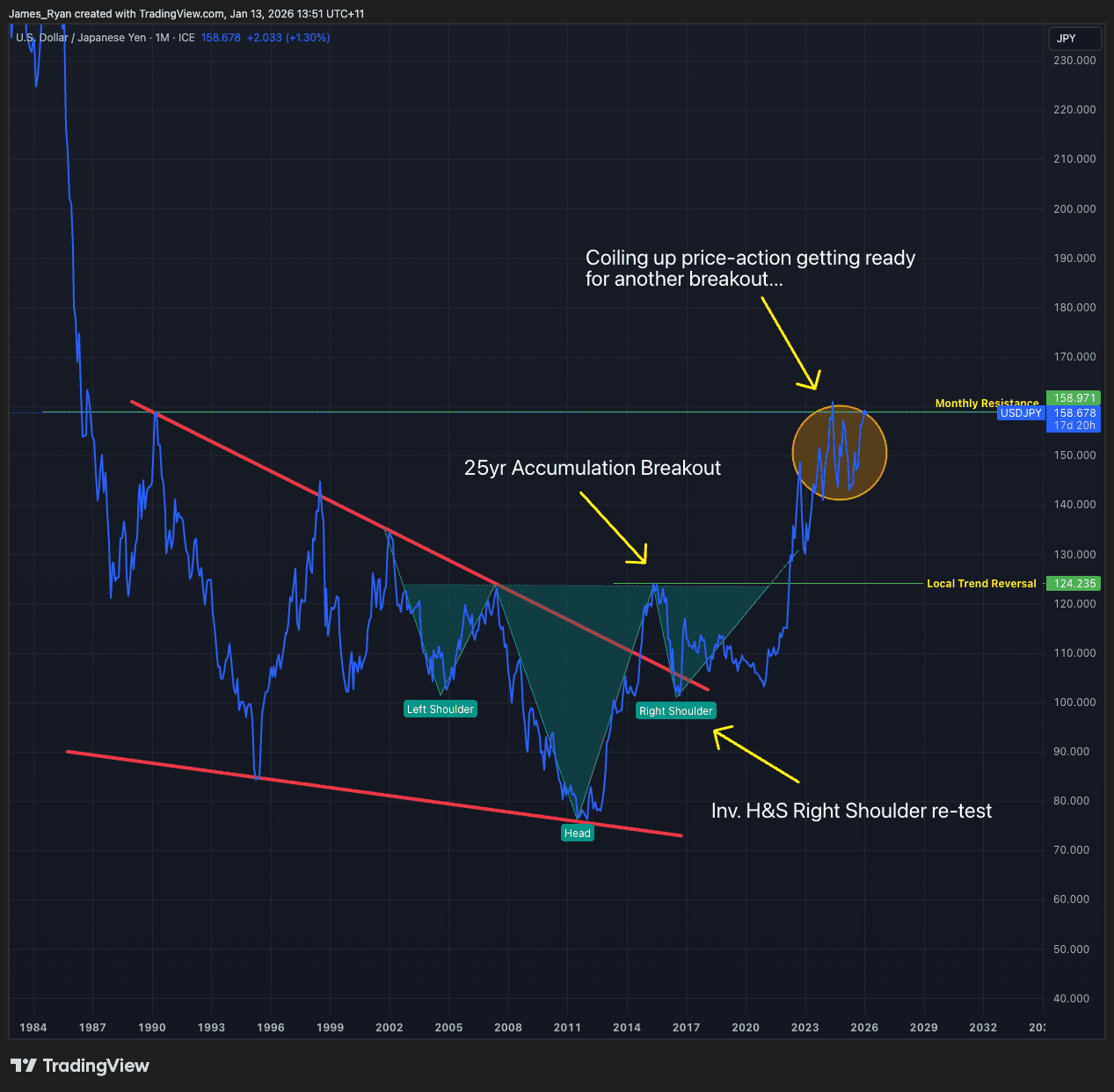
Another way we’re able to observe the structural decline of the Japanese Yen relative to the USD is simply by looking at the USD/JPY chart. This FX pair is one we’ve been eyeing for a number of years now and has proven to be highly effective as a barometer for broader market volatility, given its correlation to large macro-economic market swings for traditional markets.
The amount of confluence on this chart is quite staggering; not only have you got a breakout of a 25-year long accumulation breakout to the upside, an Inverse head and shoulders bullish pattern that successfully completed, along with another breakout that’s now launched straight into price resistance with ease, you’re also currently looking at price-action coil upwards - appearing to get ready for another significant push higher, of which there’s very little headwind resistance above. A third swing-higher here will be a large move and will likely maintain the Yen carry trade for a while longer as the USD appreciates in value compared to the JPY, which could potentially signal a green light for risk-on markets to keep printing higher, despite the rising BOJ interest rates. Naturally, at some point the BOJ will need to back-stop a depreciating Yen if it keeps losing value rapidly, however they’ll need to tread lightly as domestic Japanese wages are still very low compared to other developed Asian countries, and a rapid increase in interest rates like what we saw here in Australia over the last few years would likely ravage an already tepid Japanese economy. This is good for Bitcoin in the long term and plays neatly into our BTC strategy for 2026 and onwards. 

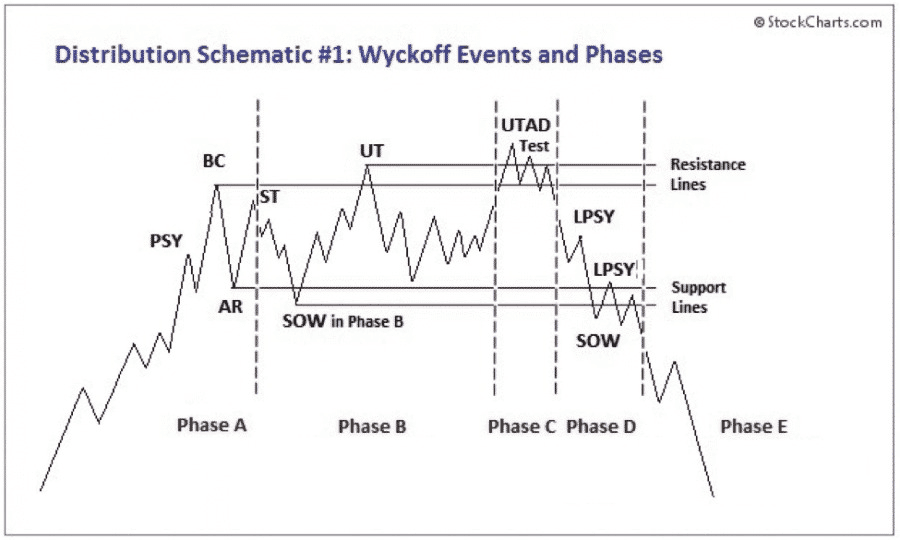
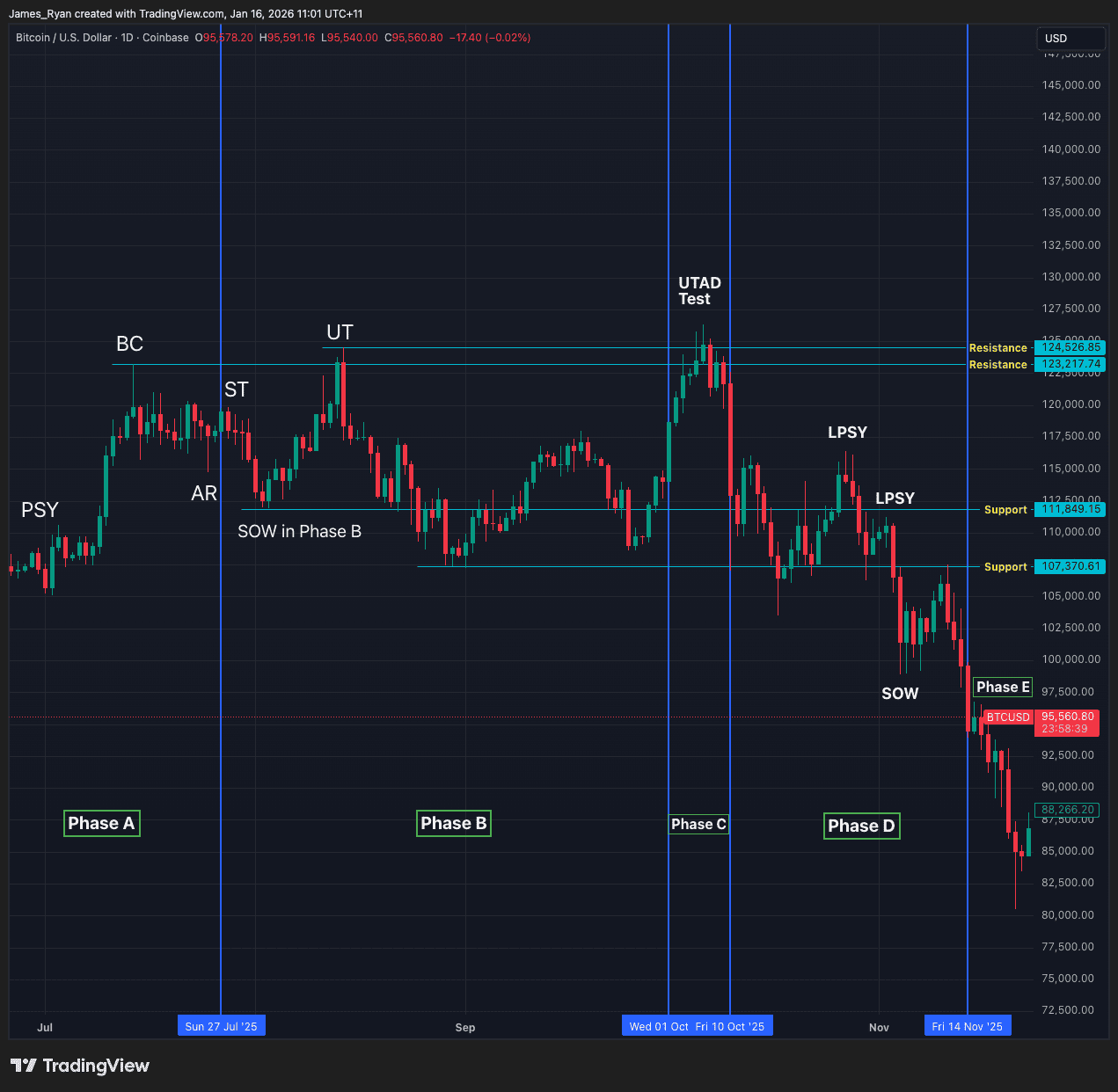
Bitcoin has taken the opportunity to correct and retrace to some excellent short-term buying opportunities over the past few months since the October 6th all-time-high, coming in at a whopping $126,000 USD per Bitcoin. Whilst this price push was short-lived, we stayed vigilant in not buying into the emotional euphoria and remained level-headed in our risk approach towards the market. Only four days later after printing the all-time-high we saw the largest liquidation in Crypto history ever on October 10th; where over $19 Billion USD worth of forced liquidations occurred from over-leveraged buyers that were far too exposed to downside risk, likely chasing the wave and coming in too late to the party. This is why Bitcoin blew out over the two weeks prior to the liquidation, as BTC held our aforementioned $108K support in late September and then launched into a massive +16% in the following two weeks. Conservative investors were taking profits during this time as we correctly identified the potential risk of a Wyckoff distribution pattern forming - of which, has since come to fruition. This is how the pattern forms from a textbook example. 
Now let’s see how Bitcoin’s Price-action compares…
This was a bearish setup and conservative positions have since been rewarded with lower prices to add to position sizing with steep discounts. We can see it mirrored the setup near perfectly, although it was missed by many external retail participants due to the late-stage bullrun mania. This is exactly why remaining cool, calm and collected when adding to position sizing remains one of the most underrated skills in investing - as opposed to getting caught up in the “one more pump” mentality which saw bandwagoners take unnecessary hits to their PnL. The two solutions to this problem that plagues 95% of investors is simple; don’t use leverage, and always dollar-cost-average down, rather than up. While Bitcoin is holding in a price channel currently, let’s strategise an optimal path and determine how price-action might progress from here over the coming months based on BTC’s historical performance from previous bear market cycles. 

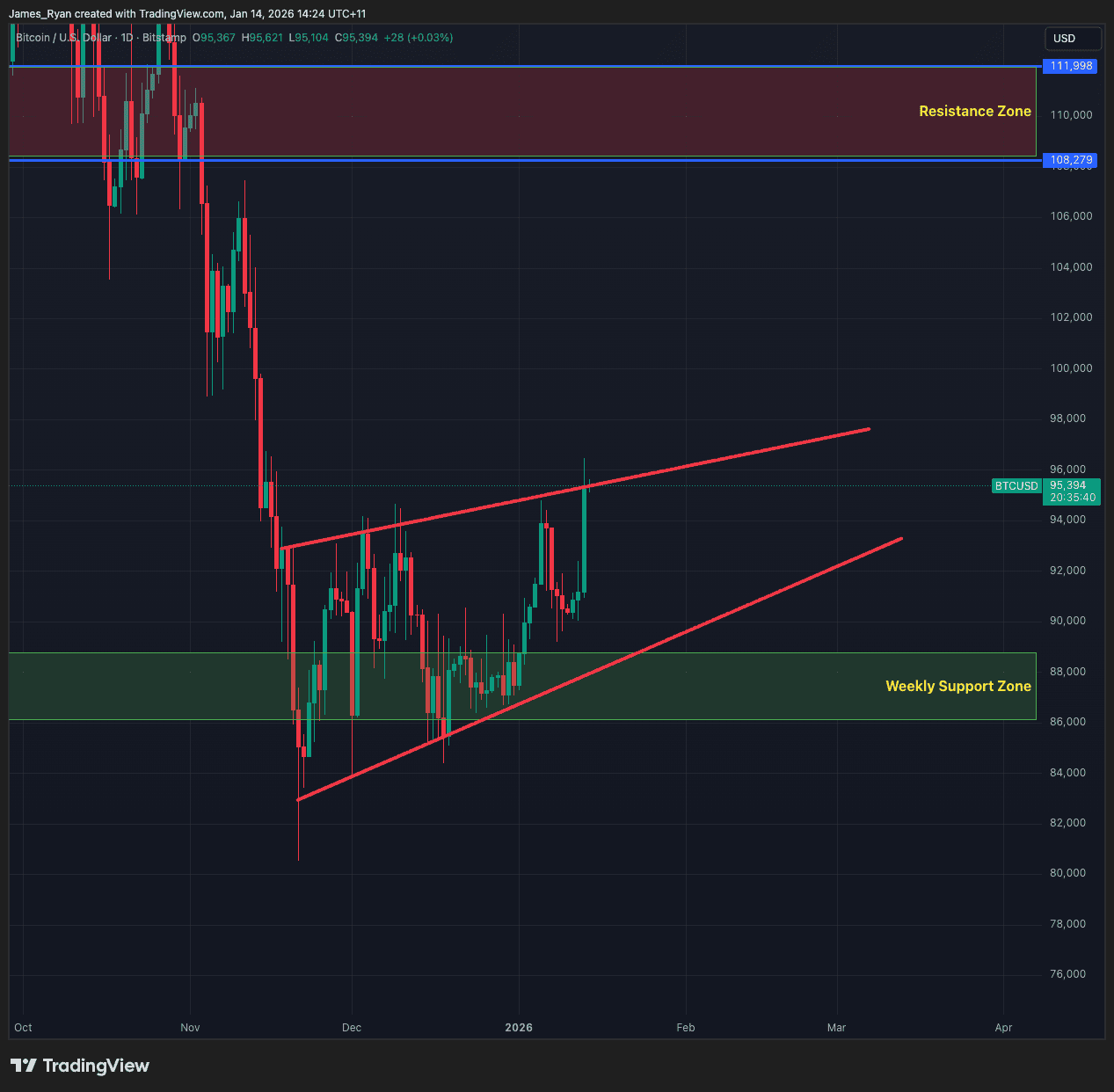
After the selling cascade which lasted throughout the month of November, we eventually saw BTC find its temporary bottom at $80,537 on November 21st. Since then, we’ve been range bound and in an upwards channel trying to break the mid-$90K zone without any success.
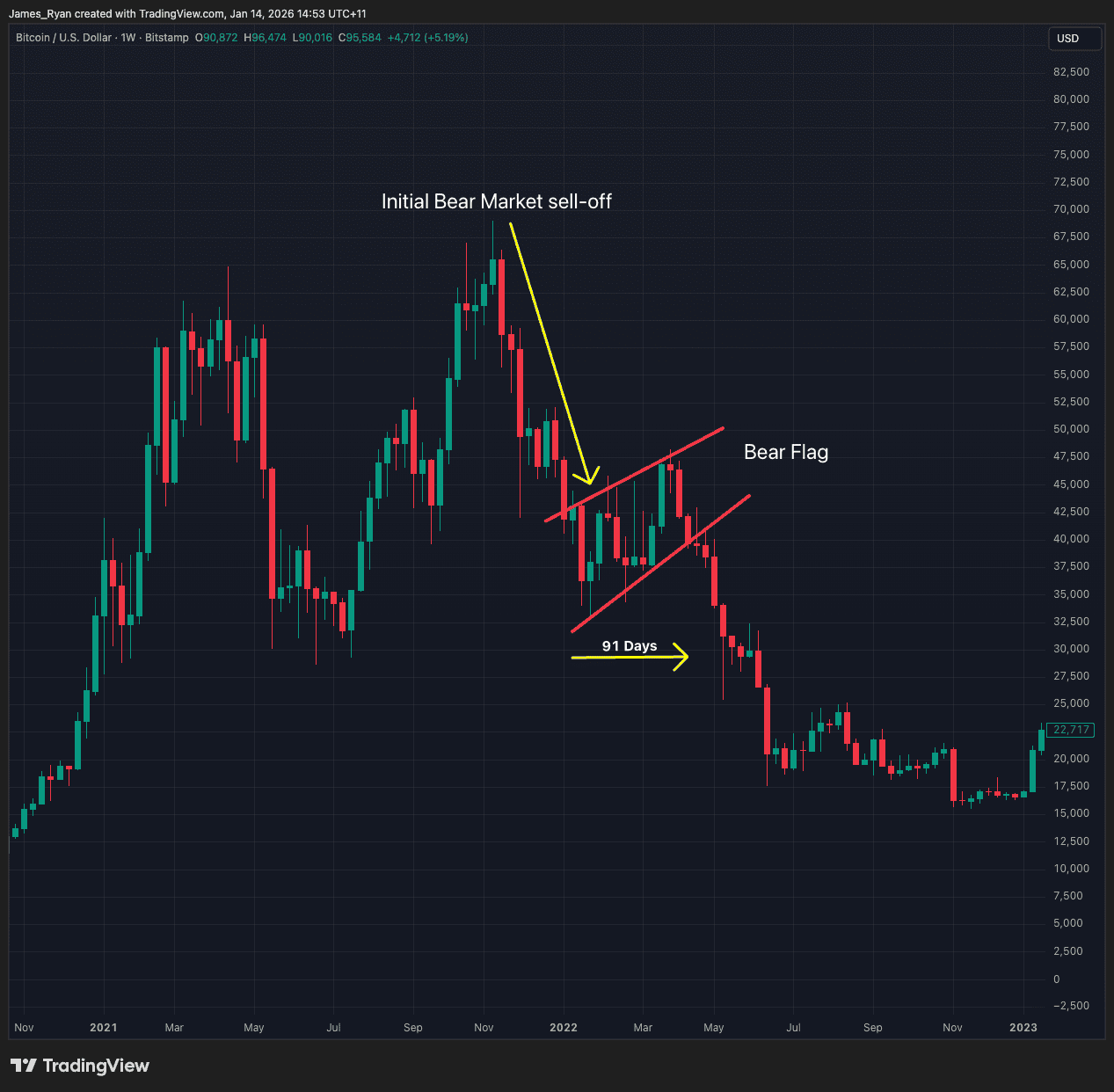
Whilst the bottom came in and has since held our weekly support zone between $88K to $86K, of where we anticipated a potential higher low - ultimately our predicted bounce from here was to be expected sooner rather than later due to seller exhaustion. This doesn’t mean we’re out of the woods quite yet. Headwind price resistance still plays a major factor as on higher time frames we still remain in a downtrend despite the current short-term grinding higher. This channel BTC is stuck in is known as a “Bear Flag” pattern; quite the opposite of the “Bull Flag” structures we saw Bitcoin doing consistently throughout 2024, which saw it continually breakout to the upside getting us to  six-figure Bitcoin prices in USD terms for the first time in history. These Bear Flags as you might surmise tend to break to the downside given they’re a bearish structure. If we see another selling cascade over the coming months which validates the pattern, investors can expect to see Bitcoin running the low $70K price range where more significant liquidity resides before another bounce may come into effect. This scenario would be highly correlated with the previous bear market if it plays out. 
During that time, BTC initially sold off, commencing its bear-market at the end of 2021, with a Q1 rally slowly grinding higher within a bear flag-like channel over the course of 91 days, before eventually completing the bearish pattern by spilling to the downside. This coincided with the Terra Luna collapse of May 2025, sending BTC plunging hard and fast from $48K down to $17K, in the red over -63% over just a few short months until June 13th where it found more liquidity at the 2017 highs. Once here, it formed another temporary bottom providing relief to HOLD’ers, until FTX collapsed five long months later; widely considered a result of the brutality that occurred earlier in the year which started the dominos falling. 

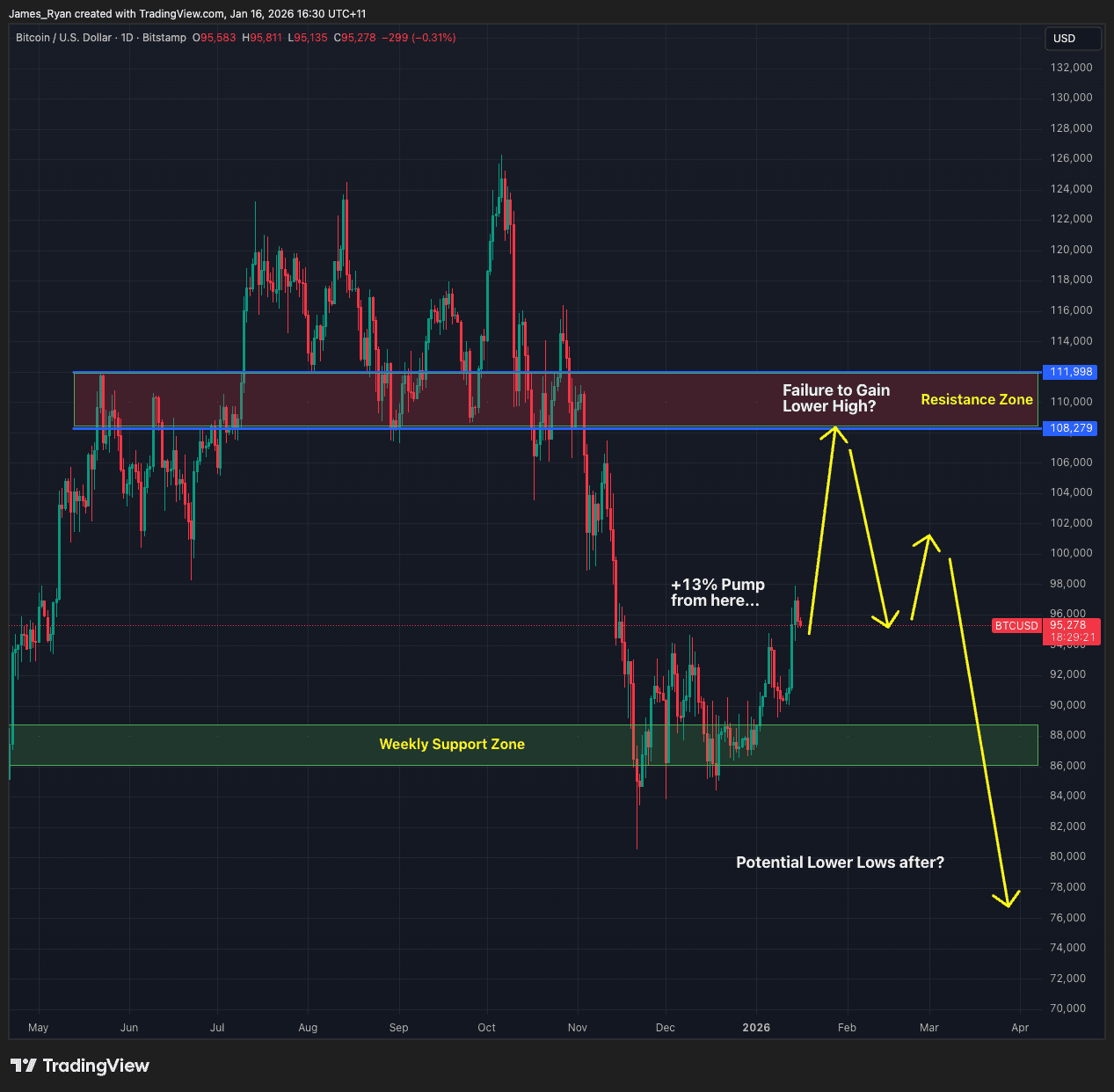
In saying that, not every current cycle is designed to perfectly mirror the last - whilst the market does rhyme, it’s not always a 1:1 recreation, meaning in this instance a more substantial short to mid-term pump very well could be on the cards if buying momentum maintains strong here, before we then potentially go lower, so long as the market does eventually give us some very juicy prices at generational lows at $70K or below. This intermittent rally can be common in the earlier stages of bear markets, and is known as a “Failure-to-gain” rally. This is because whilst we get a strong move up, it doesn't take out the previous highs - essentially meaning the market prints a lower high before continuing the downward trend into lower lows.

Whilst at first glance this might seem like bad news, it absolutely isn’t. This type of market price-action gives both bulls and bears an excellent opportunity to capitalise off volatility, before getting even better long-term entries to add to their bag sizes before the next generational Bitcoin bull market begins. Volatility = opportunity, and seasoned traders/investors can make the most out of this brief window of time to ensure they’re on the right side of the trade at all times. When generation lows do come, if you’ve made the right decisions along the way, you’ll hopefully have the most amount of capital available to you at the bottom - then loading up the truck becomes much more viable as you can scoop up what little BTC supply is available then, given the asset will get even more scarce, whilst other retail investors likely wait until it’s too late to pile in again at astronomical prices. Getting ahead of the curve in a bear market is arguably even more important than during a bull market cycle. Consistency and patience is rewarded usually in spades for those that execute and keep increasing their position sizes, this will be paramount over the next 9 - 12 months. Don’t get caught out again, just like those that waited for sub $10K BTC in 2022, just to end up buying back in at all time high prices yet again…sometimes a price too low really is too good to be true. 


In the coming months we’ll be looking at what viable generational low targets might look like, and depending on how price action behaves over the next few months, we will outline a number of likely scenarios using historical price performance to get a head start on strategizing what the next most optimal moves are for this market moving forward into the years ahead. One thing will remain unchanged; Bitcoin is extremely well positioned to take advantage of the aggressive repricing of global asset valuations currently taking place. Gold and Silver bulls waited nearly two decades for the current skyrocketing prices where long-term participants that remained steadfast in their positions for as many years are now quite easily doubling their position valuations every couple of months - and consecutively too, all in just a short span of time. Time in the market will always remain the single most important aspect to long-term investing, and that’s been proven true for Bitcoin from cycle to cycle over its 17 year long existence. The only tangible edge available to investors is execution: staying liquid, staying disciplined, and being able to act decisively when the market offers sublime windows of opportunity that close as soon as the market regains stability. That is exactly where Stormrake fits. When price is moving fast in either direction, we make it simple to accumulate, rebalance, or scale out with intent through a private, professional desk built for high-conviction decision-making. Direction is noise - but access, timing, and consistency are the best advantages for long-term success in this industry.

Written by James Ryan

Create a brokerage account today

Reach out to us at Stormrake for further market insight and allow us to help you navigate the sea of mania and laser-eye memes, so that you can realise your goals in the market!

No Advice Warning 

The information in this newsletter is general only. It should not be taken as constituting professional advice from the author - Stormrake PTY LTD.
Stormrake is not a financial adviser and does not provide financial product advice. You should consider seeking independent legal, financial, taxation or other advice to check how the information relates to your unique circumstances. Stormrake is not liable for any loss caused, whether due to negligence or otherwise arising from the use of, or reliance on, the information provided directly or indirectly, by this newsletter.
 

Disclaimer 

All statements made in this newsletter are made in good faith and we believe they are accurate and reliable. Stormrake does not give any warranty as to the accuracy, reliability or completeness of information that is contained here, except insofar as any liability under statute cannot be excluded. Stormrake, its directors, employees and their representatives do not accept any liability for any error or omission in this newsletter or for any resulting loss or damage suffered by the recipient or any other person. Unless otherwise specified, copyright of information provided in this newsletter is owned by Stormrake. You may not alter or modify this information in any way, including the removal of this copyright notice.

Copyright © 2024 Stormrake Pty Ltd, All rights reserved

Stormrake