Are You Ready For What's Next?
Are You Ready For What's Next?

We're Back, The Bear Market Is Over
Bear Market Over Signals
The Trendline That Has Never Lied
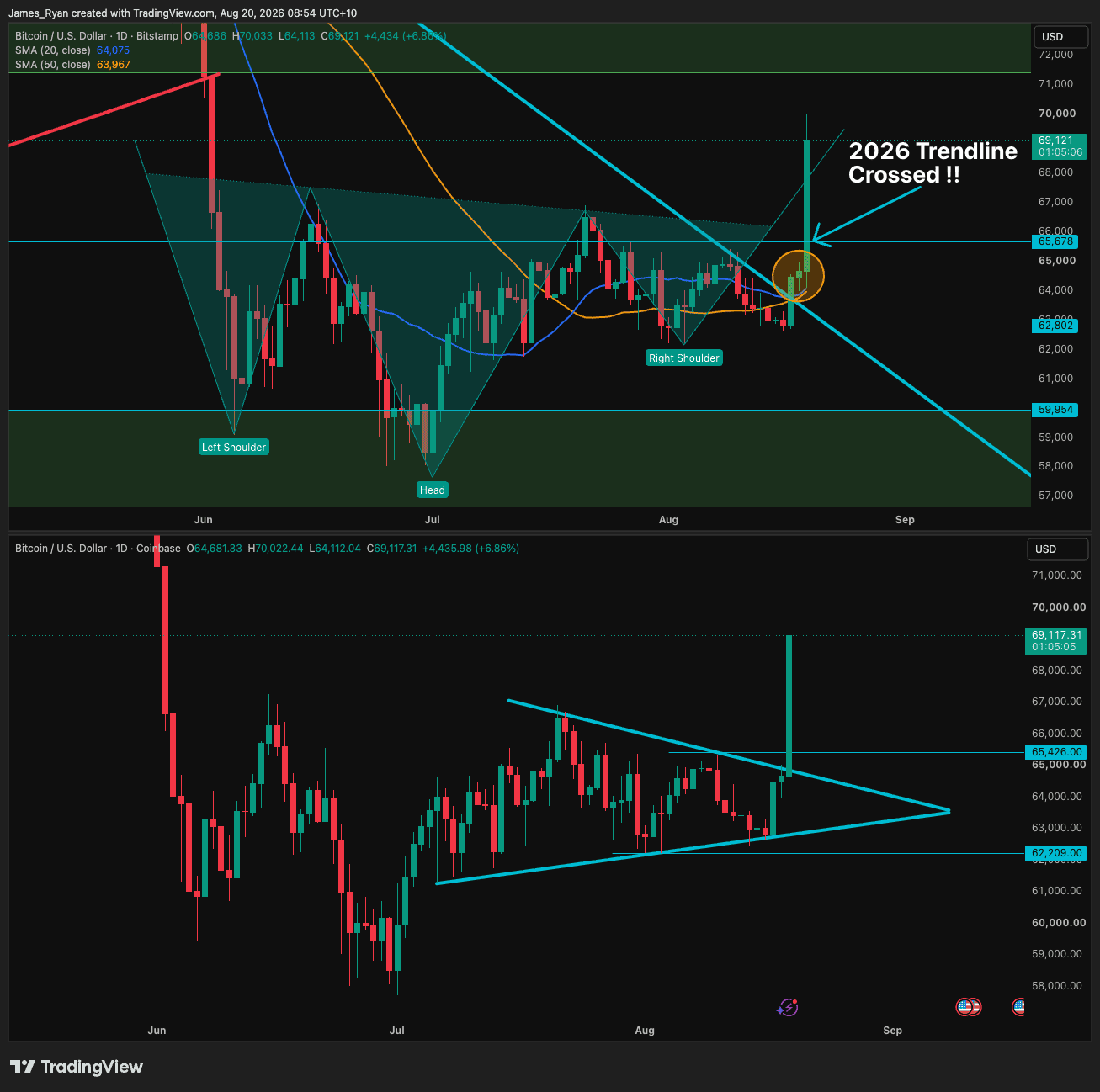
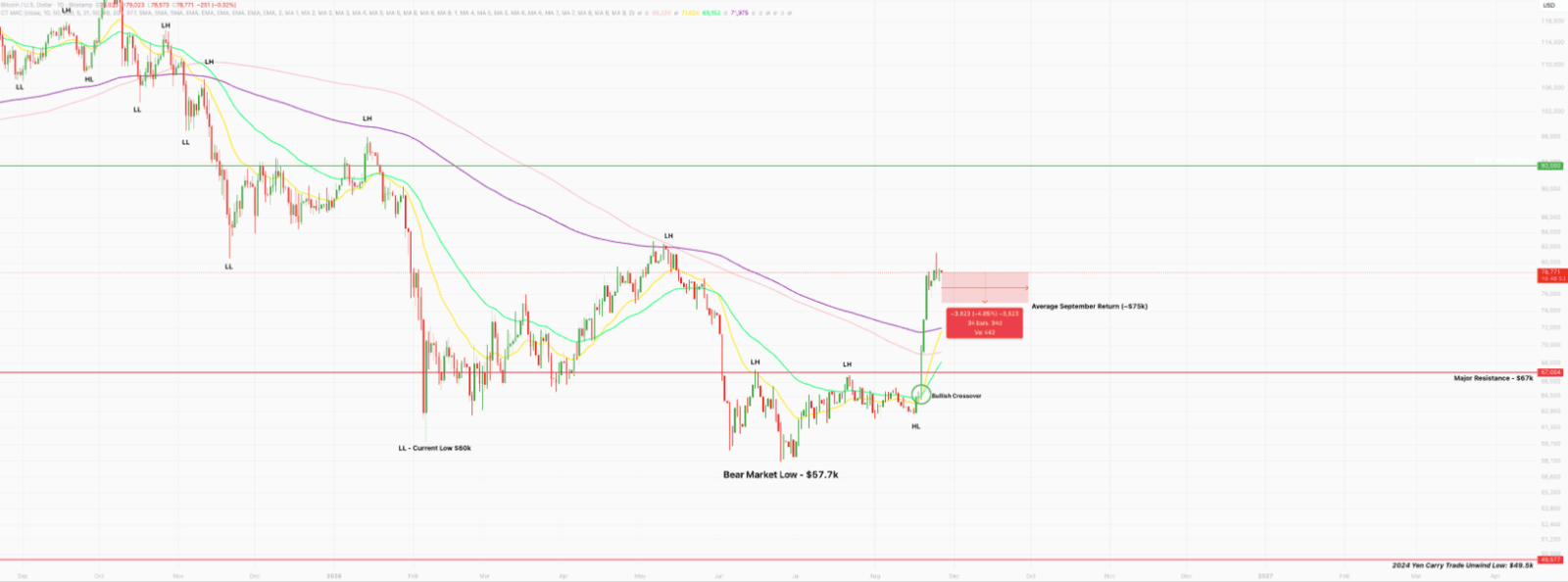
The single cleanest signal in our framework is the bear market trendline, the descending line connecting every lower high since October's peak. We've been tracking it with clients for months. In the third week of August, Bitcoin closed a daily candle above it, then closed above it again the following day, then went vertical.
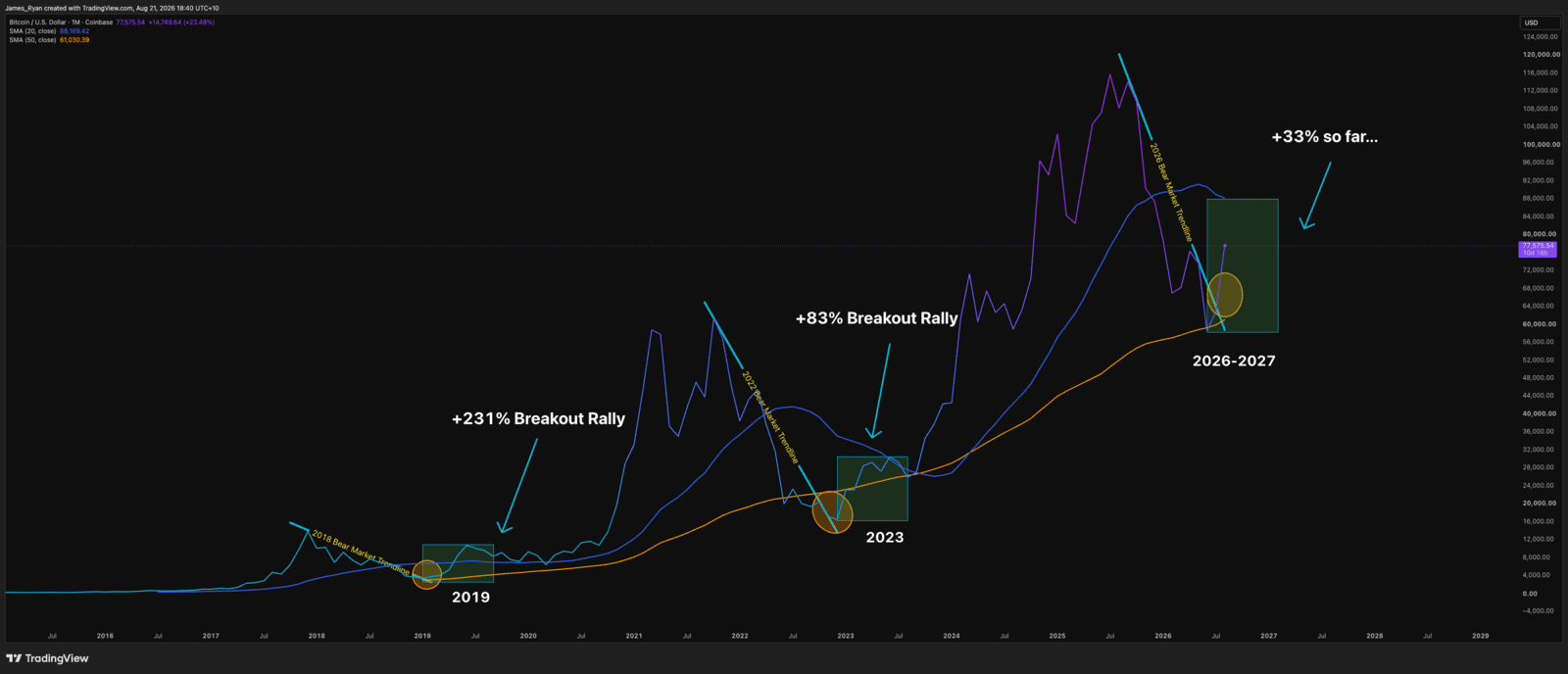
That matters because of what it has meant historically. In 2018 and again in 2022, once price closed back above the descending bear market trendline, the low was already locked in. Both cases saw some chop in the weeks that followed. Neither ever revisited the low. This is not a signal that appears often. Structurally, it happens about once every four years.
The daily chart supported it too. A textbook inverse head and shoulders had been building since June, and the break took price straight through neckline resistance around $65,000 without hesitation. On the shorter timeframe, price had been compressing inside a symmetrical triangle for weeks, and that break was exactly the kind of decisive resolution that setup eventually produces.
The Moving Average That Calls The Bottom
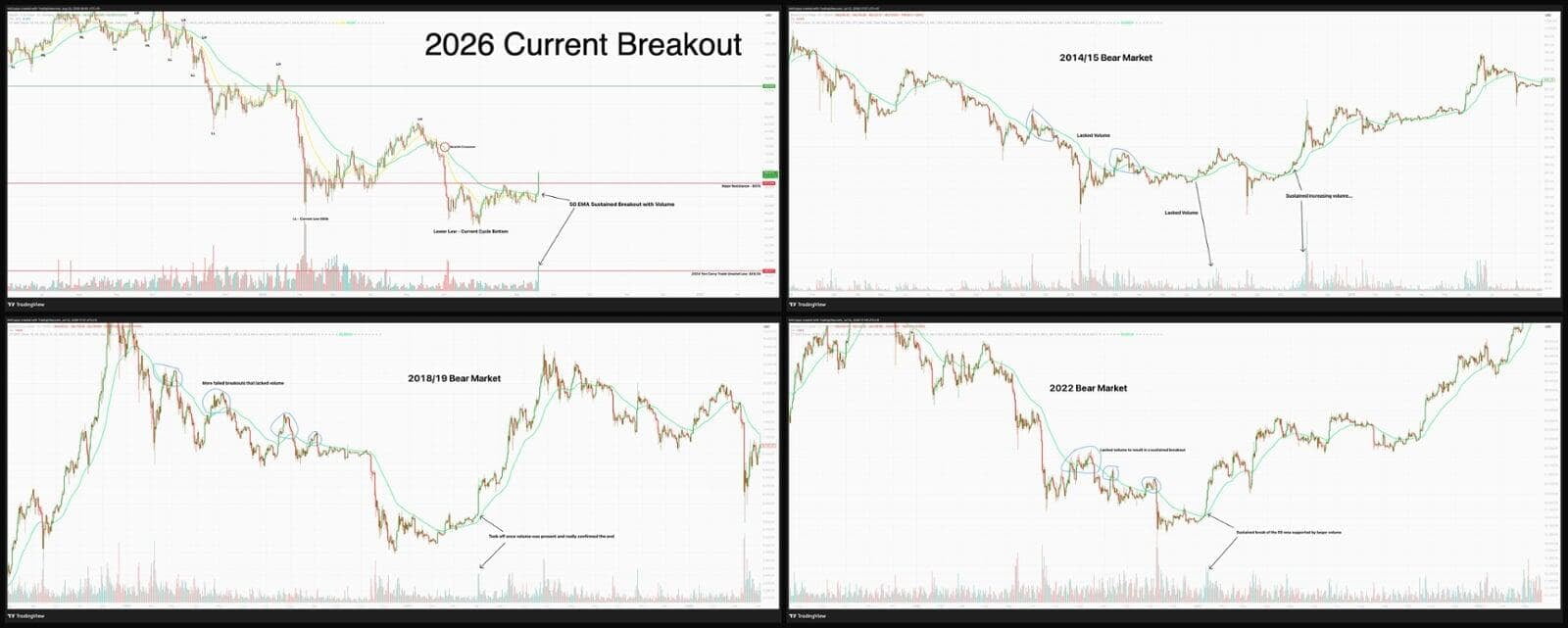
The second signal is the 50 exponential moving average on the daily. A sustained break above it, supported by volume, has historically marked the end of the bear market.
The important word there is volume. Bitcoin has attempted this break plenty of times before and failed, and the failures share two characteristics. They either lacked the volume to sustain the move, or they came too early in the cycle, before enough drawdown had actually been worn.
In 2014/15, 2018/19 and 2022, the early attempts above the 50 EMA all rolled straight back over for one of those two reasons. It wasn't until the break came with real volume behind it that the bottom was in.
This time the volume showed up. That's the difference.
The Catalyst Nobody Was Watching
Is There A Threat Of This Being A Fakeout?
It Isn't Too Late, But The Window Is Closing
- To the prior all time high of $126,080: a 1.6x, or a return of about 61%
- To our $200,000 bull market target: a 2.55x, or a return of about 155%
The Debasement Trade Is Back On
Every catalyst behind this month's breakout has been reported as its own headline. Step back from the individual events and a single thread runs through all of them, one Wall Street hasn't leaned on seriously in years.
The debasement trade.
What It Actually Means
Most explanations start with Roman emperors shaving silver out of their coins. It's a good story and it doesn't help much.
Here's a version that lands better.
You own shares in a company. The company decides it would rather print new shares than cut its spending. Your share certificate hasn't changed. The number on it is exactly the same. But your slice of the business is smaller, because there are more slices now. Nobody stole anything from you. You just got diluted.
That's debasement, applied to a currency instead of a company.
Once investors believe it's happening, they do a predictable thing. They move money into assets nobody can print more of. Gold, because you have to dig it up. Bitcoin, because the supply is fixed in code and no one can vote to change it.
That logic has always been true. The question was whether the market cared. This month it started caring again.
The Fortnight That Made The Case
Two numbers landed a day apart.
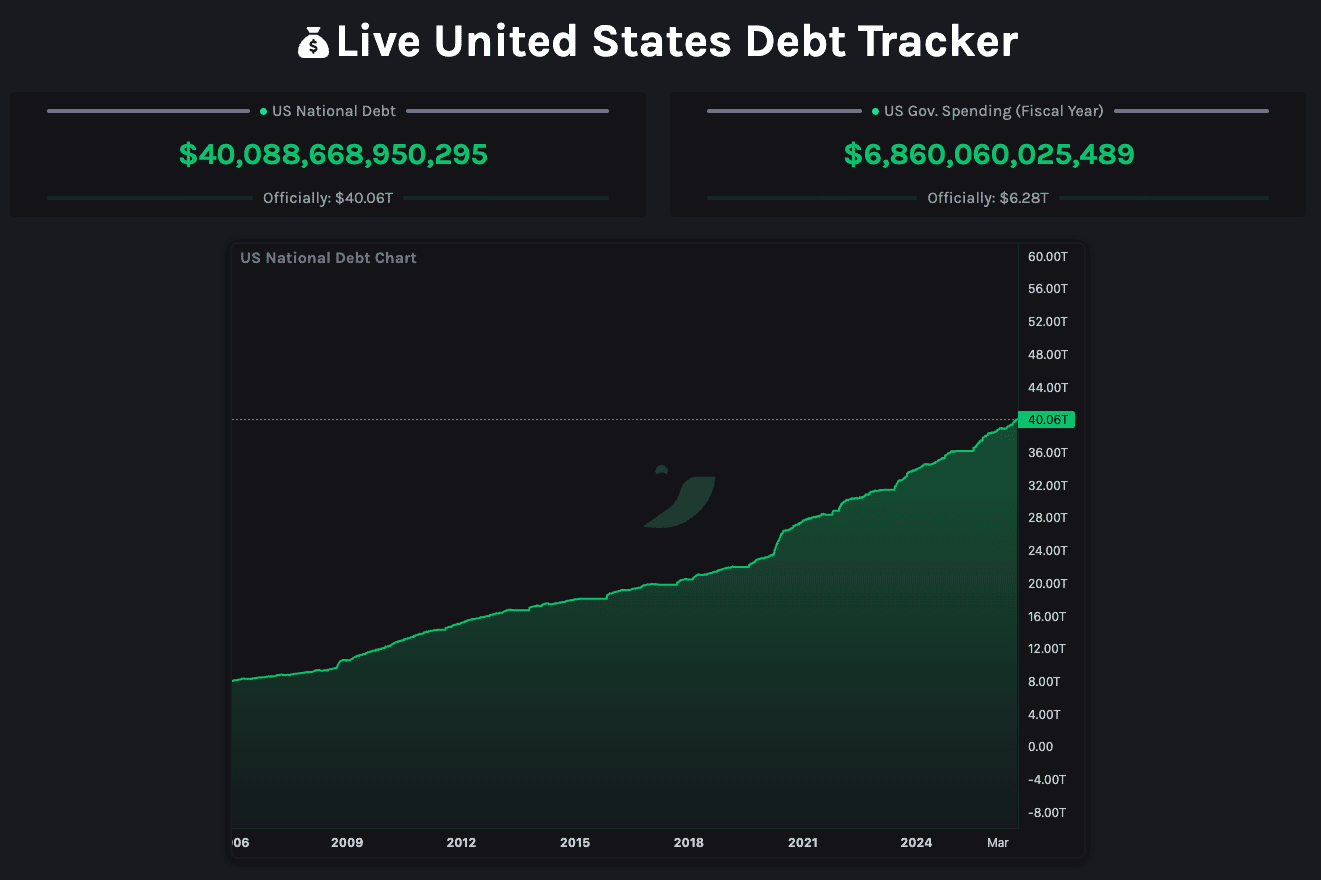
On 18 August, total US government debt passed $40 trillion for the first time. It came in at $40.047 trillion, more than double what it was in January 2017. It had only crossed $39 trillion five months earlier, back in March. July alone produced a $432 billion deficit, the fourth largest month in US history, and the shortfall for this financial year has already beaten the whole of last year with two months still to run.
The next day came the Treasury buyback announcement covered earlier, doubling the cap on purchases of long dated government debt.
One number said the debt is growing faster than anyone forecast. The other said the government will step in to keep yields down rather than let the market sort it out.
Investors put those two facts next to each other and drew the obvious conclusion about what comes next. It wasn't spending cuts.
And note what didn't move the market. Doubling a cap from $2 billion to $4 billion is a rounding error against a bond market worth tens of trillions, and the buying doesn't even start until 9 September. Not a dollar has been spent yet. What repriced it was the read on intent, which is the only variable that matters when you're working out how $40 trillion gets handled over the next decade.
Gold Moved First, Bitcoin Moved Harder
Gold is the reflex trade here, and it always has been. When investors start worrying about what a currency is worth rather than what it yields, bullion is the first thing they reach for.
It bottomed at $3,965 in late June, before the buyback announcement and before the debt headline. It now sits near $4,650. That's a gain of around 17% off the low and its best month since September 1999. The dollar went the other way, dropping to its weakest level since mid May and posting its third down week in four.
For clients who want that exposure without leaving crypto, PAXG is the cleanest way in and has tracked the move closely, sitting near $4,650. It's been on our Stormrake Spotlight in Stomrake’s Morning Note for exactly this reason.
But look at what happened next.
Bitcoin bottomed a fortnight after gold, at $57,735, and has since run to around $78,500. That's a 36% recovery against gold's 17%, measured from each asset's own low. Bitcoin arrived at the trade late and has already more than doubled the return of the asset that led it.
That's the part worth sitting with.
The Market Just Reclassified Bitcoin
Here's why all of this matters for the asset most of you actually own.
For most of this year, Bitcoin has struggled to sustain a narrative.
The risk asset argument stopped working first. The S&P 500 has hit 27 record highs in 2026 and is up around 13% for the year. Bitcoin spent that same stretch grinding lower and is still down about 10%. Whatever drove equities to record after record, Bitcoin wasn't invited.
The digital gold argument wasn't working either. Every time investors reached for safety this year, Bitcoin went the other way.
So it wasn't trading like a risk asset and it wasn't trading like a hedge. It answered to nothing, which is exactly what a bear market looks like when the story around an asset has run out.
August changed that. Bitcoin is up more than 25% on the month, printed $80,000 for the first time since May, and gained 23% in a single week. It did that in near lockstep with gold while the dollar fell.
A reason to own Bitcoin that actually works, after a year in which neither of them did.
And being the faster mover off the low is not the same as having caught up. Gold has recovered its whole year and sits around 17% below its January record. Bitcoin is still down about 10% for the year and remains roughly 38% below its all time high. Run those two facts together and the picture is straightforward. Bitcoin is moving quicker and still has considerably further to travel.
We've already called the bear market over, so we don't read that gap as a warning. We read it as Bitcoin being the faster half of a trade that has only just restarted.

There Is Only One Door Left Open
There are three ways out of a debt pile this size, and two of them are already shut.
Grow out of it. That isn't happening, because interest costs are now the second largest line in the federal budget and they're outrunning the economy. Cut spending or raise taxes. Politically dead, because the biggest items are pensions and healthcare and the population keeps ageing.
That leaves devaluing the money the debt is written in. Nobody announces it and nobody votes on it. It's simply what's left once the first two doors are bolted shut.
So this isn't really a trade. A trade has an entry and an exit. This is a direction of travel, and it only moves one way. The debt went from $39 trillion to $40 trillion in five months.
If a currency is headed one way over time, you own the things that can't be printed. Gold does that job, but its supply still grows every year as more comes out of the ground. Bitcoin's doesn't. Twenty one million, fixed in code, with no committee able to vote for more.
Every trillion added to the pile makes that argument stronger. The market spent this month remembering it.
August Delivered, Now For September to Continue the Momentum
In the News
Australia Is Heading For Another Rate Hike:

Ray Dalio Advocates for Gold and Bitcoin:
Hyperliquid Begins To Lead Once More:
Market Update
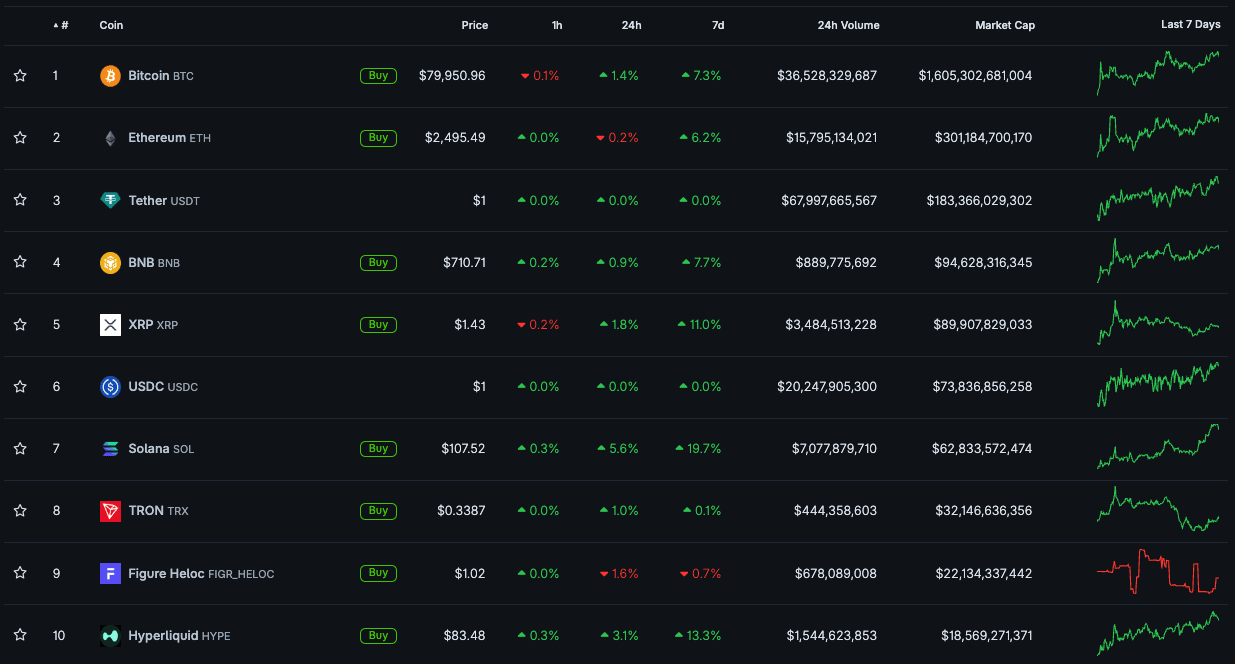
Here is the fast five of what you need to know about the market in August 2026:
Bitcoin is up over 25% in August
Ethereum has climbed 36% in August
XRP flipped USDC to become the 5th largest Cryptocurrency by market cap and HYPE has entered the top 10 once more
PAXG is up 13% in August
The entire crypto market cap grew by 25% in August
Video of the month
Coldcard Hack: $113M Stolen From Bitcoin Wallets | Bisher Khudeira on The Money Block™ Ep. 125
Education: The Coldcard Exploit And The Limits Of Self Custody
This deserves more than a paragraph in the news section. What happened to Coldcard owners at the start of this month is the most useful self custody lesson the market has produced in years, and the cheapest way to learn it is from somebody else's loss.
What Happened
At around 1:30am UTC on 30 July, Bitcoin started leaving wallets whose owners were asleep. Inside 25 minutes, roughly 594 BTC, about $38 million at the time, was swept from around 500 single signature wallets. The attacker sorted by balance and took the largest first, clearing more than $30 million in the opening ten minutes. One individual lost around $1.8 million. Three further waves followed, and Galaxy Research's running tally reached roughly 1,816 BTC, close to $116 million, drained from more than 5,200 addresses.
Nobody was phished. Nobody installed malware. Nobody approved a transaction. No device was ever physically touched. The only thing the victims had in common was the date their wallet was created.
What Caused It
Every Bitcoin wallet begins as a random number, and everything above it is derived from that one moment. Get the randomness right and the wallet cannot be guessed. Get it wrong and none of the cryptography above it matters.
Think of it as dice. A properly generated seed carries the equivalent of rolling a six sided die about 50 times and recording the sequence in order. Nobody on earth can guess that.
A build error in Coldcard's March 2021 firmware meant the device stopped drawing randomness from its dedicated hardware chip and quietly fell back to a basic software routine. It kept telling users it had rolled the die 50 times. On the older Mk3 it had effectively rolled it about 16 times, and about 28 on the newer models.
Sixteen rolls is roughly a trillion possibilities, a number modern hardware works through in an afternoon. The flaw shipped in March 2021 and survived every release until the emergency patch on 31 July 2026. Five years, in open source code, in one of the most respected devices in Bitcoin, and nobody caught it. Worse, updating the firmware doesn't repair a seed already created weakly, so affected owners face a full migration rather than a patch.
What This Means Practically
This isn't a Bitcoin problem. It's a self custody execution problem, and it's exactly the kind of tail risk that sits quietly beneath "not your keys, not your coins" until the day it doesn't. Firmware, chip design and randomness generation are layers most holders never interact with directly, which is a great deal of trust to place in work you have no way to check. The bug was Coldcard's alone, but the dependency isn't.
This is not the first self custody solution to fail and it won't be the last. Stormrake custody removes that layer entirely.
Self Custody Is A Right, Not An Obligation
We believe in self sovereignty at Stormrake, and self custody is a genuine part of that. It's a right every holder has. But a right isn't a recommendation.
This incident cost people their entire positions through no fault of their own, and the setups that survived it demanded a level of technical discipline most holders simply don't have.
If your setup is one device, a seed phrase on the card that came in the box, and a quiet hope that the firmware did its job, you're carrying risk you have no way to measure. The honest question isn't whether you have the right to hold your own keys. It's whether the consequences of getting it wrong are ones you could absorb.
Where Stormrake Fits
For clients who decide the answer is no, our custody solution takes that entire class of problem off your plate. Seed generation, firmware risk, device security, backup integrity, none of it sits with you. No drawer, no single point of failure, and no wondering five years later whether the setup you did one afternoon was done properly.
It's a different trade off rather than no trade off. You're moving from a risk you personally carry to one managed under institutional process and oversight, which is the right answer for many holders and the wrong one for some. That's why it's a conversation rather than a product.
If you're running an affected device, or you simply want your Bitcoin somewhere secure while you work out your next step, speak to your dedicated Stormrake broker.
The most expensive lessons in this market are the ones learned first hand. This one is available second hand, for free.
Start Your Brokerage Account
If you enjoyed this Rake Review, feel free to open an account and gain access to more proprietary research and work with your very own dedicated crypto broker.
No Advice Warning
Disclaimer
All statements made in this newsletter are made in good faith and we believe they are accurate and reliable. Stormrake does not give any warranty as to the accuracy, reliability or completeness of information that is contained here, except insofar as any liability under statute cannot be excluded. Stormrake, its directors, employees and their representatives do not accept any liability for any error or omission in this newsletter or for any resulting loss or damage suffered by the recipient or any other person. Unless otherwise specified, copyright of information provided in this newsletter is owned by Stormrake. You may not alter or modify this information in any way, including the removal of this copyright notice.Copyright © 2026 Stormrake Pty Ltd, All rights reserved