Clarity, Confirmation, and the Cycle Low
Clarity, Confirmation, and the Cycle Low

The Journey for Clarity
What the Clarity Act Actually Does
At its core, the bill splits crypto assets into two regulatory lanes. Assets that behave more like decentralised commodities, Bitcoin being the clearest example, would fall under the CFTC. Assets that behave more like traditional investment contracts would stay with the SEC. If you want the full breakdown of what those two regulators actually do and why crypto has never fit neatly into either box, that is this month's Education topic below. For now, the market-relevant point is simpler: a market that finally knows its own rules tends to attract the kind of institutional money that has been sitting on the sidelines for years, not because it did not want in, but because compliance teams could not sign off on something with no clear rulebook.
Where the Odds Actually Sit
The bill passed the House comfortably back in July 2025 and cleared the Senate Banking Committee in mid-May this year, and has been sitting on the Senate's calendar since. Two separate prediction market questions are worth tracking here, because they are answering different things.
The first asks a narrower, procedural question: will the Senate actually hold a recorded vote before Congress leaves for its August recess. That number has been on a wild ride through July. It was above 80% on 20 July, spiked toward 72% mid-month on news that the White House had agreed on ethics language, and has since fallen back to around 40% as Senate Majority Leader John Thune has publicly said he does not expect the bill to be done in time. That is a fast, sentiment-driven number, and it moves on headlines almost daily.
The second, broader question is whether crypto market structure legislation actually becomes law this year at all, which is a higher bar than simply getting a vote. That contract is currently pricing somewhere in the high 30s to low 40s percent for 2026 enactment, down materially from the 80%-plus odds seen back in February. If 2026 does not happen, the same markets show meaningfully better odds further out, in the region of 50 to 60% for enactment sometime before mid to late 2027.
What This Actually Means
Put simply: the market is currently pricing this as a coin flip on getting done this year, and a reasonably good bet on getting done eventually. That is a very different setup to a bill that is definitely happening or definitely dead, and it explains why price action around Clarity headlines has been sharp but short-lived rather than sustained, the market genuinely does not know yet, and neither does anyone else. Worth watching the procedural vote closely over the next fortnight, since a miss there effectively pushes the realistic timeline for this catalyst into next year.
A Familiar Shape: The Late 2023 ETF Rally
The setup has an echo worth drawing out. Through the second half of 2023, Bitcoin ran hard on the back of anticipation for a spot ETF approval that had not yet happened. The market was not reacting to the event itself, it was reacting to the increasing probability of the event, pricing in the outcome well before Washington delivered it.
The timing difference between the two setups is the part worth sitting with. The 2022 cycle low was set in November of that year, and the ETF approval did not land until January 2024, close to fourteen months later. The rally on approval expectations built steadily through most of that gap. Where we sit today is a different point in the cycle entirely. We are still inside the bear market, likely in the process of forming this cycle's low rather than well clear of it, which means a Clarity Act driven rally, if the bill does pass, would be arriving far earlier relative to the bottom than the ETF rally did. That is not a reason to write off the narrative. It is a reason to treat it as one leg of the recovery story rather than the whole of it, with the more traditional macro and cycle drivers still needing to do the rest of the work behind it.
The Bullish Case, and Its Limits
The optimistic read is straightforward: regulatory clarity tends to unlock capital that compliance and legal risk had previously kept out, particularly from institutions that have been openly waiting for exactly this kind of framework before committing meaningfully. A passed Clarity Act would be a structural tailwind, not a one-off headline, the kind of catalyst that changes the addressable pool of capital rather than just sentiment for a news cycle.
The honest counterweight is that the bill is not law yet, current odds put this year's passage closer to a coin flip than a certainty, and a market that has partly priced in passage carries real disappointment risk if the vote slips into next year. Worth watching alongside price, not worth trading purely on hope.
The mechanics of why this split even needs legislating, and what the SEC and CFTC actually do differently, are worth understanding properly rather than taking on faith. That is what this month's Education section digs into.
Forming a bottom

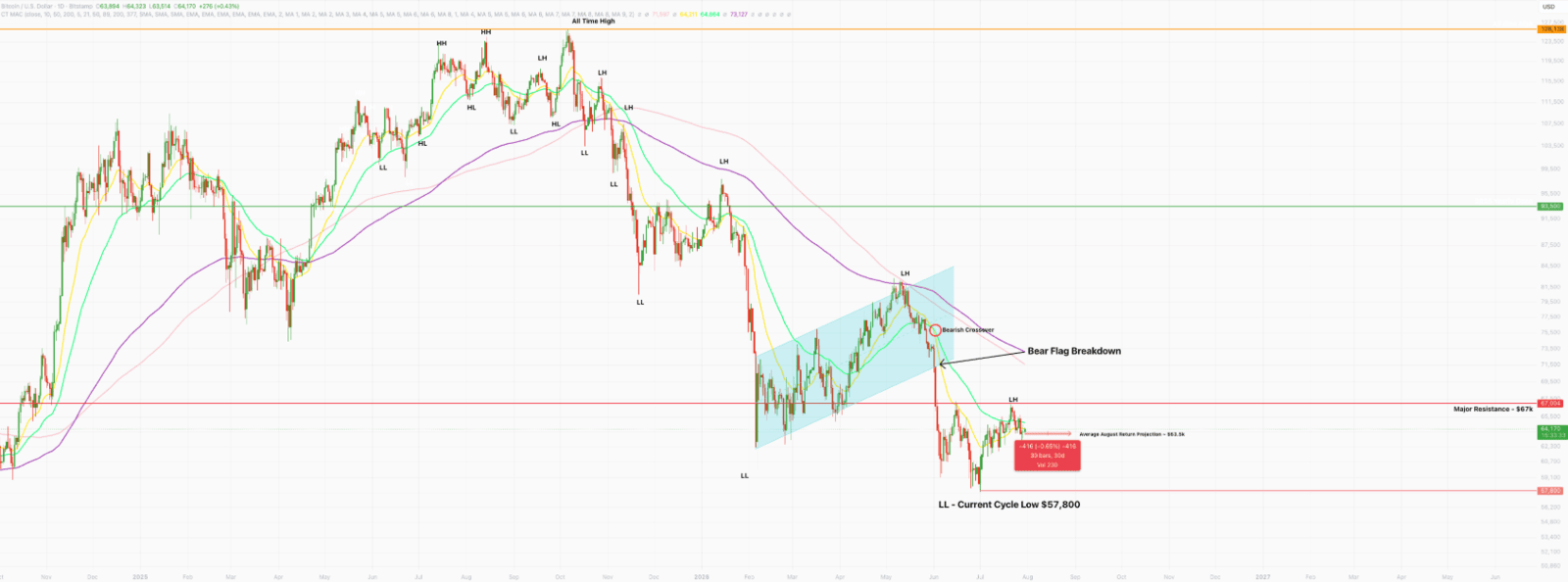
We are entering the stage of the cycle where the conversation has to shift from "are we still falling" to "have we already found the floor." Every prior Bitcoin cycle has followed a remarkably consistent rhythm from peak to trough, and on that rhythm alone, we are now deep into the window where cycle lows have historically formed.
Timing: Where We Sit Against History
Bitcoin's all time high of $126,272 was set in October 2025. That puts us roughly nine months on from the peak as of this review. Stack that against the last three major cycle troughs:
2021 to 2022: twelve months from the November 2021 all time high to the November 2022 cycle low
2017 to 2018: twelve months from the December 2017 all time high to the December 2018 cycle low
2013 to 2015: around thirteen months from the November 2013 all time high to the January 2015 cycle low
Nine months in, we are not yet at the outer edge of that historical window, but we are firmly inside it. If this cycle rhymes with the last three, the low is either recently behind us or still just a few months away.
It is also worth noting what those three windows have in common beyond their length. In each case, the trough was not obvious as it happened. The 2022 low coincided with the FTX collapse, the 2018 low ground out through a dead, directionless December, and the January 2015 low arrived with almost no fanfare at all, just a slow bleed that eventually stopped. None of them announced themselves. They were only identifiable in hindsight, usually weeks or months after the fact, which is exactly why waiting for confirmation is structurally expensive: by the time the bottom is obvious, a meaningful chunk of the recovery has typically already happened.
Our own confirmed cycle low so far this quarter sits at $57,800. Whether that print holds as the definitive low for this cycle is not something we can call with certainty yet. What we can say is that its timing, roughly eight to nine months off the October all-time high, sits comfortably inside the historical range rather than ahead of or behind it. That is the entire point of raising it now rather than after the fact. History does not repeat on a fixed clock, but it has never missed this window by much either.
The Cost of Waiting for Confirmation
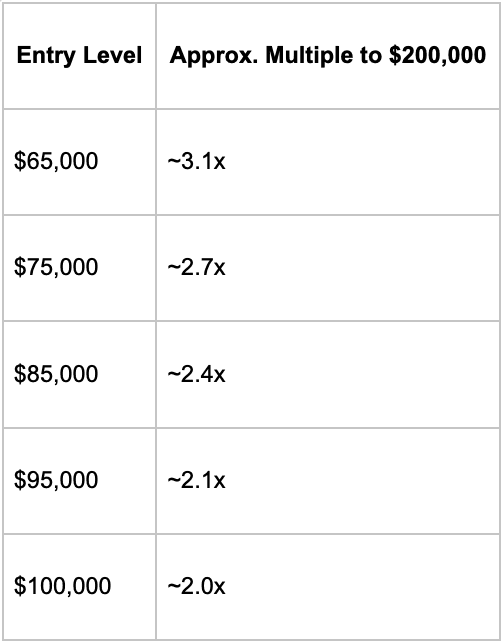
Nobody can promise the exact day the bottom is printed. What can be shown clearly is the mathematics of what waiting for that certainty actually costs.
Using $200,000 as the target for the next bull run, the multiple on offer shrinks fast the longer confirmation is awaited:
July's Bitcoin Performance Leads Into August's No Man's Land
In the News
BitMart and BitMEX Both Announce Shutdowns
The Headline Fakeout: Rate Decision
SpaceX Comes Back Down to Earth
Market Update
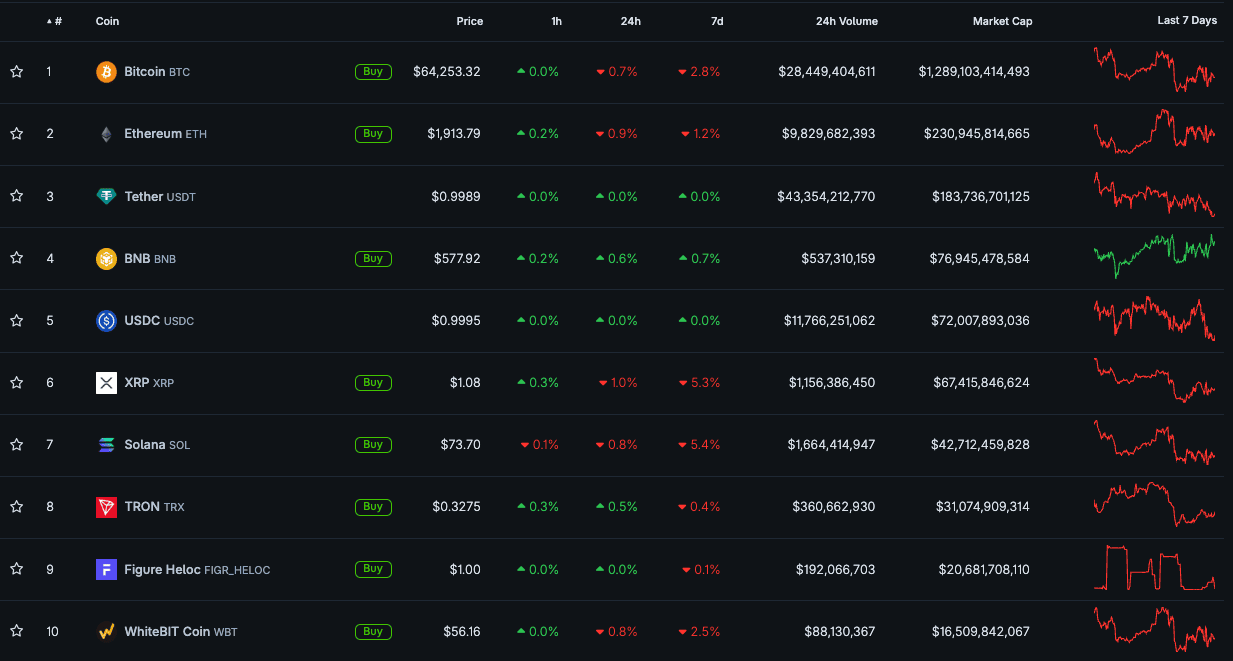
Here is the fast five of what you need to know about the market in July 2026:
- Bitcoin increased by 9%
- Ethereum increased by 21%
- XRP increased by 3.43%
- Hyperliquid fell by 17.2%
- The total crypto market cap increased by 7.50%
Video of the month
Education: SEC vs CFTC, Explained Simply
Every month the Clarity Act story keeps coming back to the same two letters: SEC and CFTC. This Rake Review has covered what the bill means for markets, but it is worth actually unpacking what these two regulators are and why the distinction between them exists in the first place.
Two Regulators, Two Very Different Jobs
The Securities and Exchange Commission, the SEC, was built to oversee securities. In plain terms, a security is typically something you buy expecting profit from someone else's effort, a share in a company, a bond, an investment contract. The SEC's job is investor protection: making sure companies disclose accurate information and that promoters cannot mislead the people buying in.
The Commodity Futures Trading Commission, the CFTC, oversees commodities and their derivatives instead. Commodities are raw, interchangeable goods, things like gold, oil, or wheat, where the value comes from the asset itself rather than from a company or a team working behind it. The CFTC's traditional focus has been on futures and derivatives markets built around those commodities, rather than on the underlying asset itself.
Why Crypto Fell Into a Grey Area
Bitcoin does not fit neatly into either box on paper, and law written decades before crypto existed was never going to answer the question cleanly. Is a decentralised network with no company behind it and no promoter making promises about future profit a security, or is it closer to a commodity like gold, valuable simply because it is scarce and useful? Regulators, courts, and the industry itself have disagreed on this for years, and in the absence of a clear answer, enforcement has often ended up deciding the question after the fact, asset by asset, case by case, through lawsuits rather than legislation.
That is the practical cost of the grey area. Exchanges have had to guess which assets might later be deemed securities and pulled listings defensively. Institutions with compliance obligations have stayed out entirely rather than take on legal risk with no clear rulebook. Everyday users have had a harder time understanding what protections, if any, actually apply to what they hold.
What the Clarity Act Is Trying to Fix
The Clarity Act's core job is to draw that line properly into law rather than leaving it to be argued out case by case. Assets that behave like decentralised commodities, without a company or promoter controlling them, would sit under the CFTC. Assets that behave more like traditional investment contracts would stay with the SEC. Nothing about the underlying assets changes, what changes is that everyone, exchanges, institutions, and everyday holders alike, would finally know which rulebook applies before acting rather than finding out after an enforcement action.
That is the entire reason this bill matters as much as it does to market sentiment, it is not really a story about any single asset, it is a story about removing the guesswork that has quietly shaped which capital has been willing to enter the market at all.
Start Your Brokerage Account
If you enjoyed this Rake Review, feel free to open an account and gain access to more proprietary research and work with your very own dedicated crypto broker.
No Advice Warning
Disclaimer
All statements made in this newsletter are made in good faith and we believe they are accurate and reliable. Stormrake does not give any warranty as to the accuracy, reliability or completeness of information that is contained here, except insofar as any liability under statute cannot be excluded. Stormrake, its directors, employees and their representatives do not accept any liability for any error or omission in this newsletter or for any resulting loss or damage suffered by the recipient or any other person. Unless otherwise specified, copyright of information provided in this newsletter is owned by Stormrake. You may not alter or modify this information in any way, including the removal of this copyright notice.Copyright © 2026 Stormrake Pty Ltd, All rights reserved