How Strong Is Your Bitcoin Conviction?
How Strong Is Your Bitcoin Conviction?
How Strong Is Your Bitcoin Conviction?

February was a true test of conviction for Bitcoin investors, forcing participants to revisit the reasons they entered the market in the first place. As historic records were set to the downside and bears tightened their grip, weak positioning was exposed and long term conviction was challenged.
A Test of Conviction and Psychology:

When it comes to Bitcoin, buying it is easy during a bull market for most retail investors, following the headlines, the hype and especially the fear of missing out (FOMO) in an uptrend. The bear market reveals those who really lack conviction and confidence in their Bitcoin purchases and will weed those out.
For the first time since 2018 and only the third time in its history Bitcoin has closed five consecutive red months. Not only this but it has also seen a historic day occur. Moving $10,000 USD from open to close in a single day. But unfortunately for the bulls these are not records that were desired.
Now down 50% from all time highs seen just five months ago, sentiment is at an all time low with single digit fear and greed readings. But Bitcoin remains above $60k, those who have conviction remain strong in the market and are taking advantage of these discounted prices.
Before we get into what smart money and those with conviction are doing, let’s take a look at what happened the last time we saw this many consecutive red months.The previous occurrences came in 2011 and 2018, both of which ultimately printed six red months and coincided with the latter stages of bear market bottoms before new expansion phases began. That isn’t to say that Bitcoin can’t extend its streak of red to longer than five or six months but it is yet another sign that we are closer to the cycle bottom than a top.
These are the times where smart money is doubling down on their conviction, it doesn’t matter if you have been in the market for multiple cycles or if you bought the top of the last one. Conviction is conviction, discounts are discounts. Those who did buy the top are using these periods to accumulate more Bitcoin and reduce their time spent underwater significantly, a deeper dive of how this can be achieved can be found in our recent Morning note here.
Conviction is not about perfect entries. It is about recognising value when it is in front of you and having the discipline to act. Greed exists during bear markets, people who stay sidelined as they wait for lower prices risk missing out on the major discounts altogether. Windows in bear markets close sooner than most expect. Whilst the chance of a further drawdown does exist, those who get allocated at discounts will often be in a much better position than those who tried picking the bottom and ended up missing it.
History shows that bottoms are processes, not single candles. They are built through exhaustion, disbelief and time. Five red months, a 50% drawdown, and a $10,000 single day move are not comfortable conditions. They are the conditions that test patience and expose weak positioning.
The market does not reward comfort. It rewards preparation.
This phase is separating reactive capital from strategic capital. The former waits for headlines to improve. The latter builds exposure when sentiment is washed out and risk to reward begins to skew favourably.
No one rings a bell at the bottom. But when fear reaches extremes, volatility expands, and multi month weakness stretches conviction to its limits, historically that has marked the late stages of corrective phases rather than the beginning of new euphoric cycles.
The question each participant must answer is simple. Are you reacting to price, or positioning for the next expansion?
Because when momentum returns, it rarely offers the same discounts twice.
The Rise of AI and Its Impact on Bitcoin:

A hot topic of February was the rise of AI and the threat it poses to many things we know and love within the world. Tech stocks faced the brunt of the concern and bearish price action as a result of something as simple as a post on X.
Claude AI introduced their Claude Code Security through an X post. The immediate aftermath saw $15 billion wiped from leading cybersecurity stocks including Palo Alto, CrowdStrike and Cloudflare. Beyond cybersecurity, IBM experienced a 13% single day drop, its worst day since 2000, after Anthropic launched its programming AI tool.
The market reaction was swift and ruthless. Narrative risk alone was enough to reprice entire sectors.
So the question naturally arises. Is Bitcoin next?
The harsh truth is that AI will continue to improve. It will create new products that replace existing ones. It will threaten business models and displace jobs. That evolution is not speculative, it is inevitable.
So could AI create a new blockchain or coin and replace Bitcoin?
The simple answer is no.
Consider how many altcoins have been created over time with the explicit goal of improving Bitcoin. Faster throughput, better scalability, enhanced programmability, lower fees. Yet none have succeeded in replacing it. Almost all have trended toward zero against Bitcoin over time.
It would be no different if AI were involved. Whether a human instructs AI to build a superior blockchain, or autonomous systems collaborate to design their own digital currency, the challenge remains the same.
Bitcoin is not dominant because it has the most advanced code. It is dominant because it has the strongest network.
Nearly two decades of uptime. A globally distributed node network. The largest and most secure proof of work hash rate in existence. Deep liquidity across spot, futures and ETF markets. Integration into corporate treasuries and institutional portfolios.
AI can optimise software. It can simulate economic systems. It can produce technically elegant consensus mechanisms. But Bitcoin’s moat is not purely technological. It is social, economic and game theoretic.
The Lindy effect applies. The longer Bitcoin survives, the more likely it is to continue surviving. It has endured exchange collapses, mining bans, regulatory hostility and internal ideological splits. Each crisis has reinforced its resilience.
Replacing Bitcoin would not simply require better code. It would require convincing miners to redirect hash power, institutions to rotate balance sheets, ETFs to migrate capital, developers to abandon infrastructure, and millions of holders to exchange the hardest digital monetary asset ever created for something unproven.
That is not a product upgrade. That is a global coordination problem.
AI is more likely to enhance Bitcoin than replace it. It can improve security tooling, optimise mining efficiency, strengthen Lightning infrastructure and refine on chain analytics. In many ways, AI could accelerate Bitcoin’s maturity.
The more realistic short term impact is narrative competition. Capital follows attention. If AI continues to dominate headlines, speculative liquidity may rotate toward AI related equities and tokens.
But Bitcoin is not a software company. It is a monetary network.
Monetary networks are not replaced because something faster appears. They are replaced when trust breaks. And nearly twenty years in, Bitcoin’s trust layer remains intact.
AI will reshape industries. It will create disruption and volatility.
But replacing the most secure and decentralised digital monetary network ever created?
That bar is far higher than writing better code.
February Extends the Red Streak. Can March Reverse Momentum?
February Extends the Red Streak. Can March Reverse Momentum?
We mentioned that Bitcoin has now printed a fifth consecutive red month, with February closing down 15% and price falling to levels not seen since October 2024. Conviction continues to be tested as bears maintain short term control of the market.
Momentum is clearly to the downside on the higher timeframes. Lower highs have formed, rallies are being sold into, and sentiment remains fragile. But as history shows, it is precisely these environments that tend to offer asymmetric opportunities. We now turn to March.
Historically, March has not been the most consistent month for Bitcoin. Only six of the last fifteen March closes have been green. However, those green months have been significant, strong enough to skew the average March return to +10.9%. In other words, whilst the probability of a green month is not dominant, when March does perform, it performs meaningfully.
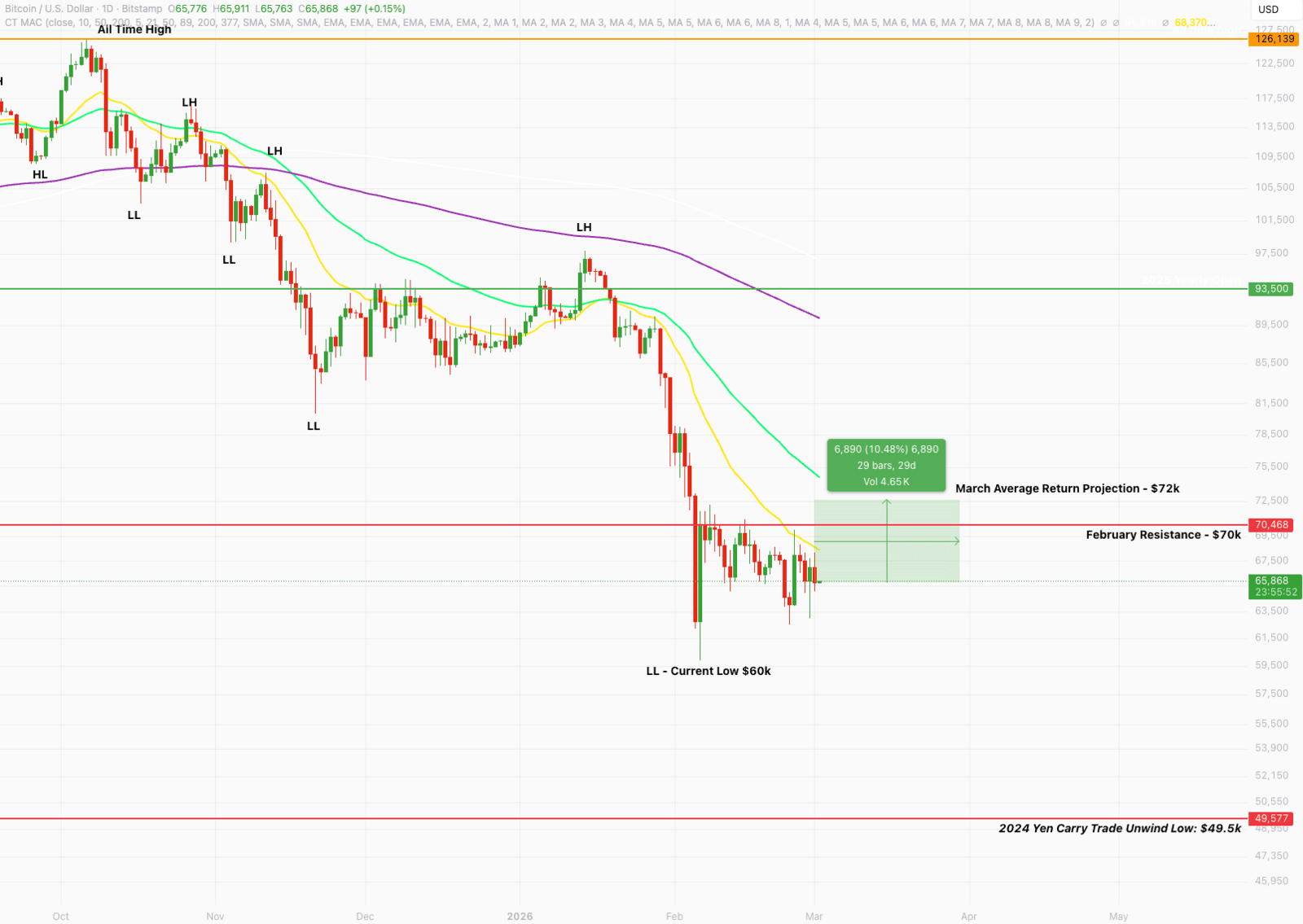
The chart above highlights the position Bitcoin currently finds itself in. Price is trading within a clear bearish structure on the daily timeframe, with resistance overhead and momentum yet to convincingly shift. The market is cautious, liquidity remains thin on rallies, and volatility expansion suggests another decisive move is building.
Yet bearish structure and opportunity are not mutually exclusive.
We have covered extensively in our Stormrake Morning Notes why accumulation during periods of compression and fear can provide a structural edge. Whether you are a new entrant looking to build exposure, an investor who bought higher and is currently underwater, or a multi cycle participant with deep conviction, these environments reward strategic positioning rather than emotional reaction.
If you are underwater, periods like this can materially reduce your breakeven level through disciplined accumulation. For new entrants, these are prices that were considered unattainable just months ago. And for those with experience, there is little need for persuasion. You understand that volatility is the entry fee for asymmetric upside.
It is also worth remembering that Bitcoin has never printed more than six consecutive red months in its history. On previous occasions where streaks of this magnitude ended, they coincided with the latter stages of bear markets and preceded significant upside expansions.
This is not a definitive bottom call. Nor are we suggesting that if March closes green the path lower is permanently closed. Markets do not move in straight lines, and macro headwinds still exist.
What we are saying is this. Five red months. A 50% drawdown. A $10,000 single day move. Single digit fear readings.
Historically, environments like this have been far closer to long term opportunity than late cycle risk. Volatility remains elevated. Uncertainty remains high. But from a cycle perspective, we are statistically and structurally much closer to the bottom than the top.
In the News
In the News
US Supreme Court Strikes Down Trump’s Tariffs

Last month we highlighted the pending US Supreme Court decision regarding President Trump’s tariff authority, with prediction markets assigning roughly a 35% probability that the ruling would favour the administration. The decision has now landed, with the court determining the tariffs were unlawful.
However, policy uncertainty did not end there. In response, Trump announced a fresh round of global tariffs at 10%, before subsequently increasing them to 15%. Whilst the legal question may have been addressed, trade tensions remain unresolved. Markets dislike uncertainty more than they dislike bad news, and the back and forth continues to inject volatility into risk assets, including Bitcoin.
Geopolitical Tensions Return to the Middle East
Risk off sentiment returned as tensions escalated once again in the Middle East, involving Iran, the US and Israel. The United States has deployed one of its largest naval presences in the region in decades, whilst Israeli strikes on Iranian targets triggered immediate market reactions. Bitcoin sold off sharply during the escalation whilst PAXG has begun to rally again.
Jane Street Under Scrutiny

Jane Street, a dominant quantitative trading firm and key liquidity provider across both traditional and crypto markets, is reportedly facing potential claims exceeding $1 billion linked to its alleged role in the 2022 Terra Luna collapse. In addition, market participants have pointed to repeated sharp Bitcoin moves around 10am EST, aligning with the US equity open, raising questions around cross asset liquidity dynamics.
Market Update
Market Update
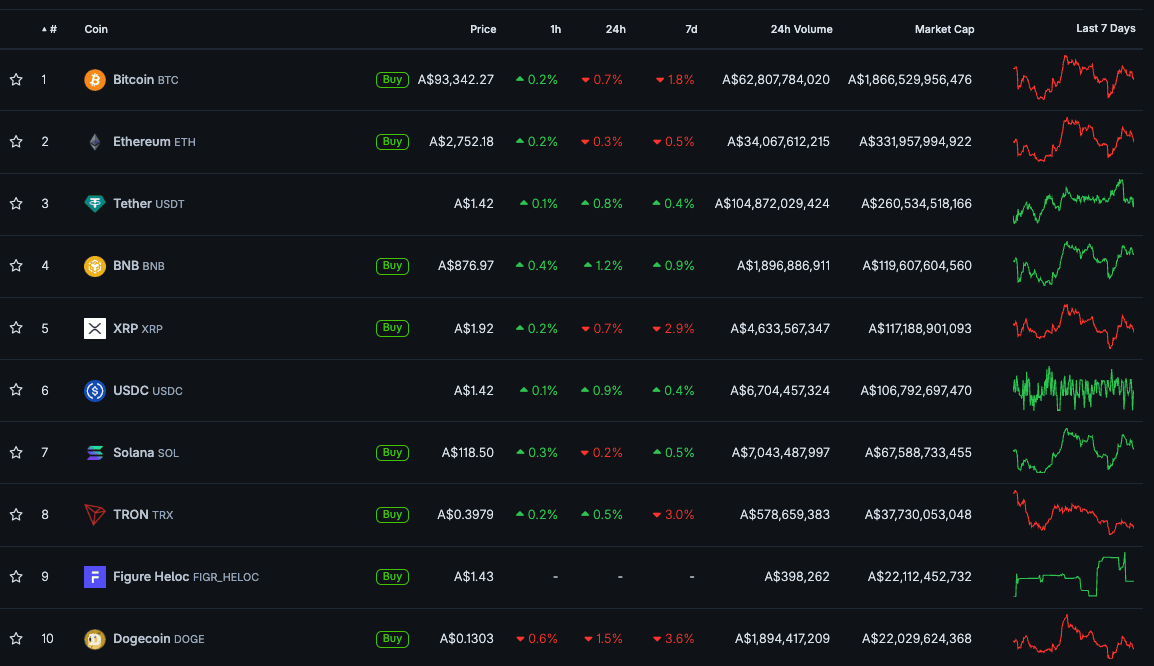
Here is the fast five of what you need to know about the market in February 2026:
- Bitcoin fell 15% in February
- Ethereum declined 20% during the month
- Stablecoin dominance increased by 17% in February
- PAXG stood out, rising 10% whilst the majority of the market closed red
- The total crypto market capitalisation fell by 13%
Video of the month
Bitcoin Is Going to $35,000. Here's Why I'm Buying. - Money Markets & Mayhem and Bisher Khudeira
Education: Real World Bitcoin Adoption
One of the most common questions surrounding Bitcoin is simple. How do you actually use it? It is also often framed as criticism by those unfamiliar with the ecosystem. You cannot spend your Bitcoin, so what is the point?
We have consistently reinforced Bitcoin’s core value proposition as a monetary asset. It is decentralised, scarce, censorship resistant and transferable without reliance on a central authority. That foundation alone resolved one of the biggest problems in finance, sending value peer to peer across the globe without needing permission from a bank or intermediary.
There is no debate around the success of that use case.
However, adoption does not stop at holding. Utility evolves.
The real innovation has come from the development of Layer 2 infrastructure, particularly the Lightning Network, built on top of Bitcoin to improve speed and scalability. Lightning enables near instant transactions with extremely low fees, making everyday payments practical in a way that base layer transactions were never designed to handle at scale.
Lightning does not replace Bitcoin. It enhances it.
By moving transactions off chain while still ultimately settling in Bitcoin, Lightning dramatically increases throughput. Payments that once required waiting for confirmations can now be completed in seconds. Fees are often fractions of a cent, opening the door for microtransactions and real world retail usage.
And the growth is measurable.
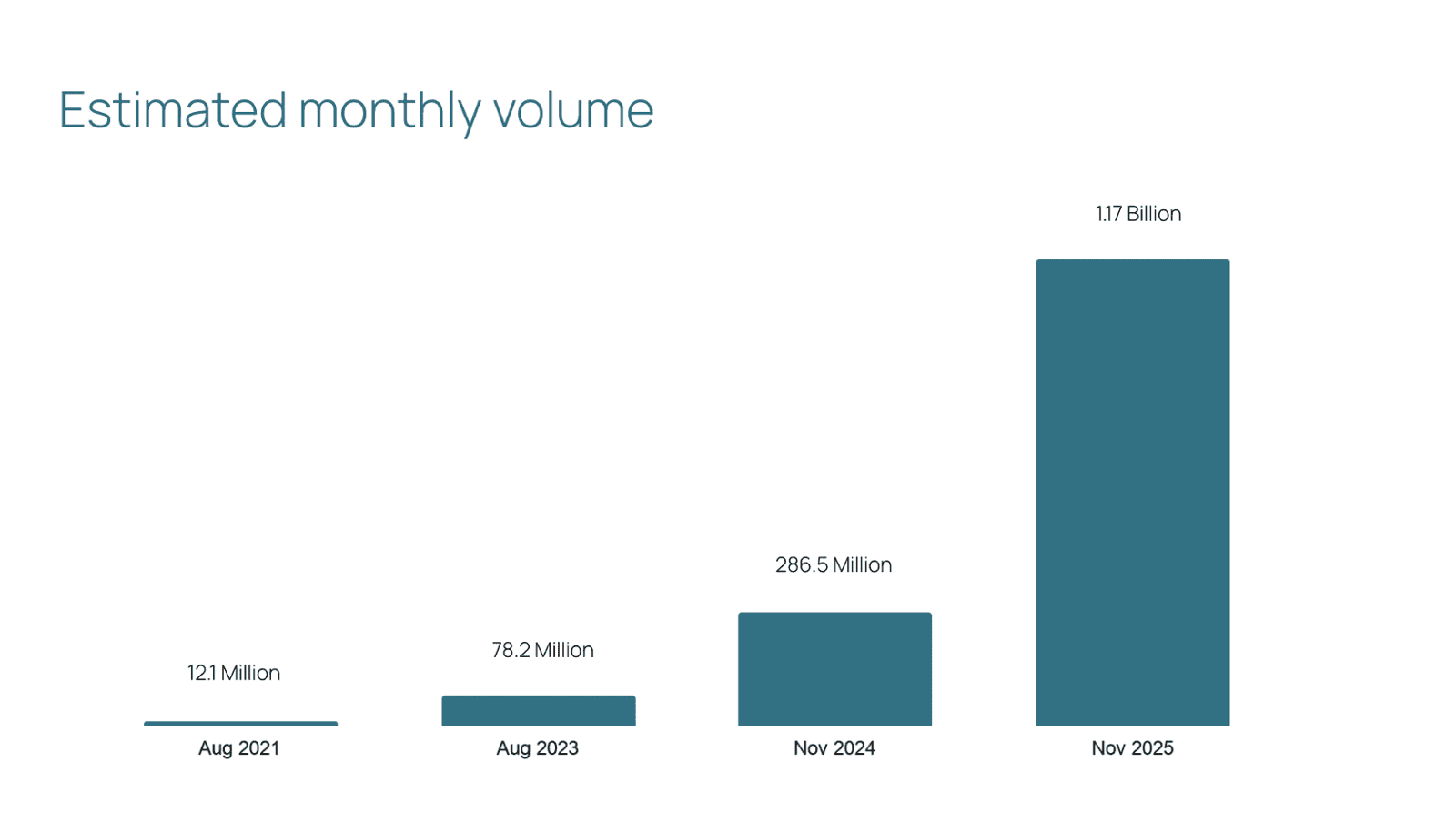
As shown in the chart above, estimated monthly Lightning volume has expanded from just $12.1 million in August 2021 to $78.2 million in August 2023. By November 2024 that figure had surged to $286.5 million, and projections for November 2025 stand at $1.17 billion.
That is not theoretical adoption. That is exponential growth.
But volume alone does not tell the full story.
The Lightning Network has evolved from an experimental scaling solution into a fully developed industry layer built on top of Bitcoin.
The growth of Lightning is not just visible in transaction volume. It is visible in real world usage.
As explored in our piece “One Steak Sandwich and a Side Of Bitcoin Please”, Bitcoin is no longer confined to online transfers or speculative holding. It is being used in physical environments, from restaurants to retail counters, where customers can pay instantly via Lightning by scanning a QR code.
What once required a card terminal, a bank intermediary and processing fees can now be settled peer to peer in seconds.
Major exchanges have integrated Lightning deposits and withdrawals. Wallet providers have refined user experience across both custodial and non custodial options. Payment processors allow merchants to accept Bitcoin and instantly convert to local currency if they wish, removing volatility risk whilst benefiting from lower fees and zero chargebacks.
For everyday users, the process is simple. A Lightning enabled wallet, a small Bitcoin balance, and the ability to transact globally without restriction.
In emerging markets, Lightning is being used for remittances and small business transactions. In developed economies, it is increasingly used for retail payments, online services and tipping. The use cases are expanding quietly rather than loudly, which is often how real adoption takes hold.
The idea that Bitcoin cannot be spent is outdated.
The infrastructure exists. The usage is growing. The real world examples are no longer theoretical.
Bitcoin remains digital hard money at its base layer. But through Lightning, it is also becoming a practical and scalable payment network that can function in day to day life.
Written by Alexandar Artis
Start Your Brokerage Account
If you enjoyed this Rake Review, feel free to open an account and gain access to more proprietary research and work with your very own dedicated crypto broker.
No Advice Warning
The information in this newsletter is general only. It should not be taken as constituting professional advice from the author - Stormrake PTY LTD.
Stormrake is not a financial adviser and does not provide financial product advice. You should consider seeking independent legal, financial, taxation or other advice to check how the information relates to your unique circumstances. Stormrake is not liable for any loss caused, whether due to negligence or otherwise arising from the use of, or reliance on, the information provided directly or indirectly, by this newsletter.
Disclaimer
All statements made in this newsletter are made in good faith and we believe they are accurate and reliable. Stormrake does not give any warranty as to the accuracy, reliability or completeness of information that is contained here, except insofar as any liability under statute cannot be excluded. Stormrake, its directors, employees and their representatives do not accept any liability for any error or omission in this newsletter or for any resulting loss or damage suffered by the recipient or any other person. Unless otherwise specified, copyright of information provided in this newsletter is owned by Stormrake. You may not alter or modify this information in any way, including the removal of this copyright notice.Copyright © 2026 Stormrake Pty Ltd, All rights reserved