The Shift is Underway
The Shift is Underway
The Shift is Underway
March was the month everything changed for Bitcoin. For much of the year, we highlighted its true purpose. In March, that narrative became reality.
Chaos is Accelerating the Shift:
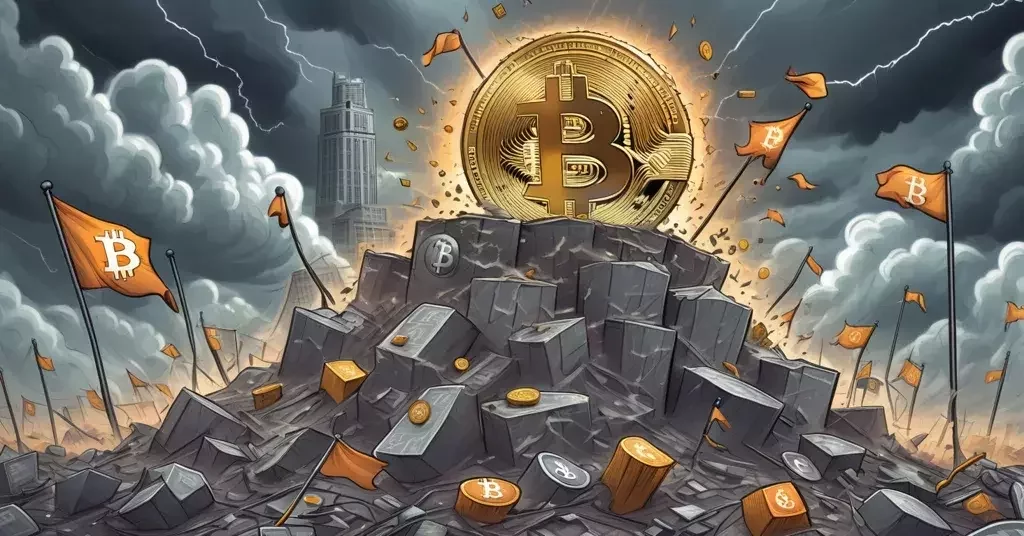
There are often turning points or key events within the globe that cause a major shift in the globe, usually in the form of revolutions or changes in world powers. These shifts catch most by surprise but those who were able to identify the signs early and position themselves are sitting in the best spot for once the change occurs.
The current conflict that dominated headlines and influenced every market throughout the month has accelerated this shift. The conflict in the Middle East, we saw it occur last year but it only lasted a couple of weeks, markets took a slight detour before recovering and tracking higher.
This conflict has already surpassed a month and isn’t showing signs of ending anytime soon, despite the chaos in the headlines. Historically these events have resulted in investors rotating into extremely low risk assets such as cash and gold. But to many surprise this hasn’t been the case, in fact we have seen capital leave the likes of gold and return into Bitcoin.
It is a sign of a shift in Bitcoin and its role in the global economy.
What we are witnessing is not just a short term reaction to geopolitical stress, but a structural change in how capital behaves under pressure. In previous cycles, moments like this forced a predictable rotation into gold and cash. This time, that playbook is being challenged in real time.
Across the Middle East, investors have been actively selling gold, not because they have lost faith in it as a store of value, but because of its limitations in a fast moving and uncertain environment. Gold is difficult to transport, costly to secure, and inefficient to transact across borders. In contrast, Bitcoin offers instant mobility, divisibility, and self custody. When capital needs to move quickly, those properties matter.
There is also a market structure element at play. Increased selling pressure in physical gold markets has led to local bullion dealers offering below market rates due to imbalances in supply and demand. This creates friction at the exact moment investors need liquidity. Bitcoin, on the other hand, trades in a global, continuous market where liquidity remains accessible regardless of local conditions. The ability to exit at a transparent market price is becoming increasingly valuable.
This shift is already visible in price action. Since the conflict escalated, Bitcoin has held strength and pushed higher, while gold has softened and equities have struggled. That divergence is not noise. It points to early signs of decoupling, a theme we explored in The Bitcoin Regime Change Has Begun and further reinforced in our analysis of shifting monetary dynamics.
Bitcoin is no longer behaving purely as a speculative risk asset. In regions where traditional financial infrastructure is strained or inaccessible, it is actively being used as money. Settlement, preservation of value, and cross border transfer are no longer theoretical use cases, they are being tested in real conditions. As highlighted in Bitcoin at the Strait, this transition from narrative to utility is critical.
At the same time, broader monetary conditions are reinforcing this behaviour. As confidence in fiat systems continues to fluctuate and global liquidity remains uneven, capital is searching for alternatives that are both liquid and independent. Bitcoin is increasingly fitting that role.
The key takeaway is simple. This is not just about one conflict or one month of price action. It is about a redefinition of what investors consider a safe or reliable asset in times of uncertainty. Bitcoin is beginning to earn that status, not through speculation, but through performance under pressure.
The Market Never Closes Anymore:
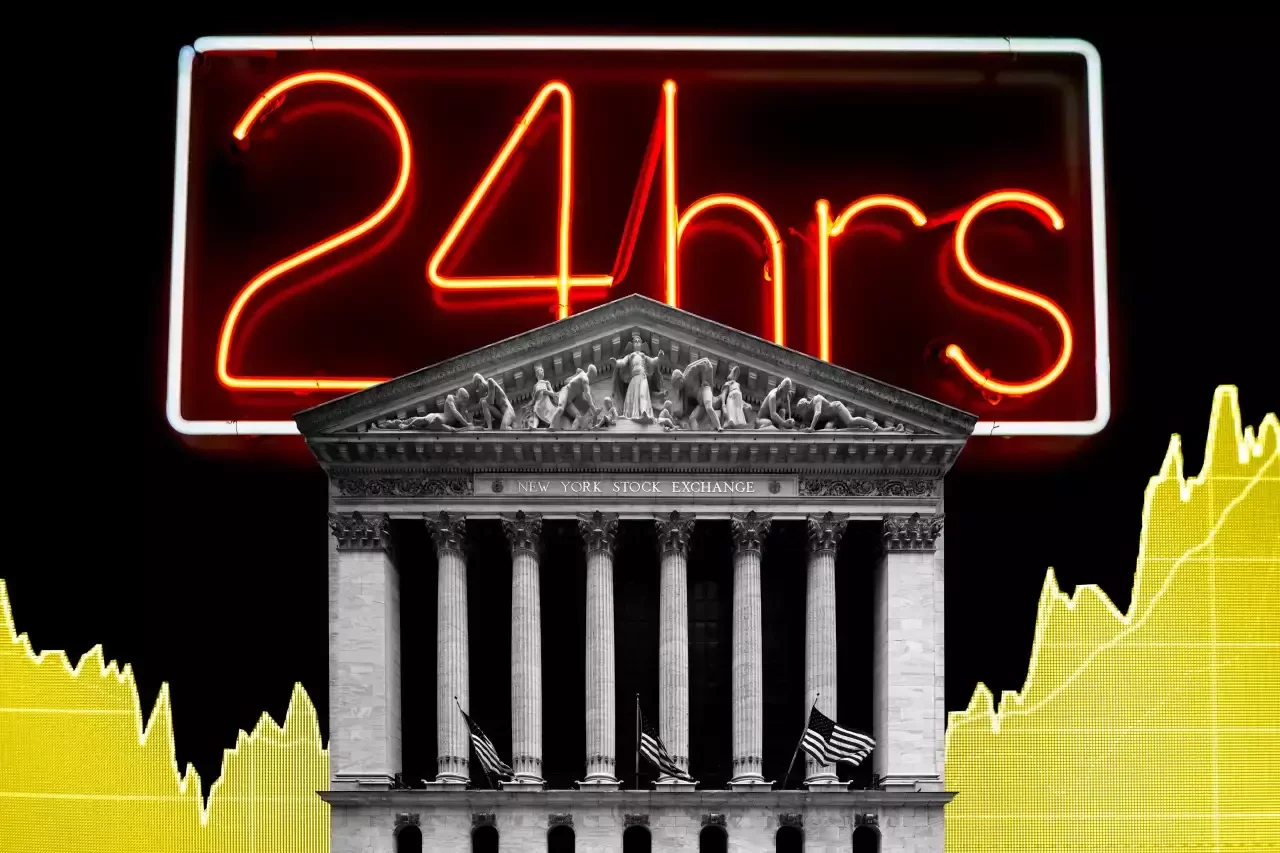
Keeping on the theme of this broader shift, we are now seeing it move beyond capital flows and into the structure of finance itself. This is where things become more meaningful. It is no longer just about where money is going, but how the system it moves through is being rebuilt.
Traditional finance has always been constrained by time, geography, and layers of intermediaries. Markets open and close. Settlement takes time. Access depends on jurisdiction, permissions, and counterparties. That model worked in a slower, more fragmented world, but it is increasingly out of sync with how capital now behaves.
Crypto infrastructure removes those constraints entirely.
Markets are now operating in a continuous cycle. Capital moves 24/7, reacting instantly to news, macro shifts, and geopolitical developments. There is no delay between regions, no waiting for sessions to overlap, and no downtime where risk cannot be managed. This fundamentally changes how participants interact with markets. Exposure can be adjusted in real time, and liquidity is constantly available rather than concentrated into specific windows.
This shift is not theoretical, it is already being stress tested in real conditions.
Throughout the recent conflict, major geopolitical updates have not waited for market hours. Trump, in particular, has made several market moving statements over weekends, a period where traditional finance is effectively offline. In previous cycles, investors would have been forced to wait, unable to react until markets reopened.
Now, that delay no longer exists.
On platforms like Hyperliquid, traders have been actively positioning in real time, not just in crypto, but in tokenised representations of traditional markets. Oil, the S&P 500, and major equities such as Tesla and Apple have all seen price discovery continue over the weekend, driven by these developments. By the time traditional markets reopen, a significant portion of that price movement has already occurred on-chain.
This is a fundamental shift in where and when markets move.
Hyperliquid sits at the centre of this evolution. It is not just offering an alternative venue for crypto trading, it is building infrastructure that mirrors and, in some areas, surpasses traditional derivatives markets. Onchain order books, deep liquidity, and continuous trading create an environment where capital does not need to wait for legacy systems to catch up.
The significance of this is underscored by its growing integration with traditional finance. The Nasdaq deal with Hyperliquid signals that this is no longer an isolated crypto native experiment. Established financial players are beginning to recognise the advantages of on-chain infrastructure, particularly when it comes to speed, transparency, and global accessibility.
At the same time, tokenisation is accelerating this convergence.
By bringing traditional assets on-chain, tokenisation allows them to inherit the benefits of crypto rails. Assets that were once restricted by market hours can now trade continuously. Settlement becomes instant, ownership becomes more flexible, and access becomes global. The lines between crypto and traditional finance are no longer clear cut, they are beginning to merge.
What this creates is a financial system where capital is always in motion.
Liquidity no longer sits idle waiting for markets to open. It reacts instantly to information, whether that comes from central banks, geopolitical events, or unexpected headlines over the weekend. Price discovery becomes a continuous process rather than a fragmented one, and increasingly, it is happening on-chain first.
The key takeaway is clear. Crypto is not just complementing traditional finance, it is actively replacing some of its core functions. When markets close, crypto stays open. And as more capital, infrastructure, and institutions move in this direction, the question is no longer if traditional finance adapts, but how quickly it can catch up.
A Turning Point Beneath the Surface:
A Turning Point Beneath the Surface:
Despite widespread uncertainty and continued pressure across traditional markets, March marked a subtle but important shift for Bitcoin. Breaking the streak of red months, Bitcoin closed March up 1.83%, avoiding what would have been the longest drawdown in its history.
While the gain may appear marginal on the surface, the significance runs far deeper.
March was a fundamentally strong month. Bitcoin not only held its ground but began to decouple from traditional risk assets, outperforming in an environment where equities struggled and gold failed to attract sustained demand. This is the shift we have been highlighting, and in March, it began to materialise in real time.
As we move into Q2, April becomes a focal point.
Historically, April has been one of Bitcoin’s strongest performing months, second only to November. It has delivered an average return of 33.4% and closed green in 10 of the last 15 years. While past performance is not a guarantee of future results, it does provide a seasonal tailwind that aligns with the improving conditions we are beginning to see.
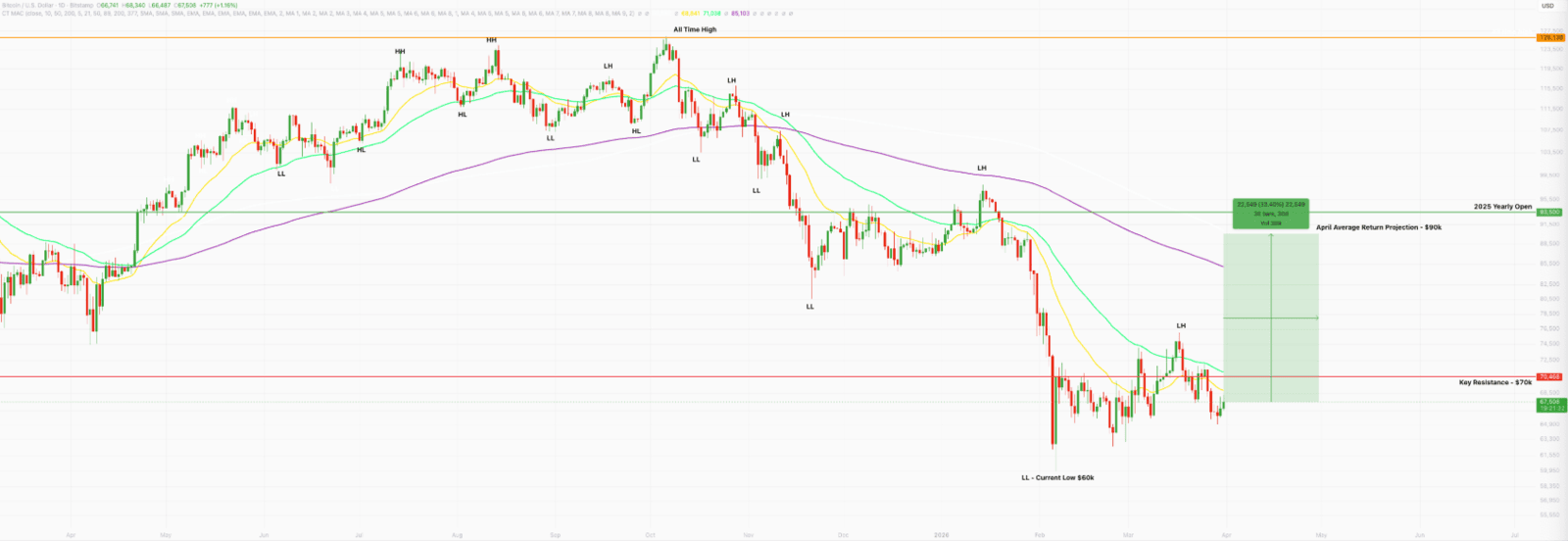
From a technical perspective, March was largely defined by consolidation.
Price spent the majority of the month ranging, with multiple attempts to break higher failing to gain sustained momentum. This has created a clear structure heading into April. The key level for the bears sits at $60K, while the bulls need to reclaim and hold above $70K. A decisive break and hold beyond either of these levels is likely to dictate the next major move.
Momentum is now beginning to shift.
The bears, after months of control, are showing clear signs of exhaustion. Selling pressure is no longer accelerating, and downside follow through has weakened. On the other side, the bulls are starting to reassert themselves. March saw a return of strong ETF inflows, signalling renewed institutional demand, alongside improving onchain metrics.
Layer on top of that a historically strong month, and the setup becomes increasingly constructive.
If Bitcoin were to align with its historical April average of 33.4%, it would place price in the region of $90K. While that is not a forecast, it provides a framework for what a strong recovery phase could look like. More importantly, a move of that magnitude would likely signal that the bear phase has ended and that the market is transitioning back into expansion.
As always, the focus should not be on a single outcome, but on the shift in conditions.
After months of downside, the balance is beginning to tilt. March may have been modest in percentage terms, but structurally, it was one of the most important months in this cycle so far.
In the News
In the News
Aussie Super Funds Eye Bitcoin
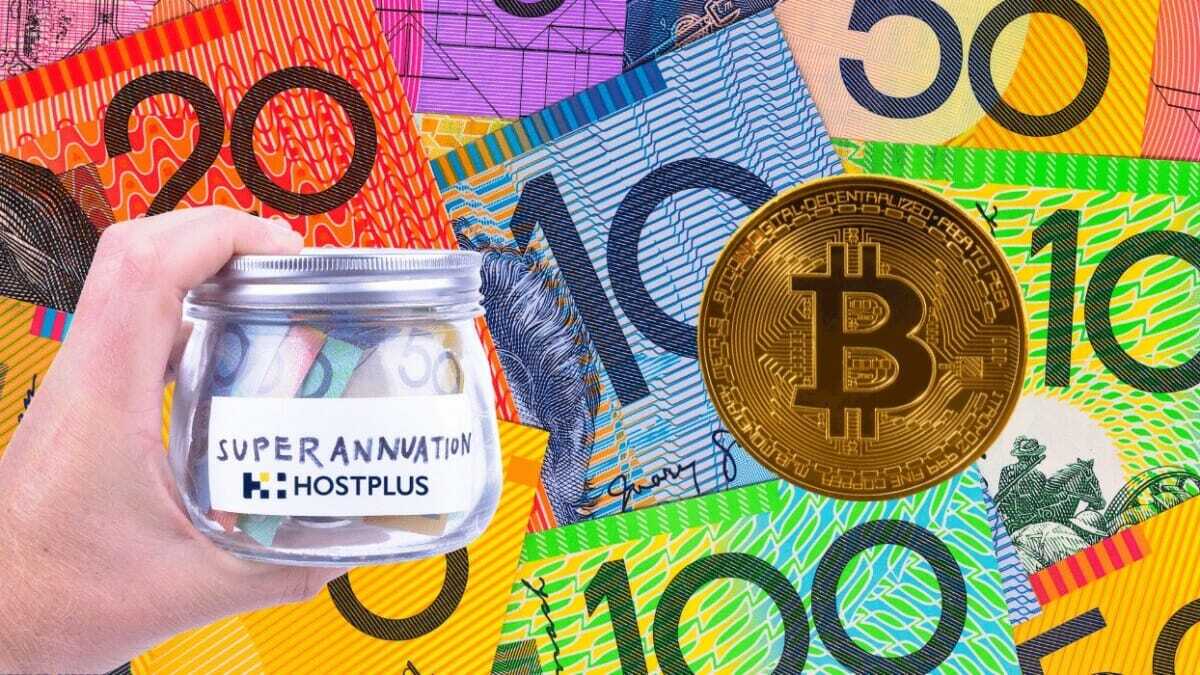
A long standing gap within the Australian superfund industry has been its lack of exposure to Bitcoin and digital assets. Despite global momentum, most funds have remained on the sidelines, offering little to no access for clients. That may now be starting to change, with Hostplus reportedly exploring the introduction of digital assets as an investment option.
If implemented, this would mark a meaningful shift. Superannuation represents a significant pool of capital, and even a small allocation to Bitcoin could drive notable demand. While AMP introduced Bitcoin exposure back in 2024 and faced backlash from traditional players like Vanguard, the landscape in 2026 is very different. Adoption has accelerated globally, and Australia now appears to be moving in the same direction.
Tether Moves Towards Full Audit
Tether, the largest stablecoin issuer, has announced it will undergo its first full independent audit conducted by a Big Four accounting firm. This is a major step forward for transparency within the digital asset space, particularly given the systemic importance of stablecoins to market liquidity.
Following the stablecoin legislation introduced last year, this move sets a higher standard for accountability and trust. As institutional involvement continues to grow, these developments play a key role in strengthening the foundation of the industry and reducing long standing concerns around reserve backing and stability.
Oil Becomes the Pressure Point

As a result of the Middle East conflict, crude oil has become a focal point for global markets. The Strait of Hormuz, which accounts for roughly 20% of global oil flows, has faced disruption, driving a sharp increase in prices.
Crude surged to highs of $120 and is currently trading around $100. With the conflict showing no signs of slowing, some analysts are now projecting significantly higher prices, with prediction markets assigning a 21% probability of oil reaching $200 at some point this year.
The implications of this are broad. Rising oil prices feed directly into inflation, increasing costs across nearly every industry, from transport to manufacturing. This adds further pressure to an already fragile macro environment and reinforces the importance of assets that can operate outside traditional economic constraints.
Market Update
Market Update
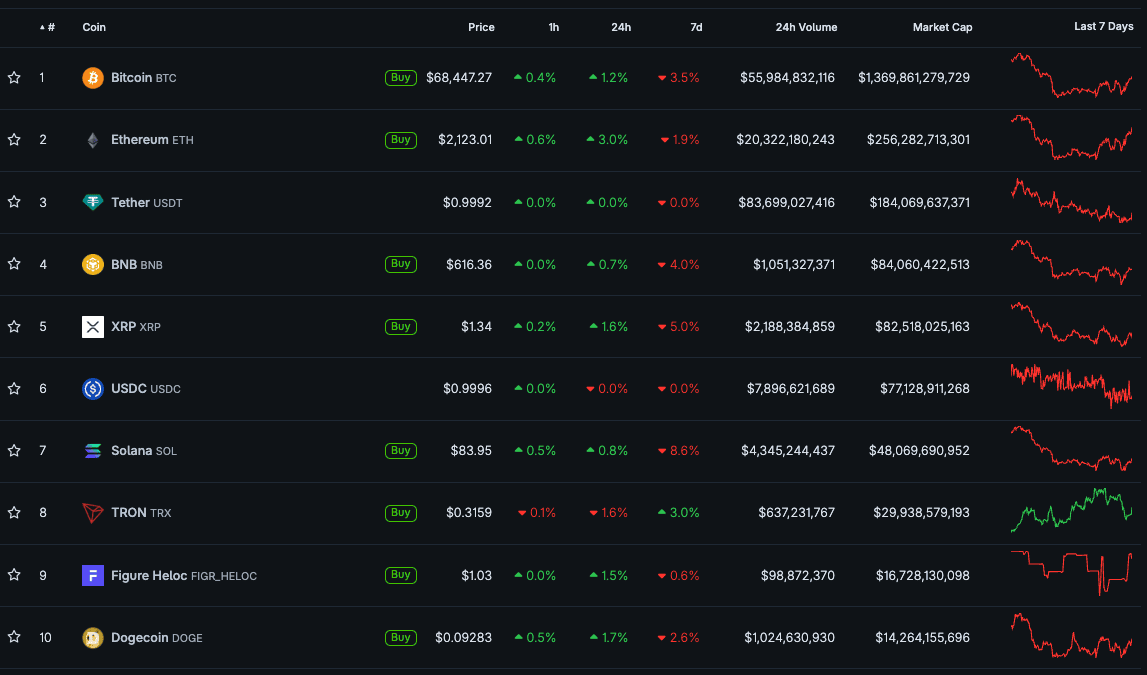
Here is the fast five of what you need to know about the market in March 2026:
- Bitcoin increased by 1.83% in March
- Ethereum increased by 7.07% in March
- PAX Gold fell by 12.8% in March
- Hyperliquid was the clear standout up 17.03% in March
- The total crypto market cap grew by 1.89%
Video of the month
Australian Banks Are Blocking Bitcoin Purchases…Here's What They Don't Want You to Know.
Adam Hudson and Bisher Khudeira
Education: Understanding Correlation
One of the most important concepts in markets, yet one of the most overlooked, is correlation.
Correlation measures how assets move relative to each other. When assets are positively correlated, they move in the same direction. When they are negatively correlated, they move in opposite directions. This relationship underpins how capital is allocated across markets.
Traditionally, the structure has been clear.
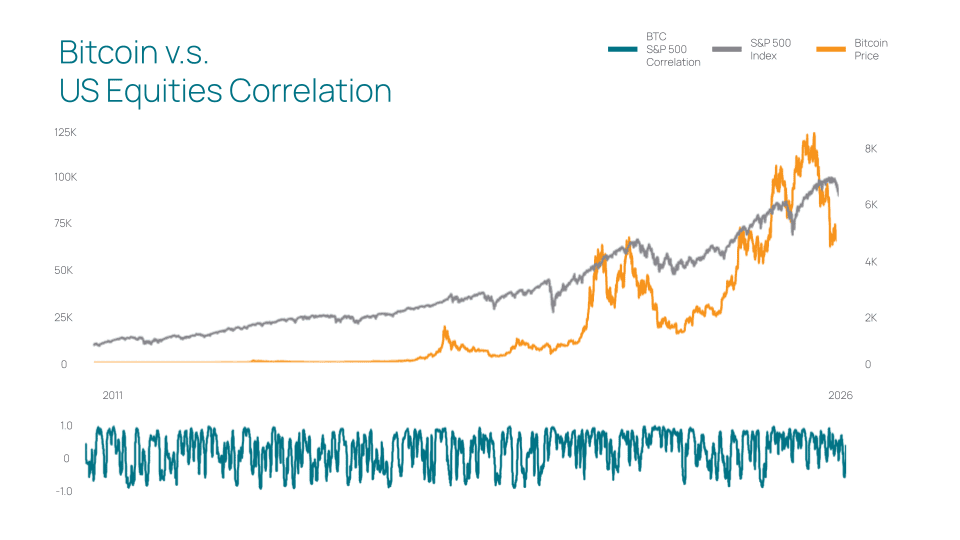
Bitcoin has largely traded as a risk asset, often showing a strong positive correlation with equities. At times, this correlation has been as high as 0.6, meaning Bitcoin and the S&P 500 were broadly moving together. When equities sold off, Bitcoin typically followed.
That relationship is now starting to break down.
As the recent conflict escalated, the S&P 500 moved lower, yet Bitcoin continued to absorb capital. The correlation has not disappeared, but it has weakened significantly, now fluctuating between 0.28 and 0.49. This is a meaningful shift and signals that Bitcoin is no longer tightly bound to equity market behaviour.
As shown below, this breakdown is clearly visible, with correlation becoming more unstable and less predictive of Bitcoin’s direction.
At the same time, Bitcoin is not behaving like a traditional safe haven either.
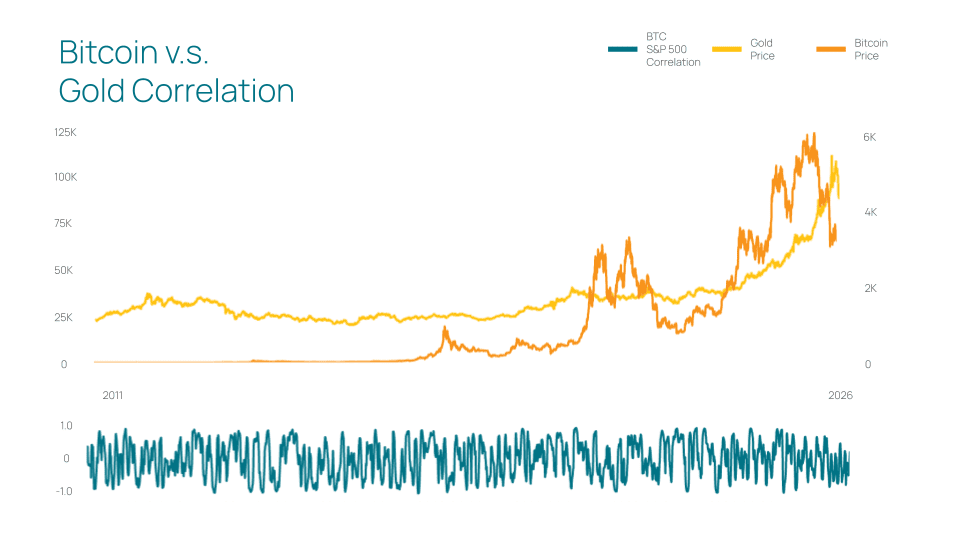
Gold, which typically benefits during periods of geopolitical uncertainty, has not shown a consistent relationship with Bitcoin. The correlation between the two remains unstable, frequently shifting between positive and negative territory.
This reinforces an important point.
Bitcoin is not simply replacing gold, nor is it behaving like equities. It is beginning to trade independently.
As shown below, the lack of a stable correlation with gold highlights that Bitcoin is still in a transition phase, carving out its own role within the global financial system.
This is a critical shift.
Under the old framework, Bitcoin was viewed as a high risk extension of equities. Under this emerging framework, it is becoming an asset that does not cleanly fit into traditional categories.
For investors, this changes how Bitcoin should be viewed.
If you are only watching equities or gold to understand Bitcoin, you are likely to misread the market. The relationships that once defined its behaviour are no longer as reliable.
The key takeaway is simple.
Do not just track price, track relationships. Correlation tells you how the market views an asset. And when those correlations begin to shift, it is often the earliest signal that a larger structural change is underway.
Right now, Bitcoin is in that transition.
And understanding that shift is what separates reacting to the market from positioning ahead of it.
Written by Alexandar Artis
Start Your Brokerage Account
If you enjoyed this Rake Review, feel free to open an account and gain access to more proprietary research and work with your very own dedicated crypto broker.
No Advice Warning
The information in this newsletter is general only. It should not be taken as constituting professional advice from the author - Stormrake PTY LTD.
Stormrake is not a financial adviser and does not provide financial product advice. You should consider seeking independent legal, financial, taxation or other advice to check how the information relates to your unique circumstances. Stormrake is not liable for any loss caused, whether due to negligence or otherwise arising from the use of, or reliance on, the information provided directly or indirectly, by this newsletter.
Disclaimer
All statements made in this newsletter are made in good faith and we believe they are accurate and reliable. Stormrake does not give any warranty as to the accuracy, reliability or completeness of information that is contained here, except insofar as any liability under statute cannot be excluded. Stormrake, its directors, employees and their representatives do not accept any liability for any error or omission in this newsletter or for any resulting loss or damage suffered by the recipient or any other person. Unless otherwise specified, copyright of information provided in this newsletter is owned by Stormrake. You may not alter or modify this information in any way, including the removal of this copyright notice.Copyright © 2026 Stormrake Pty Ltd, All rights reserved